

Key Takeaways
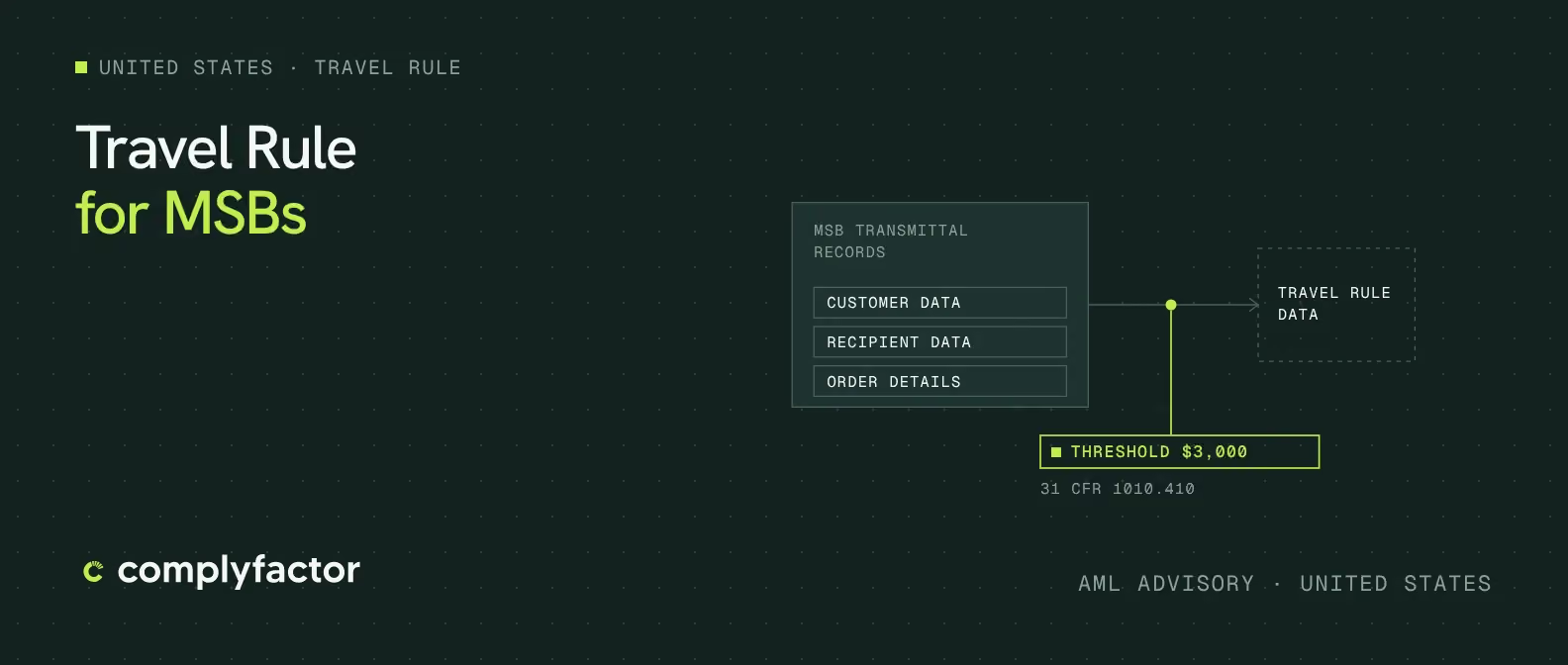
- The Travel Rule and Recordkeeping Rule threshold is still $3,000 under 31 CFR 1010.410.
- FinCEN and the Federal Reserve withdrew the $250 cross-border proposal on 9 November 2026.
- Your duties depend on whether you are the transmittor's institution, an intermediary or the recipient's institution.
- Walk-in customers trigger identity collection and verification duties.
- Records are kept for five years and must be retrievable by transmittor name.
Short answer
A U.S. money services business (MSB) that accepts, forwards or pays out a transmittal of funds of $3,000 or more has two linked duties under 31 CFR 1010.410. The Recordkeeping Rule (paragraph (e)) requires it to collect and keep specified information. The Travel Rule (paragraph (f)) requires it to pass specified information to the next institution when it sends the transmittal order on.
The threshold is still $3,000. On 9 November 2026, FinCEN and the Federal Reserve Board withdrew their 2020 proposal to lower it to $250 for transfers that begin or end outside the United States. The withdrawal changes nothing for MSBs today. The agencies said they wanted fresh public feedback before adopting any similar amendment, and that no final rule will be issued without another opportunity for public comment.
Which duties apply to you depends on the role your MSB plays in the chain: the institution that takes the customer's order, an intermediary, or the institution that pays the recipient. The sections below separate the three.
What changed on 9 November 2026, and what did not
The withdrawn proposal was a joint FinCEN and Federal Reserve notice of proposed rulemaking published on 27 October 2020 (85 FR 68005). It would have done two things:
- lowered the Recordkeeping Rule and Travel Rule thresholds from $3,000 to $250 for funds transfers and transmittals of funds that begin or end outside the United States;
- clarified that "money" in these rules covers convertible virtual currency (CVC) and digital assets with legal tender status.
According to the final published notice (91 FR 70824, Federal Register document 2026-22809, RIN 1506-AB41, published 9 November 2026), the agencies gave two reasons. More than five years had passed, and they wanted more public feedback before adopting any similar amendment, so that no final rule would be issued without another opportunity for public comment. And CVC markets had matured and new legal frameworks had emerged, including the GENIUS Act for payment stablecoins, enacted on 18 July 2025. The notice says the agencies will take no further action on the proposal, and withdraws it as of 9 November 2026.
If you built a $250 cross-border workflow in anticipation of the proposal, you are not required to keep it. You may still choose to collect more data than the rule requires for risk reasons, and many MSBs do. That is a risk decision, not a legal requirement.
Who is covered and what counts as a transmittal of funds
Paragraph (e) applies to U.S. agents, agencies, branches or offices of non-bank financial institutions for a transmittal of funds of $3,000 or more. FinCEN's own Questions and Answers on the Travel Rule (FIN-2010-G004, 9 November 2010) say the covered non-bank institutions include money transmitters, check cashers, currency exchangers, and money order issuers and sellers subject to the Bank Secrecy Act.
The key definitions sit in 31 CFR 1010.100:
- Transmittal of funds is a series of transactions that starts with the transmittor's transmittal order and is meant to pay a recipient. It includes funds transfers, and it is complete when the recipient's institution accepts the order for the recipient. It excludes electronic fund transfers under the Electronic Fund Transfer Act, and transfers made through an ACH, ATM or point-of-sale system.
- Transmittal order is an instruction from a sender to a receiving institution, given orally, electronically or in writing, to pay a fixed or determinable sum to a recipient. It is limited to instructions that set no payment condition other than timing.
- Money transmitter includes a person that accepts currency, funds or value that substitutes for currency from one person and transmits it to another location or person by any means. The definition is facts-and-circumstances based and has carve-outs, such as payment processors acting under an agreement with the seller.
FinCEN's guidance says the rules apply whether or not currency is involved, so a card-funded or account-funded transmittal can be in scope. It also notes that the Travel Rule requires no report to the government. A suspicious transmittal may still call for a suspicious activity report (SAR); see our guide to MSB SAR filing.
The Recordkeeping Rule: what to collect and keep
When your MSB accepts a transmittal order as the transmittor's financial institution, paragraph (e)(1)(i) requires you to keep the original, a copy, microfilm or an electronic record of the order, and the following information:
- the transmittor's name and address;
- the amount of the order;
- the execution date;
- any payment instructions received with the order;
- the identity of the recipient's financial institution;
- as many of the following as you receive: the recipient's name and address, account number and other specific identifier;
- any transmittal form completed or signed by the person placing the order.
If the customer is not an "established customer", paragraph (e)(2) adds identity collection. The next section sets it out.
As an intermediary, or as the recipient's financial institution, you must retain the transmittal order you accept (paragraphs (e)(1)(ii) and (iii)). A recipient's institution also has extra steps when the recipient is not an established customer (paragraph (e)(3)).
Established customers and walk-ins: what you must verify
An "established customer" is a person who has an account with the institution, or whose name, address and taxpayer identification number (or, if none, an alien identification or passport number and issuing country) the institution keeps on file and uses to provide services (31 CFR 1010.100(p)). Many MSB customers are not established customers, because they walk in or use a service without an account.
For identity verification, paragraph (e)(5) points to a document other than a signature card, preferably one showing name, address and photograph, that is normally accepted for cashing checks for non-customers. For a non-resident or alien, a passport, an alien identification card or another official document showing nationality or residence is acceptable.
Records must be retrievable by the transmittor's name, and by account number if the transmittor is an established customer with a transmittal account. The same applies to recipient records. The rule does not prescribe how you store them.
Exceptions
Under paragraph (e)(6), a transmittal is excluded where both the transmittor and the recipient are banks (or wholly owned domestic subsidiaries of U.S.-chartered banks), securities brokers or dealers (and their wholly owned domestic subsidiaries), futures commission merchants or introducing brokers in commodities (and their wholly owned domestic subsidiaries), the United States, a state or local government, a federal, state or local government agency or instrumentality, or a mutual fund. A transmittal is also excluded where the sender and recipient are the same person and both institutions are the same securities broker or dealer. The Travel Rule in paragraph (f) has the same exceptions. Most consumer remittances are not covered by them.
The Travel Rule: what must go with the order
When your MSB sends a transmittal order on to another institution, paragraph (f)(1) requires the transmittor's financial institution to include:
- the transmittor's name and, if the payment is made from an account, the account number;
- the transmittor's address;
- the amount of the order;
- the execution date;
- the identity of the recipient's financial institution;
- as many of the recipient's name, address, account number and other specific identifier as you receive;
- either the name and address or a numerical identifier of the transmittor's financial institution.
Paragraph (f)(3) gives a safe harbor while institutions transition to the expanded Fedwire format: a transmittor's institution that includes the amount, date, recipient's institution and available recipient items, and supplies the remaining transmittor details on reasonable request, is treated as compliant. An intermediary institution must pass on the same items, to the extent it received them from the sender (paragraph (f)(2)). FinCEN's guidance says an intermediary has no general duty to obtain information that the earlier institution did not provide. The data does not have to keep its original format, as long as all the required items are included. If a lawful order or another institution asks, an intermediary must trace back up the chain to retrieve Travel Rule information that was left out because of system limitations.
Two practical points from FinCEN's guidance:
- True address. Keep the transmittor's true address on file and retrievable for law enforcement, even if you send a different mailing address in the order.
- Bank and MSB roles. If a bank aggregates an MSB's customers, the bank may name the MSB as the transmittor or recipient, but the MSB still has its own duty to pass on the required information.
Three roles, three sets of duties
This is why a customer-facing remittance MSB, a payout agent and a processing partner in the middle can all be in scope for the same payment, with different tasks. If your business model changes your role, for example when you add a payout network, your record fields change too.
Virtual currency transfers
FinCEN's 2019 guidance (FIN-2019-G001, issued 9 May 2019) states that it does not establish new regulatory expectations or requirements. It consolidates existing FinCEN regulations and applies them to certain business models involving convertible virtual currency. On money transmission, the guidance says a money transmitter handling CVC must comply with the funds transfer recordkeeping rule (31 CFR 1010.410(e)) and the Travel Rule (31 CFR 1010.410(f)) where its activity is a transmittal of funds, and that a transmittal of $3,000 or more, or its equivalent in CVC, can trigger them. It also says the required information must be obtained or provided before or at the time of the transmittal, and that if a protocol cannot carry it, the information may be sent in a separate message.
The withdrawn 2020 proposal would have written a CVC clarification into the rule text. The final notice withdraws both the proposed threshold change and the proposed clarification, and says any future CVC-related amendments should reflect developments such as the GENIUS Act. The withdrawal leaves 31 CFR 1010.410 as currently published unchanged, and the notice does not say that digital-asset transfers are outside the rules. If you move crypto value, confirm your model with counsel and build for transmitting data to counterparty institutions, which is the hard operational part. For wider crypto controls, see our crypto AML compliance services.
Retention and retrieval
Records required by the BSA regulations must be kept for five years and be accessible within a reasonable period of time, and the required speed depends on the nature of the record and how long ago it was made (31 CFR 1010.430(d)).
Where MSBs go wrong
These are our practical observations, not FinCEN findings.
- Treating the threshold as a per-day or per-customer rule. The trigger is the transmittal of funds of $3,000 or more. Test how your system handles a transmittal at exactly $3,000 and one just below it.
- Recording the data but not sending it. The Recordkeeping Rule and the Travel Rule are separate duties. Records in a back-office system do not satisfy the transmission duty.
- Weak non-established customer files. Missing identification type and number, or no note that a TIN was not provided, is a common gap to test.
- No view of your role. Agents and payout partners often assume the principal's system covers them. Your own duty exists even where policy work is allocated by agreement; see our guide to authorized delegate oversight.
- Splitting patterns ignored. A series of transmittals just under $3,000 can be a sign of avoidance. A suspicious pattern is a SAR question, not only a recordkeeping question.
- No test of the records. An independent review should sample whether records exist, are complete and can be retrieved by name. Our BSA/AML audit checklist shows how reviewers approach this, and the IRS Title 31 examination guide explains what an examiner may ask for.
An illustrative example
This example is hypothetical. A money transmitter takes a $3,400 cash order at a storefront from a customer with no account. It sends the payment through a partner institution to a recipient abroad.
- The transmittor is not an established customer and ordered in person, so the MSB verifies identity before accepting the order and records name, address, identification type and number, and TIN or the alternative.
- It keeps the order, the amount, the execution date, the payment instructions, the identity of the recipient's institution, the recipient details it received, and any form the customer signed.
- When it sends the order to the partner, it includes the transmittor's name and address, the amount, the date, the recipient's institution, the recipient details it has and its own name and address or an identifier.
- If the same customer returns that week with several $2,900 orders, the MSB's record duty does not change, but its monitoring should ask why. That is the point to consider a SAR.
Checklist: is your funds transfer recordkeeping and Travel Rule process ready?
- We have mapped the role we play for each product: transmittor's institution, intermediary or recipient's institution.
- Our systems capture every Recordkeeping Rule item for transmittals of $3,000 or more.
- We distinguish established customers from walk-ins, using the definition in 31 CFR 1010.100(p).
- For in-person non-established customers, we verify identity with an acceptable document and record type and number.
- We record the TIN or alternative, or note that it was not provided.
- For orders placed other than in person, we keep the payment method record.
- Our outgoing orders carry the Travel Rule data fields, and we test that the data arrives.
- We keep the true address, even when a different mailing address is sent.
- Records are retrievable by transmittor name, and by account number for established customers.
- We keep records for five years and can retrieve them within a reasonable period.
- Our independent review tests these records and our SAR process considers patterns near the threshold.
- Staff and agents know the $250 proposal was withdrawn and that $3,000 is the working threshold.
How ComplyFactor can help
We can map your products to the roles above and test whether your records and outgoing transmittal data match the rule. Start with our BSA/AML compliance program services, have the process tested in a BSA/AML audit, or fix gaps found by an examiner through our compliance remediation services. A fractional BSA/AML officer can help keep the process maintained. For the program-level picture, see our guide to the BSA/AML risk assessment for MSBs.
Frequently asked questions
Is the Travel Rule threshold now $250?
No. FinCEN and the Federal Reserve Board withdrew the 2020 proposal to lower it to $250 for cross-border transfers. The $3,000 threshold applies to both the Recordkeeping Rule and the Travel Rule.
Does the Travel Rule require me to report transfers to FinCEN?
No. FinCEN's guidance says the Travel Rule itself requires no government reporting. A suspicious transmittal may require a SAR if your business is subject to SAR rules. Cash transactions can also trigger separate currency transaction reporting.
What is the difference between the Recordkeeping Rule and the Travel Rule?
The Recordkeeping Rule makes you collect and retain information about transmittals of $3,000 or more. The Travel Rule makes you include certain of that information in the order you send to the next institution. The rules complement each other, and the rule text is in the same section, 31 CFR 1010.410.
Who is an established customer?
A person with an account at your institution, or a person whose name, address and TIN (or the alien identification or passport alternative) you keep on file and use to provide services. Everyone else is treated as a non-established customer, which brings identity collection and verification duties.
Does the rule apply to virtual currency transfers?
FinCEN's 2019 guidance says money transmitters that handle convertible virtual currency must comply with the funds transfer recordkeeping and Travel Rule provisions, and that a transmittal of $3,000 or more, or its CVC equivalent, can trigger them. The proposal that would have written CVC into the rule text has been withdrawn, so the position rests on the existing rule and that guidance. Confirm your own model with counsel.
Are any transmittals exempt?
Yes. Transmittals where both the transmittor and the recipient are banks, securities brokers or dealers, futures commission merchants, government bodies or mutual funds are excluded under 31 CFR 1010.410(e)(6). See the exceptions section above.
How long must I keep the records?
Five years, and they must be retrievable within a reasonable time (31 CFR 1010.430(d)).
I also operate in Canada. Is the rule the same?
No. Canada has its own travel rule requirements administered by FINTRAC, and the thresholds and data differ. See our guide to what data to collect from payment partners before filing a FINTRAC EFTR.
Official sources
- 31 CFR 1010.410: Records to be made and retained by financial institutions (eCFR, current as of 19 November 2026)
- 31 CFR 1010.100: General definitions (eCFR)
- 31 CFR 1010.430: Nature of records and retention period (eCFR)
- FinCEN: Funds "Travel" Regulations: Questions and Answers (FIN-2010-G004)
- Federal Register: withdrawal of the 2020 proposed rule, 91 FR 70824, document 2026-22809 (9 November 2026), and its govinfo PDF
- Federal Register: 2020 proposed rule on the funds transfer threshold and convertible virtual currency, 85 FR 68005 (27 October 2020)
- FinCEN: Application of FinCEN's Regulations to Certain Business Models Involving Convertible Virtual Currencies (FIN-2019-G001) and its PDF
This article is general information, not legal advice. Reviewed 23 November 2026 against the sources above. Regulation text was checked against the eCFR as current on 19 November 2026.

ComplyFactor is a Canadian AML and regulatory compliance advisory firm serving MSBs, PSPs, fintechs and other regulated businesses.


Related insights
Book a free compliance consultation?
Tell us about your business and we'll confirm which services you need. Free, no obligation, 30 minutes.