BSA/AML Risk Assessment for MSBs: What Is Required, What Examiners Expect and How to Build One
Is a BSA/AML risk assessment required for a U.S. MSB? What 31 CFR 1022.210, FinCEN's exam manual and the April 2026 proposal say, with a seven-step method, scoring matrix and examination-readiness checklist.



Key Takeaways
- 31 CFR 1022.210 does not use the term "risk assessment" or expressly require a standalone written one, but it requires a program commensurate with your risks, and FinCEN's MSB manual encourages a written assessment.
- Examiners prepare their own assessment of an MSB that has none, and some state regulators tell MSBs they must complete one.
- FinCEN's April 2026 proposal would make risk assessment processes an express requirement, but it is only proposed and is not law.
Short answer
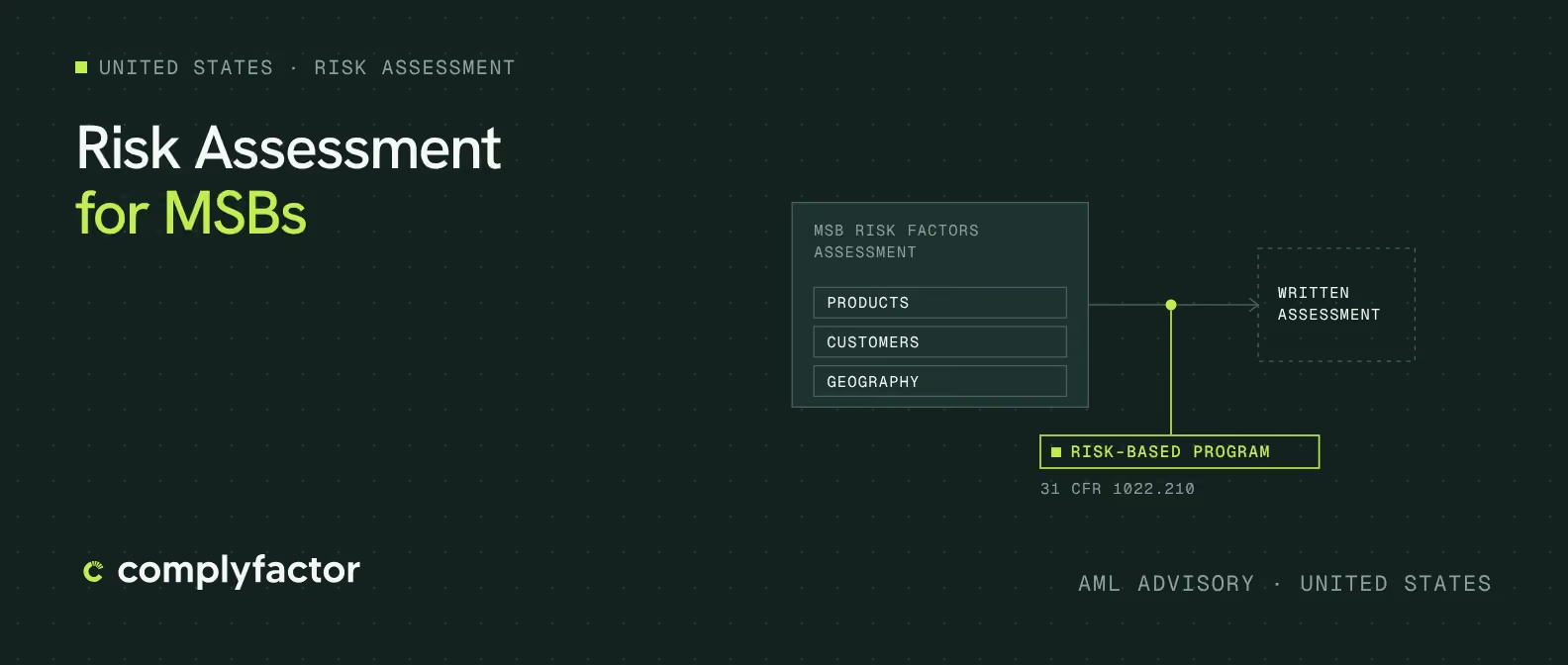
The anti-money laundering (AML) program rule for money services businesses (MSBs), 31 CFR 1022.210, does not use the words "risk assessment" and does not expressly require a standalone, written one. It does require the program to be "commensurate with the risks" posed by your location, size, and the nature and volume of your services. You cannot meet that standard without knowing your risks.
FinCEN's examination manual for MSBs says a written risk assessment is not required by regulation, but it encourages one, and it tells examiners to build their own assessment of your business if you do not have a usable one. Some state regulators go further and tell MSBs they must complete one. A FinCEN proposal published on 10 April 2026 would make risk assessment processes an express part of every AML/CFT program, but it is only proposed. It is not law.
The practical answer is simple. Write the assessment, tie it to your controls, approve it at senior level and update it when your business changes.
What the rules actually say today
The sources below carry different weight. Treat them differently.
Three points follow from the table.
- The regulation is risk-based but silent on format. Section 1022.210(b) ties the program to risk. Section 1022.210(d)(4) ties the scope and frequency of your independent review to the risk of your services. Both assume you know where your risk is.
- The manual and the states carry the practical weight. The MSB manual lists the categories examiners look at, and examiners use your assessment to scope their work.
- The 2026 proposal is not final. As of 20 November 2026 we found no final rule. FinCEN proposes that a final rule take effect 12 months after it is issued, and that period could change.
Why write it down when it is not strictly required
- Examiners will build one if you do not. The manual tells examiners to prepare an assessment of an MSB that has none or an inadequate one, using BSA database information, prior exam reports and management discussions. Their version drives the scope of your examination.
- It is how you show the program is "commensurate". Without a documented assessment, you have no clean way to explain why a control is set where it is.
- It scopes your independent review. Section 1022.210(d)(4) ties the review's scope and frequency to risk. See our BSA/AML audit checklist for U.S. MSBs for how reviewers test the program.
- It prepares you for the proposed rule. A documented, regularly updated assessment is the direction FinCEN has said it intends to take.
The four risk categories examiners use
The FinCEN MSB manual lists four categories as examples. It describes them as illustrations rather than a closed list, so add anything specific to your model.
The manual also stresses that risk varies inside each category. Its example is a business that sends 1,000 international transfers a day: the risk is different depending on whether customers transact in person or online.
How to build the assessment
Step 1: Inventory what you actually do
List every product, service, delivery channel, agent and location, and every country you send to or receive from. Use your real data. A description of the business plan is not enough.
Step 2: Gather the data
Pull figures you already hold: transaction counts and values by product and corridor, share of cash, customer types, number of agents and their locations, alert volumes, SARs filed, and findings from past examinations and reviews.
Step 3: Rate inherent risk
For each factor, rate the risk before controls: low, medium or high. Write down the reason for each rating. A short reason beats a long score.
Step 4: Map your controls
For each high or medium inherent risk, name the control that addresses it: limits, customer due diligence steps, transaction monitoring rules, agent oversight, sanctions screening, training.
Step 5: Rate residual risk
Rate the risk that remains after the control. If a control is untested or weak, say so and give it a lower credit.
Step 6: Approve and assign actions
Have senior management and the BSA/AML compliance officer approve the assessment. Convert every gap into an action with an owner and a date.
Step 7: Link it to the program
Update policies, monitoring rules and training to reflect what the assessment found. An assessment that sits in a folder while the controls stay the same will not impress an examiner.
An illustrative scoring matrix
The matrix below is a teaching example. FinCEN does not prescribe a scale, and you should adapt it to your model.
Worked example (hypothetical)
A money transmitter sells transfers through 40 agent locations, mostly cash funded, to six countries. Its assessment might read like this.
The ratings are invented to show format. Your ratings must come from your own data. See our guide to authorized delegate oversight for U.S. MSBs for the agent side of the picture.
Put sanctions risk inside the assessment
OFAC's framework names risk assessment as one of the five essential components of a sanctions compliance program, alongside management commitment, internal controls, testing and auditing, and training. OFAC publishes the framework as a voluntary guide, and it has said that an effective program can be a mitigating factor when it assesses a violation. Add sanctions exposure to the factors above: the countries you serve, the counterparties you pay and the screening you run. Our OFAC sanctions compliance services support that work.
When to update it
The regulation sets no calendar. The MSB manual tells examiners to check whether your process for periodically reviewing and updating the assessment is adequate (printed p. 32). It does not list update triggers, so the triggers below are our practical suggestions. Some practitioners recommend an annual review plus updates after significant changes. Treat annual review as good practice, not as a legal deadline.
Typical triggers:
- a new product, delivery channel or corridor;
- a new agent network or a change in agent locations;
- a merger, acquisition or change in ownership;
- an examination finding, an independent review finding or a regulator's feedback;
- a new FinCEN order, alert or rule that touches your business.
One current example is FinCEN's southwest border geographic targeting order. FinCEN announced the reissued order on 2 September 2026. In the version filed for the Federal Register it is effective 3 September 2026 and ends 1 March 2027. It requires MSBs located in specified ZIP codes in Bernalillo, Doña Ana and San Juan counties in New Mexico, and in Cameron, El Paso, Hidalgo, Maverick and Webb counties in Texas, to file currency transaction reports within 30 days for cash transactions of $1,000 to $10,000. If you have locations or agents in a covered area, your geographic and cash-risk ratings should say so. Check the order for the exact ZIP codes and any exclusions.
What changes if FinCEN finalizes the 2026 proposal
Nothing changes yet, because the proposal is not a final rule. If it is adopted as proposed, the Federal Register notice and the commentary we reviewed say that:
- risk assessment processes would become an explicit requirement across institution types, using the same language;
- the process would have to evaluate the institution's money laundering and terrorist financing risks from its business activities;
- institutions would review FinCEN's AML/CFT priorities and incorporate them as appropriate;
- the assessment would be updated promptly when a change significantly alters the risk profile;
- FinCEN proposes that the final rule take effect 12 months after it is issued.
The proposal says the processes need not take the form of a single standalone assessment, but a documented assessment is the simplest way to show you have one. Building it now costs little and puts you ahead of that date. For wider context on the proposal, see FinCEN's fact sheet and the Federal Register notice linked below.
Common mistakes
- Copying a template. The state-regulator self-assessment tool is optional and its own instructions say it is not a substitute for a risk assessment.
- Scoring without reasons. A column of "high, medium, low" with no explanation cannot be defended.
- Ignoring agents. Agent locations and behaviour are part of your risk. Even where policy work is allocated by agreement, each MSB stays solely responsible for implementing its program.
- Mixing up inherent and residual risk. Rating risk after controls without first rating it before controls hides weak controls.
- Never updating it. An assessment that still describes last year's products is a finding waiting to happen.
- No link to testing. The independent review should test whether the controls match the assessment. See our guide to choosing between a fractional BSA officer and an independent reviewer.
Checklist: is your BSA/AML risk assessment examination-ready?
- It covers products, customers, geography and operations, plus anything specific to your model.
- It uses your own data: volumes, corridors, agents, customer types and alert statistics.
- Each rating has a written reason.
- Inherent risk, controls and residual risk are shown separately.
- Sanctions exposure is included.
- Every gap has an owner and a due date.
- Senior management and the compliance officer have approved it, with a date.
- Policies, monitoring rules and training reflect its conclusions.
- It has an update process and a list of triggers.
- It is available to an examiner on request. Our guide to the IRS Title 31 examination explains what to expect.
How ComplyFactor can help
We help MSBs build and update business-specific risk assessments around their products, customers and geography. Start with our BSA/AML compliance program services, have the assessment tested in a BSA/AML audit, or bring in a fractional BSA/AML officer to help keep it current. If you file suspicious activity reports, see our MSB SAR filing guide.
Frequently asked questions
Is a written BSA/AML risk assessment legally required for an MSB?
The text of 31 CFR 1022.210 does not use the term, and FinCEN's MSB examination manual says a written assessment is not required by regulation. The program must still be commensurate with your risks, and the manual encourages a documented assessment. Some state regulators say MSBs must perform one. A written assessment is the safer course.
How often should an MSB update its risk assessment?
There is no fixed interval in the regulation. The manual tells examiners to check that you have a process for periodically reviewing and updating the assessment. It sets no interval and lists no triggers. Many practitioners recommend a yearly review plus updates after significant changes. If FinCEN finalizes its proposal, updates would be required promptly after a significant change in risk.
Can I use the CSBS self-assessment tool as my risk assessment?
The tool is optional. Its instructions state that it is not a substitute for a risk assessment and should be used in addition to FinCEN's examination manual. Use it as a prompt, not as the finished document.
I am an agent of a larger MSB. Does the principal's assessment cover me?
The regulation lets an agent allocate responsibility for policy development to the principal by agreement, but each MSB remains solely responsible for implementing the program. Make sure the assessment reflects your own location, customers and transaction patterns, and keep a copy of what you rely on from the principal.
Who should approve the risk assessment?
The regulation does not name an approver. It requires you to designate a compliance officer for day-to-day compliance. As good practice, have that person and senior management sign it, with a date, so the program shows management oversight.
Is a risk assessment the same as the independent review?
No. The assessment identifies and rates your risks. The independent review under 1022.210(d)(4) tests whether the program works, and its scope and frequency should be commensurate with your risk. The two should connect, but they are separate documents.
Does the risk assessment have to cover OFAC sanctions?
Sanctions compliance is a separate obligation from the BSA, but OFAC's framework treats risk assessment as a core component of a sanctions program. Most MSBs include sanctions exposure in the same exercise or run a linked one.
Official sources
- 31 CFR 1022.210: AML programs for money services businesses (Cornell LII)
- FinCEN: Bank Secrecy Act/Anti-Money Laundering Examination Manual for Money Services Businesses (printed pp. 19-25 and 32; the file shows no edition date)
- Federal Register: Anti-Money Laundering and Countering the Financing of Terrorism Programs, proposed rule (10 April 2026)
- FinCEN: Fact sheet on the AML/CFT Program NPRM
- OFAC: A Framework for OFAC Compliance Commitments
- Washington DFI: BSA/AML risk assessment for MSBs
- CSBS: MSB BSA/AML Self-Assessment Tool, introduction and instructions
- Mayer Brown: FinCEN proposes fundamental reform of AML/CFT program requirements
- FinCEN: news release on the reissued southwest border geographic targeting order (2 September 2026)
- Federal Register (public inspection copy): Geographic Targeting Order Imposing Recordkeeping and Reporting Requirements on Certain Money Services Businesses Along the Southwest Border
This article is general information, not legal advice. Reviewed 20 November 2026 against the sources above.
ComplyFactor is a Canadian AML and regulatory compliance advisory firm serving MSBs, PSPs, fintechs and other regulated businesses.


Related insights
Book a free compliance consultation?
Tell us about your business and we'll confirm which services you need. Free, no obligation, 30 minutes.