MSB Suspicious Activity Reports: When to File, the 30-Day Clock, and What to Document
When a U.S. MSB must file a SAR: the $2,000 threshold, the 30-calendar-day clock, narrative structure, agent responsibilities, and what FinCEN's October 2025 FAQs changed on continuing activity and no-file documentation.



Key Takeaways
- MSBs in the categories covered by 31 CFR 1022.320 must file a SAR for a suspicious transaction of at least $2,000 within 30 calendar days of initial detection. The $5,000 figure applies only to money order and traveler's check issuers reviewing clearance records.
- FinCEN's October 2025 FAQs say continuing-activity reviews and documentation of decisions not to file are not legal requirements. Treat both as optional practice, and label them that way in your procedures.
- A good narrative covers who, what, when, where, why and how, in date order, with no tables or "see attached".
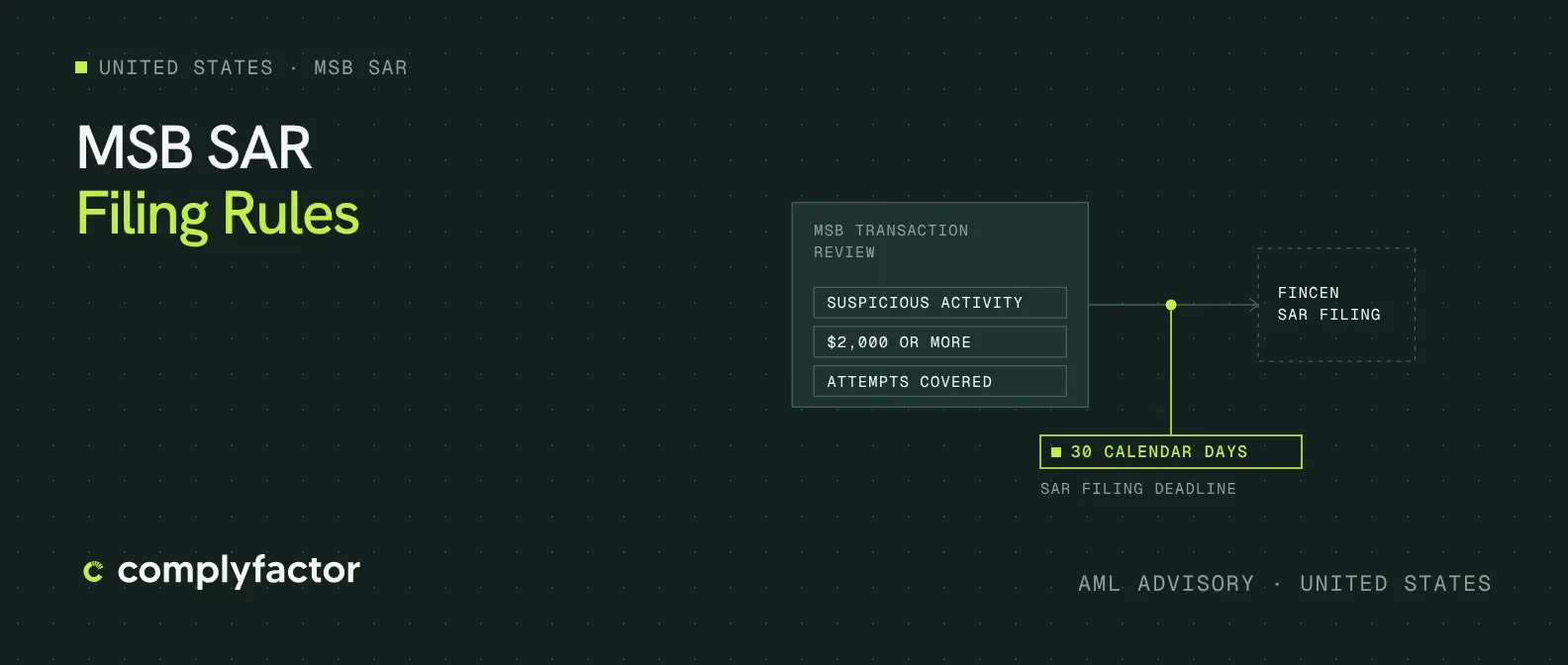
A US money services business (MSB) in the categories covered by 31 CFR 1022.320 must file a suspicious activity report (SAR) when a transaction conducted by, at or through it involves at least $2,000 and it knows, suspects or has reason to suspect that the transaction fits one of four suspicion categories. The report is due within 30 calendar days of initial detection of the facts that may support it. FinCEN's October 2025 FAQs made two things clear: continuing-activity reviews and documentation of decisions not to file are not legal requirements. This guide separates what the rule requires from what is sensible practice.
This is the broad SAR guide for MSBs. For AI-enabled identity fraud, see our article on deepfake identity fraud, KYC controls and SAR reporting.
Which MSBs must file a SAR?
The SAR rule for MSBs applies to the categories of MSB listed in 31 CFR 1022.320(a)(1), which refers to 31 CFR 1010.100(ff). It covers money transmitters; dealers in foreign exchange (exchanging currency for others in amounts over $1,000 per person per day); issuers and sellers of traveler's checks or money orders (over $1,000 per person per day); providers of prepaid access; sellers of prepaid access that meet the conditions in 1010.100(ff)(7); and the U.S. Postal Service, other than for the sale of postage or philatelic products. Check cashers are not covered by the mandatory rule but may file voluntarily. The definition also excludes banks, certain SEC- or CFTC-registered firms, and individuals who act only infrequently and not for gain. Confirm your own category against the definition in 1010.100(ff), because registration and category depend on what you actually do.
Any MSB may also file voluntarily, and a voluntary report still benefits from the safe harbor.
What triggers a SAR: the $2,000 threshold and four tests
A report is required when all of these are true:
- the transaction, or a pattern of transactions including it, is conducted or attempted by, at or through the MSB;
- it involves or aggregates at least $2,000; and
- the MSB knows, suspects or has reason to suspect that it:
- involves funds from illegal activity or is meant to hide them;
- is designed to evade BSA requirements, including structuring;
- has no business or apparent lawful purpose, and the MSB knows of no reasonable explanation after examining the facts; or
- involves use of the MSB to facilitate criminal activity.
The $5,000 figure is separate. Under 31 CFR 1022.320(a)(3), issuers of money orders or traveler's checks need only report activity of $5,000 or more that they identify from clearance or similar records. It is not a general MSB threshold.
Near $10,000 is not enough by itself. FinCEN's FAQs of 9 October 2025 and its April 2026 filing instructions say that activity at or near the currency transaction report threshold does not by itself require a SAR. A SAR is required only if the institution knows, suspects or has reason to suspect the activity is designed to evade reporting.
The 30-calendar-day clock
File no later than 30 calendar days after initial detection of facts that may constitute a basis for filing. If the matter is urgent, such as ongoing money laundering, also telephone law enforcement immediately.
Two practical points:
- Plan for 30 days, not 60. FinCEN's general SAR instructions and the bank rule allow up to 30 more days to identify a suspect, with a 60-day outer limit. The MSB rule text we reviewed contains no such extension, so do not build your procedure around one without confirming it with the regulation or FinCEN.
- Start the clock on facts, not on the alert. An alert is a lead. A conservative reading starts the clock when your review has established facts that may support a filing, and your procedure should set a short, fixed review time so alerts do not sit. This is a practice recommendation, not a definition in the rule.
Decision examples
These examples are hypothetical and are not based on any real customer.
What to write: the SAR narrative
The narrative is the one free-text part of the report. FinCEN's guidance asks for the five Ws and the how: who, what, when, where, why and how. Keep it chronological and concise, say whether the activity was completed or only attempted, explain why it is unusual for this customer, and do not use "see attached" or tables in the narrative. Tabular data goes in a single CSV attachment of up to 1 MB that the narrative describes. Do not include legal disclaimers or conclusions without facts.
A workable structure is an introduction (the type of suspected activity, prior reports and why), a body (facts in date order, with amounts and locations), and a conclusion (follow-up action, such as account closure or monitoring, and where supporting records are kept).
Fictional example narrative
The names and numbers below are invented to show structure.
Introduction. Example Remit Inc. is filing this report on transfers by Subject A, who sent six outbound money transfers to Subject B between 3 and 12 March 2026 through three different agent locations, totaling $11,400. The activity may be structured to avoid identification and verification procedures. No prior SAR has been filed on Subject A.
Body. On 3 March, Subject A sent $1,900 at Agent 1. On 4 March, Subject A sent $1,900 at Agent 2. On 6 March, $1,900 at Agent 3. On 8, 10 and 12 March, Subject A sent $1,900 each at Agents 1, 2 and 3. Every transfer went to Subject B in the same destination country. Each amount stayed just below our enhanced review level. Subject A's profile shows two transfers of under $300 in the prior six months. When an agent clerk asked about the purpose of the 10 March transfer, Subject A said it was "for family" and declined to provide the relationship to Subject B or the source of funds. The activity is unusual because it increased more than tenfold in volume, used a different location each time, and the customer refused routine questions.
Conclusion. Example Remit has restricted Subject A's profile pending further review and will monitor for further activity. Transaction records, agent logs and the clerk's written statement are held in the compliance case file, reference EXAMPLE-0001.
Continuing activity: what is required and what is optional
FinCEN's FAQs of 9 October 2025 say institutions are not required to conduct a separate review of a customer or account after filing a SAR to see whether activity has continued. They may rely on risk-based policies, procedures and controls. The older practice of filing every 90 days is not a requirement. If you choose to follow FinCEN's continuing-activity timeline, the example is: detection on day 0, initial SAR by day 30, end of the 90-day period on day 120, continuing SAR by day 150. The continuing report should cover the full 90-day period and should not repeat the earlier narrative.
Requirement: report suspicious activity you know of or have reason to suspect within the 30-day clock. Recommended practice: keep a risk-based trigger, such as an alert on a customer with a prior SAR, so new facts reach a filing decision quickly. If your SAR procedures are out of date after the 2025 FAQs, our BSA/AML compliance program services cover rewriting them.
Do you have to document a decision not to file?
No. The FAQs say there is no requirement or expectation under the BSA or its regulations to document a decision not to file a SAR. FinCEN had encouraged documentation before but did not require it. If you do record it, a short statement of the facts reviewed and the reason usually suffices. Some MSBs keep these notes because partners and examiners may ask how alerts were resolved (see what to expect in an IRS Title 31 examination). That is a business choice and should be described in your procedures as such.
Agents, principals and joint filing
Each MSB involved in a transaction must identify and timely report suspicious activity, but only one report is needed if it contains all relevant facts. An agent is itself an MSB for SAR purposes. Whether a principal is liable for an agent's failure to report depends on the relationship under general agency principles.
In practice, document which entity files in which scenario, how agent red flags reach the principal's compliance team, and who keeps the records. Joint filing is available only for distinct legal entities and not where a subject is an officer, director, employee or controlling owner of a filer. Our article on authorized delegate oversight covers agent selection and monitoring.
Confidentiality, safe harbor and records
- Confidentiality: do not tell the person involved that a SAR was filed, and do not disclose it except as the rule permits. If you receive a subpoena or request for a SAR, decline it, cite the rule and notify FinCEN.
- Safe harbor: MSBs and their personnel are protected from civil liability for reports made, to the extent 31 U.S.C. 5318(g)(3) provides.
- Records: keep a copy of each SAR and its supporting documentation for five years from filing. Supporting documentation is treated as filed with the SAR and must be available to authorities on request.
Alert key terms
When a FinCEN alert asks for a key term, put it in SAR field 2 (Filing Institution Note to FinCEN) and in the narrative. For example, FinCEN's alert FIN-2026-Alert009 of 30 October 2026 on foreign-agent-directed transactions asks filers to use FIN2026FOREIGNAGENT. Use field 2 only for a specific alert or advisory and leave it blank otherwise.
From alert to filing: an internal workflow
- Alert or referral. Log the source (monitoring, agent, staff, partner bank, law enforcement request).
- Triage. Assign an owner and a target date for a first decision.
- Gather facts. Customer profile, transaction history, agent records, and any customer explanation.
- Apply the test. Is the amount at least $2,000 (aggregated)? Do you know, suspect or have reason to suspect one of the four categories?
- Decide and, if you want, record. File, or close. A record of a decision to close is optional under the FAQs; many MSBs keep a short note.
- File within 30 days. Use the BSA E-Filing System and complete the narrative to FinCEN's guidance.
- Protect and retain. Keep the file for five years and restrict access.
- Escalate follow-up. Decide whether to restrict, close or monitor the account, and whether to alert law enforcement by phone in urgent cases.
Checklist
- ☐ Is the entity in a category covered by 1022.320?
- ☐ Does the transaction or pattern reach $2,000?
- ☐ Is there knowledge, suspicion or reason to suspect under one of the four tests?
- ☐ Was the transaction attempted but not completed?
- ☐ Is a key term requested by a current FinCEN alert?
- ☐ Does the narrative cover who, what, when, where, why and how, with no tables or "see attached"?
- ☐ Filed within 30 calendar days of initial detection?
- ☐ Confidentiality and five-year retention applied?
Building and testing the program
An MSB's AML program under 31 CFR 1022.210 should include procedures for detecting and reporting suspicious activity. For an independent view of whether alerts are escalated and filings made on time, see our independent BSA/AML audit services. Where you need ongoing ownership of the program, a fractional BSA/AML officer can hold the compliance-officer role.
Frequently asked questions
Is $2,000 the threshold for every MSB?
It is the general MSB threshold. Money order and traveler's check issuers use $5,000 only for activity they identify from clearance records.
Can I file a SAR for a transaction under $2,000?
Yes, voluntarily. A voluntary report is not mandatory and is still protected by the safe harbor.
Do I have to file a SAR if a customer cancels?
Possibly. The rule covers attempted transactions, so a cancelled one can still need a report if it meets the amount and suspicion tests.
Must I file every 90 days on an ongoing case?
No. FinCEN's FAQs say that is not required. The timeline is optional if you choose to follow it.
Who files when the activity runs through agents?
Each MSB involved must report, but one report with all relevant facts is enough. Agree in writing who files.
May I tell the customer I filed a SAR?
No. A SAR and information that would reveal it are confidential, although the underlying facts and business records are not themselves a SAR.
Will the proposed AML/CFT program rule change this?
FinCEN proposed program changes in April 2026. It is a proposal, and we found no final rule as of 18 November 2026. This article does not rely on it.
Official references
- 31 CFR 1022.320 (check the current text on eCFR).
- FinCEN: MSB suspicious activity reporting.
- FinCEN SAR FAQs, 9 October 2025.
- FinCEN SAR Filing Instructions, April 2026.
- FinCEN SAR narrative guidance.
- FinCEN Alert FIN-2026-Alert009.
This article is general information, not legal advice. Confirm current rule text and FinCEN guidance before acting.
ComplyFactor is a Canadian AML and regulatory compliance advisory firm serving MSBs, PSPs, fintechs and other regulated businesses.


Related insights
Book a free compliance consultation?
Tell us about your business and we'll confirm which services you need. Free, no obligation, 30 minutes.