

Key Takeaways
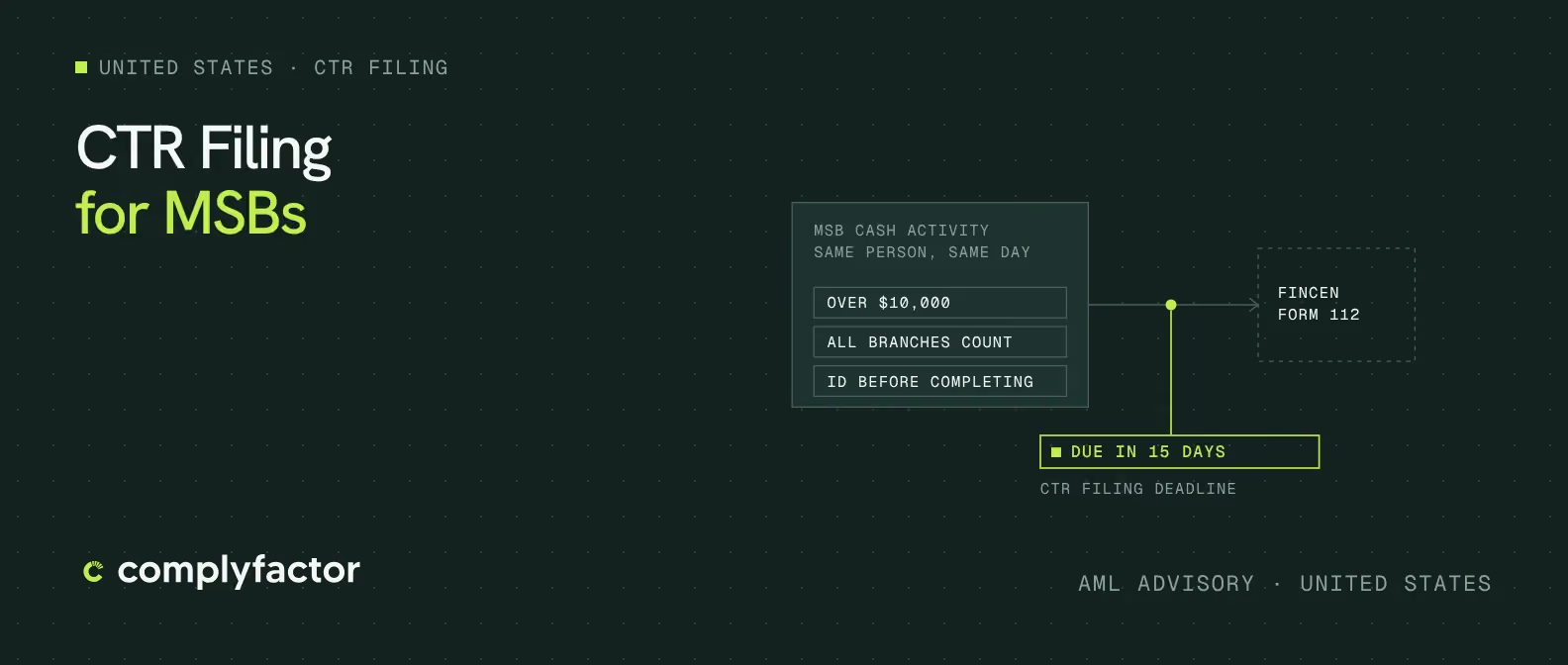
- An MSB files a CTR when it receives or pays out more than $10,000 in currency for the same person in one business day.
- Related cash transactions the MSB knows about are aggregated across branches and agents.
- The CTR is due within 15 days, and the customer must be identified before the transaction is completed.
- A FinCEN order effective 3 September 2026 to 1 March 2027 adds a $1,000 CTR trigger for MSBs in specified Texas and New Mexico ZIP codes.
- Splitting cash to avoid a report is structuring, so near-threshold patterns need a SAR decision.
Short answer
A U.S. money services business (MSB) must file a Currency Transaction Report (CTR) when it receives or pays out more than $10,000 in currency for the same person in one business day, counting every related cash transaction it knows about. The report is FinCEN Form 112. It is due within 15 days after the day the reportable transaction occurred, and the customer must be identified before the transaction is completed.
Three points trip MSBs up. The test is "more than" $10,000, so exactly $10,000 does not trigger a report. Several smaller cash transactions can add up to a reportable one. And a separate FinCEN geographic targeting order (GTO) currently adds a lower $1,000 CTR trigger for MSBs in specified ZIP codes in Texas and New Mexico, effective 3 September 2026 and ending 1 March 2027. The $10,000 rule applies everywhere; the GTO is an additional, local layer.
This guide covers the standard rule first, then the border order, then the controls an examiner will look for.
What a CTR is and who files one
A CTR reports a transaction in currency. Under 31 CFR 1010.311, each financial institution other than a casino must file a report for each deposit, withdrawal, currency exchange or other payment or transfer, by, through or to it, that involves more than $10,000 in currency. MSBs are financial institutions under the Bank Secrecy Act, so they file. The IRS describes the report as FinCEN Form 112 and says MSBs file it electronically.
Currency means coin and paper money of the United States or another country that is legal tender and customarily used as money where it was issued. That includes foreign banknotes (31 CFR 1010.100(m)). A "transaction in currency" is a physical transfer of currency from one person to another. A wire, bank check or other written order is not a transaction in currency unless physical currency is involved (31 CFR 1010.100(bbb)(2)).
The rule reaches any MSB activity that moves cash, not only money transmission. Dealers in foreign exchange, check cashers, and sellers of money orders or traveler's checks all take in or pay out currency. The MSB definition itself is in 31 CFR 1010.100(ff).
The $10,000 test
The test has three parts, and all three must be met.
- Currency. Physical cash, domestic or foreign.
- More than $10,000. The regulation says "more than", so $10,000.00 exactly is below the line.
- One person, one business day. Related cash transactions by or for the same person are treated as one when the MSB knows they are related.
The last row comes from FinCEN's guidance on check cashers: when the physical cash handed over is under $10,000, no CTR is triggered, but a payout designed to avoid the report may violate the anti-structuring law, 31 U.S.C. 5324.
Aggregation: where most missed CTRs come from
31 CFR 1010.313 requires aggregation. For institutions other than casinos, multiple currency transactions are treated as a single transaction if the institution has knowledge that they are by or on behalf of any person and result in cash in or cash out totalling more than $10,000 during any one business day. Deposits made after hours, on weekends or on holidays count on the next business day.
Four practical consequences follow.
- Every location and agent counts. The regulation treats an institution as including all of its domestic branches and any recordkeeping facility holding records of its domestic operations (31 CFR 1010.313(a)). FinCEN's MSB quick reference guide makes the same point for transactions at one or more branches or agents of the same MSB. A customer who splits cash across two counters is one customer.
- Knowledge is the trigger. The rule turns on what the MSB knows. If your systems hold the data that would link two transactions, you are expected to use it. A customer database that cannot link the same person across locations is a control gap, not a defence. Aggregation logic is one of the things an independent BSA/AML audit should test against real transaction data.
- Common ownership alone does not force aggregation. FinCEN's guidance FIN-2012-G001 says separately incorporated businesses are presumed independent, but the institution must look at the facts it learns in the ordinary course of business. Shared staff and addresses, or one business's accounts repeatedly paying another's expenses, are signs the businesses are not independent. If they are not independent, their cash is aggregated.
- Agents are not the transactor. FinCEN's guidance notes that a person who gives or receives currency as a function of an agency relationship with a financial institution is not the transactor; the transactor is the individual who gives or receives the currency from the agent. Armored car cash movements are an example. Read the guidance before building aggregation rules around them.
Identification, timing and record retention
Identify before you complete the transaction. 31 CFR 1010.312 requires the institution to verify and record the name and address of the person presenting the transaction, and to record the identity, account number and taxpayer identification number (if any) of anyone on whose behalf it is made. Non-resident aliens may be verified with a passport or alien identification card. Others may be verified with a document normally accepted in the banking community for cashing checks for non-depositors, such as a driver's license or credit card. The report must show the specific information used, such as the licence number. Entries like "known customer" are prohibited.
File within 15 days. 31 CFR 1010.306(a)(1) requires the report to be filed within 15 days following the day the reportable transaction occurred.
Keep a copy for five years. 31 CFR 1010.306(a)(2) requires a copy of the report to be kept for five years.
Structuring: the other half of the rule
31 CFR 1010.314 prohibits acting to evade CTR requirements. It covers three things: causing or trying to cause a domestic financial institution to skip a required report, causing it to file a report with a material error or false statement, and structuring or helping to structure a transaction. Structuring is also a federal crime under 31 U.S.C. 5324.
For an MSB, the practical link is the SAR. FinCEN's SAR rule for MSBs applies at $2,000 or more. A customer who repeatedly brings $9,500 in cash, or who reduces a transaction on learning about the reporting rule, is a SAR conversation even though no CTR is due. Our guide to filing SARs as an MSB covers that process.
The 2026 southwest border order: a separate $1,000 trigger
FinCEN's geographic targeting order is an additional rule, not a replacement. The order published in the Federal Register on 4 September 2026 (91 FR 56776, effective 3 September 2026) sets the following terms, and FinCEN's updated FAQs follow the same terms.
Three cautions apply.
- The $10,000 rule is unchanged. The order states that existing duties continue, including CTRs for transactions over $10,000 and SARs where appropriate. FinCEN encourages voluntary SAR filing for transactions meant to evade the $1,000 threshold.
- Court orders limit who must file. The order's definition of a covered business excludes any MSB that a court order bars the government from applying the March 2025 order to, and only while that injunction stays in force (FinCEN GTO FAQ 4). Separately, FinCEN's BSA E-Filing site carries a notice that, because of a court order, no MSB under the jurisdiction of the U.S. District Court for the Southern District of California is currently required to submit information under the GTO the notice refers to. FinCEN's order, FAQs and notice do not name any other exempt group, and we do not infer one. Check the E-Filing notice and the FAQs, and take legal advice, before you stop or start filing.
- Orders expire and change. This order's predecessors were reissued with different thresholds and areas, and the earlier versions covered parts of California and Arizona that this one does not. Check FinCEN's site for the current order and its FAQs before relying on any summary, including this one.
Is the $10,000 threshold changing?
Not as of 25 November 2026, as far as we could confirm. The CTR threshold has been $10,000 for decades. In June 2026, members of the House Financial Services Committee urged FinCEN to raise the CTR and SAR thresholds, and a GAO report on CTRs was due under the Anti-Money Laundering Act of 2020. FinCEN's April 2026 proposal to reform AML/CFT program requirements is a different rulemaking; one trade report quotes FinCEN's director saying a threshold change was not part of it. Treat any change as proposed until a final rule is published, and check the current text of 31 CFR 1010.311 before you rely on this page.
An illustrative example
This example is hypothetical and is not based on a real client.
A currency exchange business in Texas has a main branch and a smaller counter in another ZIP code. On one business day, a customer buys euros with $6,200 in cash at the main branch. In the afternoon the same customer buys pounds with $4,900 in cash at the smaller counter. The two counters share one customer database, so the second transaction is flagged.
The business knows both transactions are by the same person, and the total is $11,100. A CTR is due within 15 days, and both transactions go on the same report. If either counter sat in a covered ZIP code, the border order would be a second question to answer separately from this one.
CTR control checklist for MSBs
- Currency transactions are tagged separately from wires, checks and card payments.
- Aggregation runs across all locations, agents and channels, per person, per business day.
- After-hours, weekend and holiday cash is rolled to the next business day.
- Related businesses under common ownership have a documented independence assessment.
- Identity is verified and the specific ID details are recorded before the transaction completes.
- "Known customer" is never used as the identification entry.
- CTRs are filed within 15 days and copies kept for five years.
- A second-person review checks the CTR queue daily.
- Structuring red flags route to a SAR decision with a written rationale.
- Each location is checked against the current GTO ZIP code list, and the order's end date is diarised.
- Staff are trained on the $10,000 rule, aggregation and structuring, and training is recorded.
- The independent review tests CTR completeness, timeliness and aggregation logic.
How ComplyFactor can help
CTR errors usually show up in an IRS Title 31 examination or an independent review, long after the transaction. Our team can test your aggregation logic against real transaction data, rebuild your BSA/AML compliance program so cash controls are documented, and run the independent BSA/AML audit that examiners expect. If a late or missing CTR has already surfaced, our compliance remediation services cover look-backs and corrective filings, and a fractional BSA/AML officer can own the process day to day.
Related reading: what examiners test in an IRS Title 31 examination, the independent audit checklist, and how to update your BSA/AML risk assessment when FinCEN issues a new order. If your cash business runs through agents, see our guide to authorized delegate oversight.
Frequently asked questions
Does a $10,000 cash transaction require a CTR?
No. The rule applies to more than $10,000. A $10,000.00 cash transaction is below the line, although a pattern of transactions at just under it may call for a SAR.
Do wire transfers and card payments count toward the $10,000?
Not on their own. A transaction in currency is a physical transfer of currency. A wire transfer, bank check or other written order is not a transaction in currency unless physical currency is involved.
How long do I have to file a CTR?
15 days after the day the reportable transaction occurred, under 31 CFR 1010.306(a)(1). The border order allows 30 days for the transactions it covers.
Do I aggregate across branches and agents?
Yes, where you have knowledge that the transactions are by or for the same person. The regulation treats an institution as including its domestic branches, and FinCEN's quick reference guide applies the same logic to branches and agents of the same MSB.
Can I exempt a regular customer from CTR filing?
Do not assume so. The exemption rules in 31 CFR 1020.315 are drafted as a bank-side rule that lets a bank skip reports on certain customers. They do not set up an exemption process for MSBs, and the text restricts businesses serving as financial institutions or their agents. Take advice before treating any customer as exempt.
I am outside Texas and New Mexico. Does the border order affect me?
Not directly. The order covers MSBs located in the specified ZIP codes. Outside them, the standard $10,000 rule applies. Your risk assessment should still note the order if you serve customers who use covered locations.
Is a CTR filing a sign of wrongdoing?
No. A CTR is a routine report triggered by the size of a cash transaction. Failing to file one, or helping a customer avoid one, is what creates risk.
Official sources
- 31 CFR 1010.311: Filing obligations for reports of transactions in currency
- 31 CFR 1010.313: Aggregation
- 31 CFR 1010.306: Filing of reports
- 31 CFR 1010.312: Identification required
- 31 CFR 1010.314: Structured transactions
- 31 CFR 1010.100: General definitions (currency, transaction in currency, money services business)
- 31 CFR 1020.315: Exemptions from the requirement to report transactions in currency
- FinCEN FIN-2012-G001: Currency Transaction Report Aggregation for Businesses with Common Ownership
- FinCEN: Guidance on the definition of check casher and BSA requirements
- FinCEN: Bank Secrecy Act Requirements, A Quick Reference Guide for Money Services Businesses
- Federal Register: Geographic Targeting Order Imposing Recordkeeping and Reporting Requirements on Certain Money Services Businesses Along the Southwest Border, 91 FR 56776 (document 2026-18194)
- FinCEN news release, 2 September 2026: FinCEN reissues order requiring transparency from MSBs along the southwest border
- FinCEN: Southwest Border GTO frequently asked questions (updated 8 September 2026)
- FinCEN BSA E-Filing System (notice on the court order affecting MSBs in the Southern District of California)
- IRS: Bank Secrecy Act requirements for money services businesses
- GAO-25-106500: Currency Transaction Report requirements

ComplyFactor is a Canadian AML and regulatory compliance advisory firm serving MSBs, PSPs, fintechs and other regulated businesses.


Related insights
Book a free compliance consultation?
Tell us about your business and we'll confirm which services you need. Free, no obligation, 30 minutes.