Crypto Off-Ramps and FINTRAC: When an LVCTR, an EFTR, Both or Neither Applies
A customer sends virtual currency and you pay out fiat. FINTRAC does not treat that as one reportable object. The crypto leg and the fiat leg are tested separately, each against its own trigger, valuation rule, aggregation rule and deadline.



Key Takeaways
- One commercial off-ramp can produce an LVCTR only, an EFTR only, both, or neither. Each leg is tested against its own legal trigger.
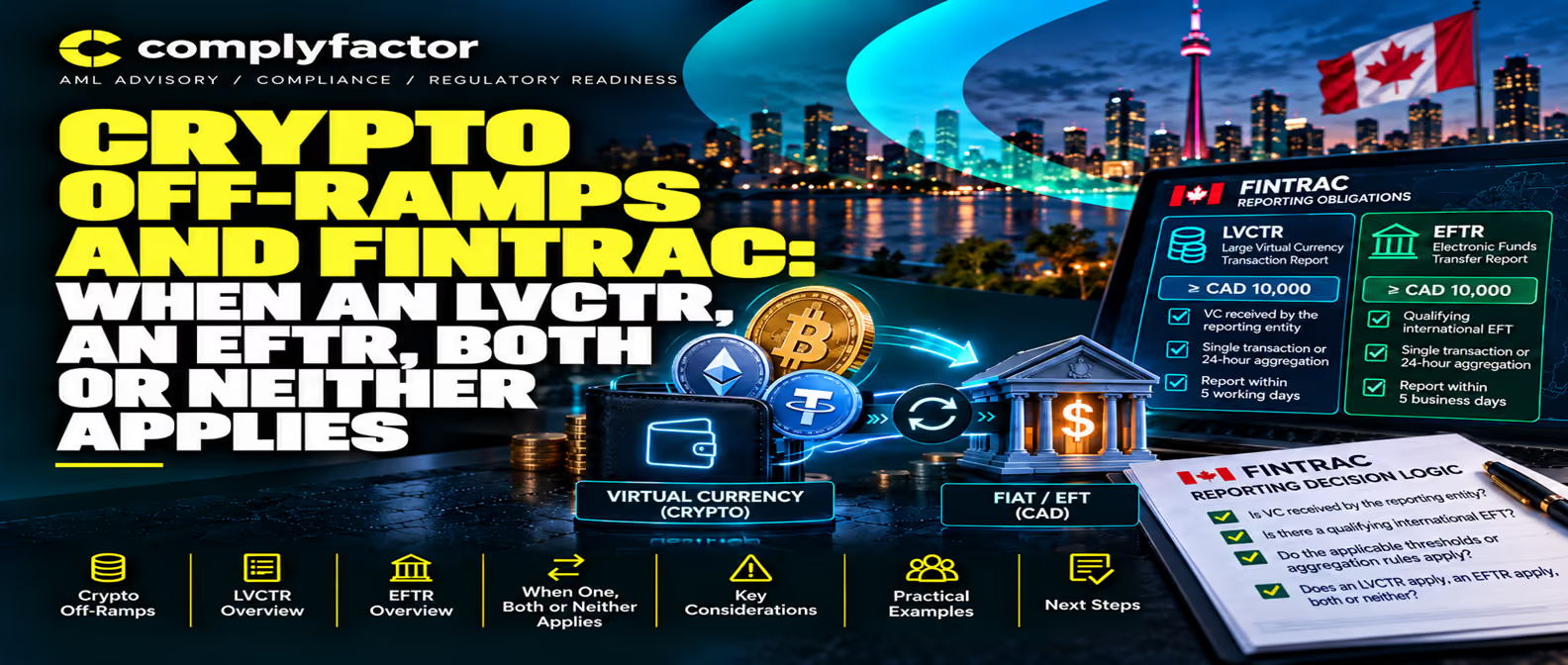
- The LVCTR trigger is receipt of virtual currency equivalent to $10,000 or more (subject to exceptions), valued at the exchange rate you establish in the normal course of business. The EFTR trigger is initiation or final receipt of a qualifying international electronic funds transfer of $10,000 or more.
- A domestic fiat payout does not create an EFTR merely because the transaction started in crypto. An EFTR concerns international electronic funds transfers.
- The two reports use different events, linking identities, aggregation logic, valuation rules, deadline wording and report fields. One generic aggregation rule cannot be applied identically to both.
- The Travel Rule, suspicious transaction reporting, identity verification and record keeping are separate obligations that can apply to the same off-ramp.
Most off-ramp reporting errors start with a modelling choice: the system records one "order" and files one report, or assumes that crypto in means an LVCTR and fiat out means an EFTR. FINTRAC's guidance does not work that way. Reporting attaches to defined events, and an off-ramp can contain more than one of them. For crypto businesses, this is a FINTRAC crypto reporting problem with two separate threshold tests.
This article covers crypto off-ramp FINTRAC reporting at the point where it is hardest: the interaction between the two reports. It applies to reporting entities with FINTRAC reporting obligations, including money services businesses dealing in virtual currency and foreign money services businesses serving Canada. Dollar amounts are Canadian. The mechanics of each report are in ComplyFactor's guides to the LVCTR, the EFTR and the 24-hour rule; this article does not repeat them.
What a Crypto Off-Ramp Looks Like for FINTRAC Purposes
"Crypto off-ramp" is an industry description, not a FINTRAC report type. A practical working definition is a workflow in which a client provides virtual currency and receives, or directs another person or entity to receive, fiat funds. The compliance analysis starts by breaking that workflow into the regulated events inside it.
A typical sequence is: the client sends virtual currency, the business is in receipt of it, the business values and converts it, and the business sends or makes available fiat to the client or a beneficiary. Conversion accounting is not itself a reporting trigger. The LVCTR analysis begins with receipt of virtual currency, subject to the applicable reporting threshold and exceptions. The EFTR analysis begins with initiating or finally receiving a qualifying international electronic funds transfer.
One Off-Ramp Can Create Zero, One or Two Threshold Reports
A report on one leg neither creates nor removes a report on the other. The outcomes are:
- LVCTR only: a large receipt followed by a domestic payout (scenarios A and F below).
- EFTR only: a receipt below the LVCTR threshold followed by an international transfer that reaches it (scenario D).
- Both: a large receipt followed by a qualifying international transfer of $10,000 or more (scenario B).
- Neither: a receipt below $10,000 with no aggregation, paid out domestically or in an amount below the EFTR threshold. Other obligations still apply.
FINTRAC tests this interaction during examinations. Its Assessment Manual includes a method (LVCTR 3) for confirming that all required reports were submitted for a given transaction, starting from LVCTRs in which the disposition was recorded as an outgoing international electronic funds transfer. That does not mean every off-ramp requires both reports; each underlying threshold and reporting condition must still be met.
When the Crypto Leg Triggers an LVCTR
FINTRAC's guidance requires an LVCTR when you receive virtual currency in an amount equivalent to $10,000 or more in a single transaction. It also applies the 24-hour rule: two or more receipts totalling $10,000 or more within a consecutive 24-hour window, where you know they were conducted by the same person or entity, conducted on behalf of the same person or entity, or are for the same beneficiary.
The first question is when you are in receipt. FINTRAC states that you are in receipt of virtual currency when the transaction can no longer be reversed or cancelled. FINTRAC does not prescribe a confirmation count or a blockchain finality standard in that guidance. Your policies should define, per asset and network, the point at which your system treats a transfer as no longer reversible or cancellable, and apply it consistently. That timestamp matters because it is the time of receipt that the threshold is tested against.
This analysis assumes that no LVCTR reporting exception applies; FINTRAC provides specific exceptions for certain operational-purpose and validation-related receipts, and for some 24-hour-rule situations. See FINTRAC's LVCTR guidance (section 7) for the exceptions and ComplyFactor's 24-hour rule guide for the aggregation exceptions. A receipt can be reportable regardless of what happens next. The payout method, the payout amount and the payout country do not decide whether the LVCTR applies.
When the Fiat Leg Triggers an EFTR
An EFTR is not required merely because fiat was paid out, a bank account was involved or the transaction began in crypto. Test the payout in order:
- Is it an electronic funds transfer? FINTRAC defines it as the transmission, by any electronic, magnetic or optical means, of instructions for the transfer of funds. For SWIFT messages, only MT-103 messages and their equivalent are included. Excluded transmissions include those involving the beneficiary withdrawing cash from their account, direct deposit, pre-authorized debit and cheque imaging and presentment, among others. Not every wire is an EFT and not every payout channel is excluded.
- Is it international? An international EFT is an electronic funds transfer other than a transfer of funds within Canada.
- Did you initiate it or finally receive it? Initiation is the first transmission of instructions for the transfer of funds. A money services business must report when it initiates an international EFT of $10,000 or more in a single transaction at the request of a person or entity. It must also report when it finally receives one of $10,000 or more. Final receipt is receipt of the instructions by the entity that makes the remittance to a beneficiary.
- Does it reach the threshold? Individually, or through the 24-hour rule.
For an off-ramp payout, the money services business is normally the initiator, acting at the request of the client. FINTRAC's summary for a money services business that is only the initiator is to report when the final receiver is located outside Canada. At initiation, the amount is what the requester instructed to be transferred, excluding fees you charge. FINTRAC's own example reports $10,950 where the requester instructed $11,000 and the fee was deducted from it, and $11,000 where the requester paid the fee separately.
Timing follows the event. For initiation, the date and time is when you initiate the transfer, which can be later than the client's instructions where the instructions are post-dated or recurring.
Edge case: the same business is initiator and final receiver
FINTRAC's guidance covers transfers between two clients of the same money services business, where the instructions may never cross a border. Here the business determines each client's residential status, in Canada or outside Canada. Status in Canada does not mean physical presence: an address in Canada, Canadian-issued identification or a Canadian-based banking or payment service can each give a client that status. Physical presence at a Canadian location of a money services business supersedes a prior status of outside Canada.
FINTRAC's table for a money services business that is both initiator and final receiver works as follows: requester in Canada and beneficiary outside Canada, report the initiation; beneficiary in Canada and requester outside Canada, report the final receipt; both outside Canada, report both; both in Canada, no EFTR. So an international EFT does not require a physical border crossing.
Does a Domestic Fiat Payout Trigger an EFTR?
Not automatically. An international EFT is one other than a transfer of funds within Canada, so a payout that stays within Canada does not create an EFTR on that basis. Some channels are also excluded from the EFT definition altogether.
That is a statement about the EFTR only. A domestic payout does not take the transaction outside FINTRAC. The crypto leg may still require an LVCTR, and record keeping, identity verification, third party determination, suspicious transaction reporting and Travel Rule obligations are tested separately. The confusion usually arises when a business routes a payout through a foreign partner: if the transfer is sent to a final receiver outside Canada, the analysis changes.
LVCTR vs EFTR: Threshold, Timing and Valuation
FINTRAC uses "working days" in its LVCTR guidance and "business days" in its EFT guidance. Build each calendar from the wording of the report it governs, and document how your calendar treats holidays.
Why Fees and FX Can Produce Different Reporting Outcomes
In crypto to fiat reporting, virtual currency received is not the same number as fiat paid out. Fees, spread, market movement, timing and payout currency all separate the two. Each report's threshold is calculated under its own rule, and neither leg's final amount should be reused for the other.
- LVCTR value: tested at the exchange rate you establish in the normal course of business, at the time of receipt. It is not the later fiat payout, not the amount after fees and not a Bank of Canada rate.
- EFTR value: the amount the requester instructed to be transferred, excluding fees you charge, converted at the Bank of Canada rate in effect at the time of the transaction where the transfer is in a foreign currency. It is not the crypto value and not your own crypto rate.
- Different clocks: the receipt time and the initiation time are different events. A rate that applied at receipt does not carry forward to a payout executed hours later.
For an international payout, a business may therefore hold a large receipt and a payout below the EFTR threshold, or the reverse. Neither result is an error by itself. The error is using one leg's number to answer the other leg's question.
The 24-Hour Rule Must Be Tested Separately for Each Report Type
Virtual currency receipts and international EFTs are aggregated independently. A set of receipts can meet the LVCTR rule while the related payouts do not meet the EFTR rule, or the reverse. The linking identities differ, as the table above shows: an EFT final receipt has no on-behalf-of basis, for example. For EFTs, SWIFT and non-SWIFT transfers are aggregated together.
FINTRAC's report instructions also require aggregation on each party separately. A business can therefore have several 24-hour windows, such as one for conductors and another for beneficiaries. Multiple off-ramps in a day need a window per report type and per linking identity. The generic mechanics are in the 24-hour rule guide.
Requester, Beneficiary and Third-Party Roles in an Off-Ramp
An off-ramp can involve a client, the sender of the virtual currency, the owner of a wallet, a requester of the payout, a beneficiary and other parties. These roles can differ, and the two reports name them differently: the LVCTR uses conductor, on-behalf-of party and beneficiary; the EFTR uses requester, third party, initiator, receiver and beneficiary. A data model limited to one "customer" and one "recipient" may be insufficient to populate both reports correctly.
Take Client A, who sends virtual currency and instructs a fiat payout to Beneficiary B. B is not automatically a third party. FINTRAC defines a third party as a person or entity that instructs another to act on their behalf; it may or may not be funding the transaction. If A is acting on B's instructions, B is the third party. If A simply chooses to pay B, B is the beneficiary. FINTRAC's EFT guidance applies the same logic to businesses: an employee who requests a transfer is the requester and the business is the third party, whereas the owner's request makes the business the requester. See ComplyFactor's third-party determination guide.
Travel Rule vs LVCTR and EFTR Reporting
The Travel Rule is a separate obligation and is not an LVCTR or an EFTR. FINTRAC's travel rule guidance describes when financial entities, money services businesses and foreign money services businesses, and for electronic funds transfers casinos, must include or obtain information with transfers. Money services businesses must include the required information when they send virtual currency transfers, and must take reasonable measures to ensure it is included when they receive virtual currency transfers that require a virtual currency record. For EFTs, they must take reasonable measures to ensure the information is included when they receive a transfer as an intermediary or final recipient.
When a transfer that should carry the information arrives without it, you must take reasonable measures to obtain it, set out in your policies and procedures. You must also have written, risk-based policies for what to do when you remain unable to obtain it, for example whether to proceed with, suspend or reject the transfer. Filing an LVCTR or EFTR does not satisfy this, and complying with the Travel Rule does not mean threshold reporting is complete. Check FINTRAC's current travel rule guidance for the data elements and scope that apply to each transfer type.
STR, Identity Verification and Records Still Apply
Threshold reporting does not replace suspicious transaction analysis. FINTRAC's guidance for both reports says a business may need to file an LVCTR or EFTR and a Suspicious Transaction Report for the same transaction. Neither a large crypto receipt, a self-hosted wallet nor a foreign beneficiary is suspicious by itself. The test is reasonable grounds to suspect, applied to the facts. ComplyFactor's guide to documenting a decision not to file covers how to record the reasoning.
Both reports also sit alongside identity verification and third party determination requirements; see the identity verification guide. Copies of submitted LVCTRs and EFTRs must be kept for at least five years from the date the report was created. Your FINTRAC record-keeping guidance for money services businesses sets out the underlying transaction records.
Practical Crypto Off-Ramp Reporting Scenarios
All scenarios are hypothetical and illustrative. They assume the business is a money services business that is the initiator of any payout, that values virtual currency at a documented normal-course rate and that no exceptions apply.
What Data Your Reporting Workflow Should Preserve
The fields below are drawn from FINTRAC's report instructions for the LVCTR and EFTR:
- Crypto leg: date and time of receipt with time zone, virtual currency type and amount, the exchange rate used, the transaction hash, sending and receiving addresses, conductor, any on-behalf-of party, beneficiary and the threshold indicator.
- Fiat leg: direction (initiation or final receipt), date and time, amount and currency, exchange rate, SWIFT or non-SWIFT type, threshold indicator, residential status questions for money services businesses, and requester, third party, receiver and beneficiary details.
- Both: the 24-hour window and aggregation type, reporting entity report and transaction reference numbers.
These are practical workflow additions, not FINTRAC fields: an identifier linking the source crypto event, the conversion and the fiat payout; the source and timestamp of each valuation rate; the threshold result for each leg; the aggregation group per report type; the filing deadline per report; and the report reference or acknowledgement once filed. FINTRAC notes that if you use an automated trigger, a person may still assess the transactions as a best practice. The linked record is what lets a reviewer follow an off-ramp from receipt through to each report.
Common Crypto Off-Ramp Reporting Errors
FINTRAC does not publish a ranked list of off-ramp reporting errors. These errors follow directly from the rules above:
- Treating the conversion as a single reporting test.
- Filing an EFTR whenever fiat is paid out, including payouts within Canada.
- Using the fiat payout amount as the LVCTR value.
- Using the virtual currency rate for the EFTR foreign-currency test, or the Bank of Canada rate for virtual currency.
- Missing an LVCTR because fees reduced the payout below $10,000.
- Missing an EFTR because the crypto receipt was below $10,000.
- Applying one aggregation window or one set of linking identities to both reports.
- Using order-creation time instead of the time of receipt or initiation.
- Losing requester and beneficiary relationships between the trading, wallet and payment systems.
- Assuming Travel Rule compliance means threshold reporting is complete.
For rejections, warnings and data-quality failures after submission, see ComplyFactor's guide to common FINTRAC report validation errors.
How ComplyFactor Supports FINTRAC Reporting Operations
Cross-leg logic is difficult because the data sits in different systems and each report applies its own rules. ComplyFactor Reporting is a workflow platform for FINTRAC reports, with live LVCTR and EFTR workflows covering import and mapping, report-specific 24-hour aggregation checks, validation, maker-checker approval, submission-status tracking and report history. Submission through FINTRAC API depends on API enrolment for each reporting entity. The software supports the process; deciding whether a report or an STR is required, and legal responsibility, remain with your compliance team. See FINTRAC Reporting Automation.
Frequently Asked Questions
Does a returned or failed fiat payout cancel the EFTR?
No. FINTRAC states that the original initiation of instructions is not affected when an EFT is returned, and the transaction must be reported whether or not it is completed or returned to the originating entity.
What rate applies to the EFTR test if the payout currency has no Bank of Canada rate?
FINTRAC's EFT guidance says that if the Bank of Canada does not publish a rate, you use the rate you establish in the normal course of business at the time of the transaction. Your process for establishing the rate should be set out in your policies and procedures.
Does a transfer from a self-hosted wallet automatically trigger an LVCTR?
No. Wallet type does not change the LVCTR threshold. It may affect the source and address information available to the reporting entity and the reasonable measures needed to identify the relevant parties, but the reporting test remains based on receipt, value, aggregation and applicable exceptions.
Can a service provider file our LVCTRs and EFTRs?
A service provider can submit and correct these reports for you, but FINTRAC states that as the reporting entity you remain ultimately responsible and that responsibility cannot be delegated.
Does describing the payout in the LVCTR mean the EFTR has been reported?
No. The LVCTR records what happened to the virtual currency, such as its exchange into funds and transfer to a bank account. That description does not report an international EFT, which is a separate report with its own trigger, parties and deadline.
If you want your off-ramp exchange-rate procedure, aggregation logic and reporting evidence reviewed, ComplyFactor can help through its AML compliance program work or an independent AML audit.
ComplyFactor specializes in FINTRAC MSB and PSP registration, independent AML effectiveness reviews, and compliance program design for Canadian and foreign money services businesses, payment service providers, fintechs, and virtual asset service providers.
.svg)
.svg)
Related insights
Book a free Canada AML consultation
Tell us about your business and we'll confirm which services you need — free, no obligation, 30 minutes.