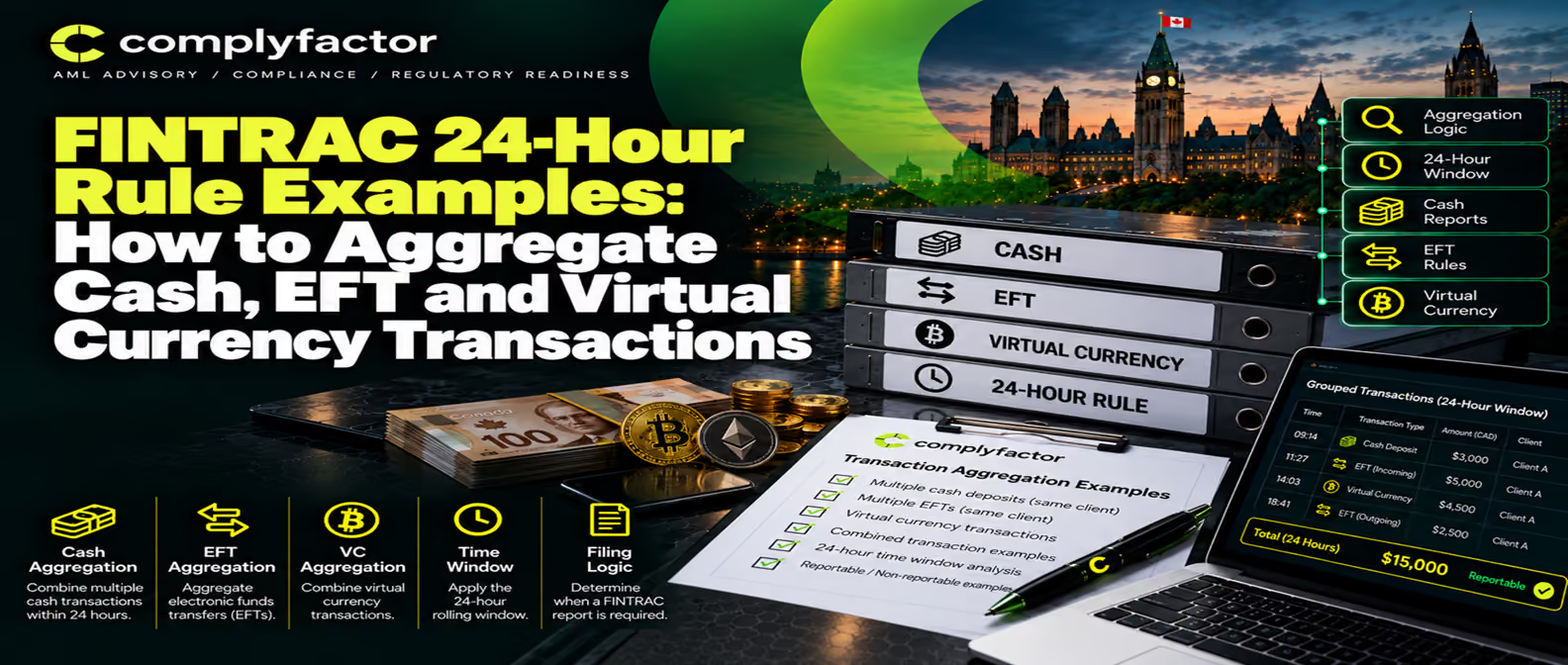
FINTRAC 24-Hour Rule Examples: How to Aggregate Cash, EFT and Virtual Currency Transactions
Practical guidance for calculating aggregation thresholds and identifying reportable transactions under FINTRAC's consecutive 24-hour rule.



Key takeaways
- Transactions below $10,000 can combine with other transactions to trigger reporting; the 24-hour rule is an aggregation mechanism, not a threshold that applies only to large individual transactions.
- Multiple branches, different time zones, and online versus in-person transactions do not automatically prevent aggregation — your static 24-hour window applies consistently across your entire organization.
- Report types are tested separately; large cash transaction reports, electronic funds transfer reports, and large virtual currency transaction reports each have their own aggregation identities and windows.
- A single transaction may legitimately appear in more than one report if it satisfies aggregation criteria under different connections (for example, as both a conductor-based aggregation and a beneficiary-based aggregation).
- Your transaction-monitoring system must retain the underlying transaction-level evidence — transaction amounts, dates, times, identities, and aggregation keys — not just the final alert, to support audit and demonstrate the basis for reporting decisions.
Introduction
A compliance analyst at a payment processor reviews three cash deposits received on the same day at different branch locations. One deposit is $7,000 received at 9:30 am. Another is $5,000 received at 2:15 pm at a different location. The third is $3,200 received at 6:45 pm, this time from a related third party acting on behalf of the original depositor. When reviewed individually, none triggers a standalone reporting obligation. But viewed together, the combined amount of $15,200 suggests a potential reporting event. The challenge is not simply whether the total exceeds $10,000 CAD. The analyst must determine whether these three transactions fall within the same applicable aggregation period, share a recognized aggregation connection under FINTRAC's rules, and belong to the same report type.
The 24-hour rule is frequently misconfigured in transaction-monitoring systems. Many compliance teams treat it as a simple daily total — counting every dollar a customer moves in a calendar day and comparing it to the $10,000 threshold. Others apply a single aggregation logic across all report types, not recognizing that cash transactions, electronic funds transfers, and virtual currency receipts follow distinct aggregation rules. Some systems ignore beneficiaries or third-party relationships, focusing only on the person or entity initiating the transaction. The result is missed reports that should have been filed, duplicate submissions that create confusion, and incomplete records when a single transaction legitimately appears in more than one aggregation report.
This guide uses original practical examples to show how to apply the 24-hour rule correctly. Each scenario demonstrates which transactions must be aggregated, which must remain separate, and when a single transaction requires multiple reports. The guidance applies the current FINTRAC policy as of October 2023 and distinguishes between static 24-hour windows and other reporting timelines.
Quick Answer: How Does FINTRAC's 24-Hour Rule Work?
The 24-hour rule requires reporting entities to treat multiple transactions of the same type as a single reportable transaction when three conditions are met: the combined amount equals or exceeds $10,000 CAD (or its equivalent in foreign or virtual currency), the transactions occur within a consecutive 24-hour period established by your organization, and they share a recognized aggregation connection. That connection depends on the report type and may involve the conductor (the person or entity making the transaction), the beneficiary (the person or entity receiving the funds), or a third party (a person or entity on whose behalf the transaction occurs). Critically, cash deposits, electronic fund transfers, and virtual currency receipts cannot be combined into a single $10,000 calculation — each report type applies its own aggregation rules independently.
The Three Tests Behind Every Aggregation Decision
Every aggregation decision depends on three independent tests, all of which must be satisfied:
Test 1: Same Applicable Transaction Type
The transaction must fall within one of the four report categories that use the 24-hour rule: large cash transactions, large virtual currency transactions, electronic funds transfers, or casino disbursements. A cash deposit cannot be combined with a virtual currency receipt, and an international EFT cannot be mixed with a cash withdrawal. Each type follows its own form and submits under its own regulatory requirement.
Test 2: Within the Correct Report-Specific Period
Your organization establishes a static 24-hour window — for example, 9:00 am Monday to 8:59 am Tuesday. Every transaction must fall within that exact 24-hour window. A transaction at 9:01 am on Tuesday falls in the next window, even if it is only two minutes after a transaction at 8:59 am on Tuesday. The period is consecutive, not rolling, and cannot exceed 24 hours.
Test 3: Same Recognised Aggregation Identity
The aggregation identity depends on the report type. For cash and virtual currency, aggregation may occur based on conductor, beneficiary, or third party. For international EFTs, initiation and final receipt use different identities. Your compliance policies must clearly document which connections trigger aggregation and which do not.
Cash, EFT and Virtual Currency: Rules at a Glance
Cash Scenario One: Several Deposits by the Same Conductor
Scenario
A currency exchange business operates three branch locations across the Greater Toronto Area. The business has established a static 24-hour window from midnight to 11:59 pm. On Thursday, the following cash deposits occur:
Analysis
The business applies Test 1: All three transactions are cash receipts — same transaction type. Test 2: All three occur within the static 24-hour window (midnight to 11:59 pm Thursday). Test 3: All three transactions have Marcus as both the conductor and the beneficiary. Combined, the three deposits total $14,800 CAD, exceeding the $10,000 threshold. The business must submit one Large Cash Transaction Report under the 24-hour rule aggregating these three transactions by conductor (Marcus). If the business's policies and procedures define the beneficiary aggregation separately from the conductor aggregation, a second report is not required here because all three transactions have the same beneficiary (also Marcus). The business may choose to submit a single aggregated report based on conductor or beneficiary — either approach results in the same transaction set.
Cash Scenario Two: A Third Party Connects Otherwise Different Transactions
Scenario
A jewellery store receives cash from two different individuals within the same 24-hour window. Deposit 1: $8,200 cash from Paul for the purchase of a necklace. Deposit 2: $6,500 cash from Sophia for the purchase of earrings. The store's compliance system flags the total as $14,700. However, on deeper review, the store's Know Your Customer file reveals that Sophia informed the store she was acting as an agent for a family trust, and Paul mentioned he was also purchasing on behalf of the same family trust. The trust is the true beneficial interest holder in both cases.
Analysis
Test 1: Both are cash transactions. Test 2: Both occur within the 24-hour window. Test 3: The transactions do NOT share the same conductor (Paul vs. Sophia) and do NOT share the same beneficiary (each purchased different items for their own interests). However, both transactions share the same third party (the family trust on whose behalf each conductor acted). The aggregation rule for cash transactions permits aggregation when transactions are conducted on behalf of the same person or entity. The store must submit one Large Cash Transaction Report aggregating both deposits by the third-party connection (family trust), totalling $14,700. The report identifies the third-party aggregation key and documents which individual conducted each transaction and what each transaction was for. This outcome differs from conductor-based or beneficiary-based aggregation because the two conductors are distinct and the items purchased differ. Third-party aggregation captures the common hidden interest.
Cash Scenario Three: A Shared Beneficiary Produces an Additional Report
Scenario
A money remittance business receives the following cash transactions on the same day from 9:00 am to 10:30 pm: Transaction A: $7,300 from Andrea to deposit into David's account. Transaction B: $6,200 from Andrea to deposit into David's account. Transaction C: $5,400 from Brett to deposit into Naomi's account. Transactions A and B share the same conductor (Andrea) and the same beneficiary (David). Transaction C has a different conductor (Brett) and a different beneficiary (Naomi).
Analysis
Applying the three tests: Test 1 passes for all (cash transactions). Test 2 passes for all (same 24-hour window). Test 3 requires separate analysis by aggregation type. Conductor aggregation: Transactions A and B share conductor Andrea (combined $13,500). Transaction C (Brett) does not match. Report 1 will aggregate by conductor. Beneficiary aggregation: Transactions A and B share beneficiary David (combined $13,500). Transaction C (Naomi) does not match. Report 2 will aggregate by beneficiary. Transactions A and B appear in both Report 1 and Report 2, but this is not duplication — it is correct reporting. The reason is that Report 1 also would include any other transactions from Andrea to any beneficiary in the window, and Report 2 would include any other transactions from any conductor to David in the window. In this case, the only transactions in each window occur between the same parties, but the aggregation basis is independently assessed. Both reports are submitted; each contains the transactions satisfying that report's aggregation criteria. Transaction C does not meet the $10,000 threshold under any single aggregation key, so it requires no report unless it individually exceeds $10,000 (which it does not).
A Cash Transaction Above $10,000 Followed by Smaller Amounts
When a single transaction independently reaches or exceeds $10,000, the transaction must be reported. The regulatory change effective October 21, 2023 clarified that if that transaction is also part of an aggregation group in the same 24-hour window, it does not need to be reported twice. Instead, it appears in the aggregation report. For example: Transaction 1 at 10:00 am: $12,500 cash from Quinn for personal investment. Transaction 2 at 2:30 pm: $4,200 cash from Quinn for the same investment purpose. Both are within the static 24-hour window and share the same conductor (Quinn) and (implicitly) the same beneficiary. Under prior guidance (before June 2021), Transaction 1 would have been reported separately because it individually exceeded $10,000, while Transaction 2 would not have triggered a report (being below threshold). The 2021 regulatory change means Transaction 1 and Transaction 2 are now aggregated together in a single report totalling $16,700. Transaction 1 is not reported twice; it appears once within the aggregation report. This change simplifies reporting and prevents misleading duplication.
International EFT Scenario: Several Requests by the Same Requester
Scenario
A bank initiates the following international electronic funds transfers on the same day within its static 24-hour window (6:00 am to 5:59 am next day):
Analysis
All three transfers are international EFTs initiated within the static 24-hour window by the same requester (Olivia). The destinations differ (Mexico, Spain, Singapore), and the beneficiaries are distinct entities (Garcia Ltd., Torres SA, Olivia Pte.). The payment channels also differ: two use SWIFT, one uses a non-SWIFT method. Crucially, SWIFT and non-SWIFT transfers are treated identically for aggregation purposes under current guidance. Combined, the three transfers total $11,200 CAD. For EFTR purposes, the relevant aggregation key for initiated transfers is the requester. All three transfers share requester Olivia. The current guidance does not require that beneficiaries be identical for aggregation — only that the transfer type (initiation), the requester, and the window align. The bank must submit one Electronic Funds Transfer Report aggregating all three initiation transactions by requester, totalling $11,200. Each transfer appears in the report with its own destination, beneficiary, and method. The fact that one transfer is non-SWIFT does not prevent aggregation; the channel is not an aggregation barrier.
International EFT Scenario: The Same Beneficiary Receives Transfers From Different Requesters
Scenario
A bank finally receives (rather than initiates) the following international electronic funds transfers within the same static 24-hour window: Transfer 1: $6,000 from a Swiss bank on behalf of Sophia (requester). Transfer 2: $5,200 from a German bank on behalf of Xavier (requester). Transfer 3: $3,100 from a UK bank on behalf of Zara (requester). All three transfers are intended for deposit into the account of Catalyst Investments Ltd.
Analysis
Test 1: All three are international EFTs. Test 2: All three occur within the static 24-hour window. Test 3: For final receipt of EFTs, the relevant aggregation keys are different from initiation. The current guidance specifies that for final receipt, aggregation occurs based on: the requester (the person whose request led to the transfer), OR the beneficiary (the entity receiving the funds). The three requesters differ (Sophia, Xavier, Zara), so there is no requester-based aggregation. However, all three transfers are for the same beneficiary (Catalyst Investments Ltd.). Therefore, aggregation is triggered by the shared beneficiary. The combined total is $14,300 CAD. The bank must submit one Electronic Funds Transfer Report for the final receipt of these three transfers, aggregated by beneficiary (Catalyst Investments Ltd.), totalling $14,300. Each transfer is listed with its own source bank, requester, and amount. The different requesters do not prevent aggregation for final receipt purposes; the beneficiary is the aggregation key.
EFT Transactions That Must Remain Separate
Initiated international EFTs and finally received international EFTs are assessed under separate aggregation rules and never combined. A bank that initiates a $7,000 transfer and later finally receives a $6,000 transfer to the same beneficiary on the same day cannot aggregate them into a single $13,000 report. Instead, the initiated transfer is evaluated against other initiated transfers, and the received transfer is evaluated against other received transfers. If neither grouping reaches $10,000, no EFTR reports are required.
Domestic electronic fund transfers within Canada are not subject to EFTR reporting, regardless of amount. A $15,000 domestic transfer between two Canadian banks does not trigger the 24-hour rule or an EFTR obligation, even if other domestic transfers push the total above $10,000.
Transfers that fall outside the static 24-hour window are tested independently in their own window. A $6,000 transfer at 11:50 pm on Monday and a $5,500 transfer at 12:15 am on Tuesday (both within a calendar day) fall in separate 24-hour windows if the organization's window is, for example, midnight to 11:59 pm. They do not aggregate.
Transfers for which no common requester or beneficiary is known cannot be aggregated. A bank receives an $8,000 transfer from an unknown requester and another $7,000 transfer from a different unknown requester for different beneficiaries on the same day. Without identifying either the requester or confirming a shared beneficiary, no aggregation occurs, and no EFTR is required.
Virtual Currency Scenario: Multiple Receipts Across Wallet Addresses
Scenario
A Canadian cryptocurrency exchange receives the following virtual currency deposits within the same static 24-hour window (9:00 am to 8:59 am next day): Receipt 1 at 10:30 am: 0.3 Bitcoin deposited to wallet address starting with 1A2b (equivalent to $6,800 CAD at the exchange rate used by the platform that hour). Receipt 2 at 1:15 pm: 5 Ethereum deposited to wallet address starting with 3C4d (equivalent to $7,200 CAD). Receipt 3 at 4:45 pm: 15,000 USDC (USD Coin, a stablecoin) deposited to wallet address starting with 2E5f (equivalent to $15,050 CAD, accounting for the stablecoin's 1:1 peg to USD and conversion at the relevant exchange rate). All three deposits are credited to the account of Riley, a registered user.
Analysis
Test 1: All three are virtual currency receipts — same transaction type. Test 2: All three occur within the static 24-hour window. Test 3: The question is whether the three receipts share an aggregation identity. The wallet addresses differ (1A2b, 3C4d, 2E5f), but they all belong to the same customer, Riley. In fact, they all funnel into Riley's account. The aggregation rule asks whether transactions share a conductor, beneficiary, or third-party connection. Here, Riley is the beneficiary of all three deposits. The combined CAD-equivalent amount is $29,050, well above the $10,000 threshold. The exchange must submit one Large Virtual Currency Transaction Report under the 24-hour rule aggregating all three receipts by beneficiary (Riley), totalling $29,050 CAD. The report records each virtual asset type, amount in that asset, wallet address from which it was received, and the CAD-equivalent value at the time of receipt. Different wallet addresses do not prevent aggregation; they are documented as part of the transaction details. The exchange retains evidence of the exchange rates used and when each conversion took place.
Virtual Currency Exceptions and Special Beneficiaries
The current FINTRAC guidance provides exceptions for aggregated virtual currency receipts when the beneficiary falls into specific categories. If an exchange receives 2 or more virtual currency deposits totalling $10,000 or more within a 24-hour window, but the beneficiary is a public body (a government entity, municipality, or public agency), the exchange does not have to submit an LVCTR for the aggregated receipts. Similarly, if the beneficiary is a very large corporation or trust with minimum net assets of $75 million on its last audited balance sheet and whose shares or units trade on a Canadian stock exchange (or a prescribed foreign exchange), and the entity operates in a Financial Action Task Force member country, no LVCTR is required for the aggregated receipts. The same exception applies if the beneficiary is an administrator of a federally or provincially regulated pension fund.
However, if ANY INDIVIDUAL virtual currency deposit independently reaches $10,000 or more, the exception does not apply. In that case, the exchange must file a separate LVCTR for each individually reportable amount, even if the beneficiary otherwise qualifies for an exception. For example, if an exchange receives a $12,000 deposit and a $3,000 deposit for the same public body in the same 24-hour window, the $12,000 deposit must be reported independently; the beneficiary's public body status does not shelter it.
Different Branches, Systems and Time Zones
A large financial institution operates branches in British Columbia (Pacific Standard Time), Alberta (Mountain Standard Time), Ontario (Eastern Standard Time), and Nova Scotia (Atlantic Standard Time). The organization must select a single time zone for its aggregation window or define how multi-location transactions are normalized. If the organization establishes a 24-hour window of 9:00 am to 8:59 am Eastern Standard Time, then a transaction occurring at 6:30 am PST in Vancouver must be converted to EST (9:30 am EST) before determining whether it falls within the window. The institution's policies must clearly document this conversion rule and apply it consistently.
In practice, most organizations choose one reference time zone for all aggregation calculations or require that transaction times be recorded in Coordinated Universal Time (UTC) at the moment of receipt, then converted to the reference time zone for aggregation analysis. Some organizations operate separate 24-hour windows for different channels — for example, a 24-hour window for in-branch cash transactions (9 am to 8:59 am local time at each branch) and a different window for online transactions (midnight to 11:59 pm UTC). The key requirement is that policies document the chosen approach and systems implement it consistently.
Transaction-monitoring systems should flag transactions with timestamps, receive times, and UTC offset so that conversion can be verified during audit or examination. When transactions from different branches or channels arrive in the system at different times due to processing delays, the system must still assess them against the aggregation window based on when they actually occurred (transaction time), not when they were recorded or processed.
What Your Monitoring System Must Capture
An effective transaction-monitoring system designed to handle the 24-hour rule must capture and retain the following fields or data elements to support reporting, audit, and examination:
Common 24-Hour Rule Configuration Errors
Error 1: Applying One Generic Rule Across All Report Types
Many systems treat the 24-hour rule identically for cash, EFT, and virtual currency. In reality, EFTR has distinct aggregation keys for initiation (requester or third party) versus final receipt (requester or beneficiary), while cash and virtual currency follow the same three-key model (conductor, beneficiary, third party). A system configured to test only conductor will miss aggregation events based on shared beneficiaries.
Error 2: Using Calendar-Day Logic Instead of a Static Window
Some systems count every dollar between midnight and 11:59 pm on a calendar date. This ignores that FINTRAC requires a static 24-hour window defined by each organization. A transaction at 11:30 pm Monday and another at 12:30 am Tuesday are in the same calendar day but fall in different 24-hour windows (if the window is, e.g., midnight to 11:59 pm). The system must support custom window start and end times.
Error 3: Looking Only for Transactions Below $10,000
A monitoring system that filters for transactions under $10,000 will miss aggregation events entirely. The rule requires aggregation of ANY transactions (above or below threshold) that share an aggregation key. A single $5,000 transaction plus a single $4,500 transaction triggers reporting, but a system searching only for sub-$10,000 transactions might overlook the first transaction entirely if it is processed alongside an individual $12,000 transaction.
Error 4: Excluding Transactions Already Above Threshold from Aggregation Logic
Some systems apply the 24-hour rule only to transactions below $10,000, treating individual large transactions separately. This contradicts current guidance (effective since June 2021) that requires all transactions — regardless of individual size — to be tested for aggregation with related transactions in the 24-hour window.
Error 5: Combining Cash and Virtual Currency Amounts
No system should add a $7,000 cash deposit plus a $4,000 virtual currency receipt to calculate a $11,000 aggregation. Each transaction type has its own reporting form and aggregation process. Cash and virtual currency are never combined.
Error 6: Ignoring Beneficiary or Third-Party Relationships
Some systems monitor only the customer (conductor) and ignore whether transactions share a beneficiary or third-party connection. A customer who transfers funds to multiple beneficiaries will not trigger beneficiary-based aggregation if the system only tests conductor-based criteria.
Error 7: Failing to Connect Different Branches
A centralized transaction-monitoring system must apply the 24-hour rule across the entire organization, not per branch. A customer depositing $6,000 at one branch and $5,500 at another on the same day should be flagged by an aggregation rule, not treated as two separate events.
Error 8: Inconsistent Time-Zone Conversion
When branches operate in multiple time zones, converting some times but not others to a reference zone will produce incorrect aggregation windows. A transaction at 8:00 pm PST in Vancouver and 11:00 pm EST in Toronto may or may not fall in the same 24-hour window, depending on the window definition. The system must apply the conversion rule uniformly.
Error 9: Monitoring Only Customer Accounts, Not Conductors and Requesters
Some systems track transactions against customer account balances but do not separately track who conducted the transaction or who requested an EFT. When a third party conducts a transaction on behalf of a customer, or when a customer requests an EFT, the system must capture these relationships to apply the correct aggregation rules.
Error 10: Treating the 24-Hour Rule as an STR Deadline
The 24-hour rule is an aggregation rule for threshold reporting. It has no bearing on when a Suspicious Transaction Report must be filed. STRs are filed "as soon as practicable" after establishing reasonable grounds to suspect, which is a separate obligation. Confusion between these timelines leads to incorrect reporting schedules.
Error 11: Losing the Underlying Transactions After Creating an Alert
A system that flags an aggregation event but deletes or archives the source transactions creates an audit trail problem. FINTRAC expects to see the evidence supporting a report: the individual transactions that combined to trigger it, with dates, amounts, parties, and identities intact.
Error 12: Creating Duplicate Reports Without Recognising Overlapping Aggregation Keys
A system might file two identical aggregation reports for the same transaction set if it does not recognize that conductor and beneficiary aggregation for the same parties result in the same transaction subset. Policies should clarify when a single report can cover multiple aggregation keys and when separate reports are necessary.
A Practical Aggregation Review Checklist
When a transaction-monitoring system or a manual review flags a potential aggregation event, use this checklist to confirm the reporting decision:
- Confirm report type: Is this a cash deposit, international EFT (initiation or final receipt), or virtual currency receipt? If unclear, the transaction does not yet have a reportable type assigned.
- Confirm the reporting entity: Does your organization have the legal obligation to report this transaction type? Financial institutions, MSBs, and many others report; private individuals and some exempt sectors do not.
- Verify date and time: Confirm the actual transaction date and time from the source system (not the posting date or system processing time). Ensure the time zone is recorded or apply your organization's time-zone conversion rule to a reference time zone.
- Normalize currency values: If the transaction involves foreign currency or virtual currency, convert to CAD-equivalent using the exchange rate applicable at the time of the transaction. Retain evidence of the rate source and the conversion time.
- Identify relevant parties: Document the conductor (the person making the transaction), beneficiary (the person receiving funds), third party (if applicable), and requester (for EFTs). Verify each identity from available records.
- Test each possible aggregation connection: For cash and virtual currency, test conductor-based, beneficiary-based, and third-party aggregation separately. For EFTs, test requester and beneficiary for final receipt; requester and third party for initiation. Identify which connection(s), if any, produce a combined amount of $10,000 or more.
- Exclude unrelated transaction types: Confirm that all transactions in your aggregation group are the same report type. Do not mix cash and virtual currency, or domestic and international EFTs.
- Review locations and time zones: If transactions occur at multiple branches or in multiple time zones, verify that your time-zone conversion rule is applied consistently and that all transactions fall within your static 24-hour window as defined.
- Determine reporting output: Based on the tests above, decide whether an aggregation report is required, whether multiple reports are required (if multiple aggregation keys are triggered), and whether a single transaction of $10,000 or more needs a separate report (it does not, if already included in an aggregation report).
- Consider whether separate suspicious-transaction analysis is needed: The 24-hour rule is separate from the requirement to file an STR. A transaction that meets the 24-hour-rule threshold may or may not meet the criteria for STR filing. Analyze both obligations independently.
- Record the rationale: Document why the aggregation decision was made, which parties and connection types were tested, what the combined amount was, and which transactions appear in which report(s). This record supports audit and demonstrates your decision-making process.
- Preserve evidence: Retain the underlying transaction records, the exchange rates used, the time-zone conversions applied, and any communications or notes supporting the aggregation analysis.
- Submit within the applicable timeframe: File the report(s) as soon as practicable after the transaction or aggregation event is identified. "As soon as practicable" means without undue delay; delays should have a documented business reason.
Testing the Rule During an Effectiveness Review
An effectiveness review of your 24-hour rule compliance should include: Historical Transaction Selection — Choose a representative sample of historical transactions, ideally 20 to 50 transactions spanning at least one full calendar month and covering all report types your organization is subject to (cash, EFT, virtual currency). Ensure the sample includes transactions from different branches, channels, and customer types.
Recalculation — For each transaction in the sample, manually reperform the aggregation analysis outside of the monitoring system. Recalculate whether the transaction should be included in an aggregation group, what the combined amount is, and whether an aggregation report should have been filed. Compare your manual conclusions to what the system actually flagged or filed.
Multi-Branch Testing — Select transactions from different branch locations and verify that the monitoring system correctly applies the 24-hour rule across branches. Confirm that a $5,000 transaction at Location A and a $6,000 transaction at Location B on the same day are tested for aggregation.
Time-Zone Handling — If your organization operates across multiple time zones, test whether transactions are correctly normalized to your reference time zone before aggregation. Verify a transaction at 11:50 pm local time in one zone and a transaction at 12:10 am local time in another zone are correctly assessed for your static 24-hour window.
False Negatives — Review the set of transactions that did NOT trigger an aggregation alert. Manually test a sample to confirm they correctly did not meet aggregation criteria. Look for instances where the system failed to flag transactions that should have aggregated.
Duplicate Alerts — Examine instances where the system flagged the same transaction in multiple alerts or where reports appear to contain overlapping transaction sets. Verify whether the overlap is correct (because the transaction shares multiple aggregation keys) or represents a system error.
Alert-to-Report Tracing — For each aggregation alert that was filed, trace it to the actual report(s) submitted to FINTRAC. Confirm that the report correctly lists all transactions that were flagged and correctly aggregates them by the applicable key(s).
Policies Versus System Behavior — Compare your organization's written policies on the 24-hour rule to how the monitoring system actually behaves. If policies state a specific window (e.g., 9 am to 8:59 am EST) but the system implements midnight to 11:59 pm, document the discrepancy and correct one or both.
Documentation — Prepare a summary of findings, including the sample size, the number of false positives and false negatives identified, any systemic gaps, and remediation steps taken. Retain this documentation as evidence of your effectiveness review.
How Workflow Automation Can Support Aggregation
Modern transaction-monitoring and compliance-workflow systems can significantly reduce manual error and accelerate aggregation analysis:
Data Consolidation
A centralized system can ingest transaction data from multiple source systems (payment processors, bank core systems, third-party payment networks) and normalize it into a common schema, reducing the risk that transactions at different locations or on different platforms are missed.
Report-Specific Aggregation Keys
Systems can define separate aggregation logic for cash, virtual currency, and EFTs, applying the correct conductor, beneficiary, and third-party rules for each. A system designed to handle report-specific rules is far less likely to miscombine transaction types.
Time Normalization
Automated conversion of transaction times from local time zones to a reference time zone (or to UTC) ensures that all transactions are assessed against the same static window, regardless of where they occurred.
Threshold Calculations
Systems can automatically convert foreign currency and virtual currency amounts to CAD-equivalent using live or configured exchange rates, reducing manual conversion errors and ensuring consistency.
Field Validation
Workflow systems can flag incomplete or inconsistent data (e.g., a transaction with no recorded beneficiary or a time recorded without a time zone) before an aggregation decision is made, prompting data-quality review.
Review and Approval
Automated workflows can route flagged aggregation events to assigned analysts with summary information (parties, amounts, proposed aggregation key, combined amount, time window), reducing review time and creating an audit trail of approvals.
Linking Source Transactions to Reports
A system can automatically link each underlying transaction to the aggregation report(s) it appears in and retain this linkage even after the report is submitted, supporting later audit and revision.
Submission-Status Tracking
Automated systems can track report submission status, filing dates, FINTRAC receipt confirmation, and any rejections or corrections, ensuring no report is lost.
Correction History
If an aggregation report is corrected or resubmitted, a system can maintain a complete history of versions, amendments, and the reason for correction, supporting compliance demonstration.
Important: Automation Requires Human Review and Responsibility
Automation can surface a potential reporting event and execute routine calculations and data preparation, but the reporting entity remains responsible for reviewing the facts, confirming the decision, and ensuring the report submitted to FINTRAC is accurate. An automated system cannot guarantee complete detection of all aggregation events, nor can it guarantee FINTRAC will accept every submitted report. Errors in system configuration, incomplete data from source systems, or ambiguities in transaction identity can result in missed or incorrect reports even in a well-designed system. System owners must regularly test and audit the system's performance and remain engaged with the underlying compliance decision, not treat automation as a substitute for judgment.
Strengthening a FINTRAC Aggregation Process
Organizations that discover gaps or inconsistencies in their 24-hour rule implementation can access support to remediate. Common engagements include reviewing written aggregation policies to ensure they align with current FINTRAC guidance; mapping report-specific aggregation logic into transaction-monitoring rules; testing source data for completeness and accuracy; reperforming historical aggregation calculations to identify missed or duplicate reports; investigating the root cause of missed reports; updating transaction-monitoring system configurations; training compliance analysts on the aggregation framework; preparing remediation documentation for submission to FINTRAC if violations are discovered; and integrating workflow automation to reduce future errors. Each engagement is tailored to the organization's size, transaction volume, and existing infrastructure.
Many Canadian MSBs, PSPs, and fintechs discover that their 24-hour rule implementation does not align with current FINTRAC guidance or their written policies. If you have questions about whether your aggregation process is correct, or if you want to conduct a review, get in touch with a compliance specialist to assess your exposure and build a remediation plan.
Frequently Asked Questions
Can transactions below $10,000 create a FINTRAC reporting obligation?
Yes. The 24-hour rule allows reporting entities to aggregate two or more transactions of any amount if they share the same aggregation type and occur within the applicable window. A $3,000 transaction plus a $4,000 transaction plus a $3,500 transaction totalling $10,500 all trigger the reporting obligation even though each individual transaction is below the threshold. The rule exists specifically to prevent fragmentation of transactions into amounts below $10,000 to evade detection.
Can cash and virtual currency be combined to reach the threshold?
No. Cash transactions are reported on a Large Cash Transaction Report under one set of aggregation rules. Virtual currency transactions are reported on a Large Virtual Currency Transaction Report under the same three aggregation identities (conductor, beneficiary, third party) but a separate report form. The $10,000 threshold is calculated independently for each transaction type. A business that receives $8,000 cash and $7,000 in virtual currency on the same day from the same customer has not triggered a single combined $15,000 report; instead, it tests whether the cash alone meets the threshold (it does not) and whether the virtual currency alone meets the threshold (it does not). No report is required unless each type individually or aggregates separately to $10,000 or more.
Does the rule follow the customer or the person conducting the transaction?
The rule follows both, depending on the aggregation type. Conductor aggregation tracks whether the same person or entity physically conducted multiple transactions. Beneficiary aggregation tracks whether multiple transactions are directed to the same recipient. Third-party aggregation tracks whether multiple transactions are made on behalf of the same person or entity. A customer account may have transactions conducted by different family members (different conductors) on behalf of the account holder (shared third party); those transactions would not aggregate by conductor but would aggregate by third party. The relevant aggregation connection depends on your organization's policies and the transaction facts.
Can the same transaction appear in two aggregation reports?
Yes. When a transaction satisfies aggregation criteria under more than one aggregation key (e.g., transactions share the same conductor AND the same beneficiary), and both keys produce aggregation groups totalling $10,000 or more, the same transaction appears in both reports. This is not a duplicate or an error; it is correct reporting that ensures FINTRAC receives the full picture of related transactions assessed under each relevant aggregation type. Your policies should document when this occurs and how your system handles multi-key scenarios.
How should transactions recorded in different time zones be compared?
Convert all transactions to a common reference time zone before determining whether they fall within your static 24-hour window. Many organizations choose Eastern Standard Time or Coordinated Universal Time (UTC) as the reference. A transaction occurring at 8:00 pm Pacific Time and another at 11:30 pm Eastern Time on the same calendar date may or may not fall within the same 24-hour window, depending on your window definition. For example, if your window is 9:00 am to 8:59 am EST, the Pacific transaction (which equals 11:00 pm EST) is in the window, but whether the Eastern transaction is included depends on the exact time. Your policies must document the conversion method, and your systems must apply it consistently.
Does the 24-hour rule apply to domestic electronic transfers?
No. The 24-hour rule for EFTR reporting applies only to international electronic funds transfers. Domestic transfers — those between two Canadian banks or between accounts within Canada — do not trigger EFTR reporting under the 24-hour rule, regardless of amount. A $50,000 domestic transfer does not require an EFTR report, even if other domestic transfers push the daily total to $100,000. If you send or receive multiple international EFTs in a 24-hour window, those are subject to aggregation and reporting; domestic transfers are not.
Is an STR automatically required when transactions appear structured?
No. A transaction that triggers a 24-hour-rule aggregation report does not automatically require a Suspicious Transaction Report. The 24-hour rule is a threshold-reporting mechanism; the STR is a suspicious-activity report filed when you establish reasonable grounds to suspect money laundering or terrorist financing. It is theoretically possible for a transaction to aggregate under the 24-hour rule and also require an STR if the facts meet the suspicion standard. However, the fact that transactions aggregated does not, by itself, satisfy the suspicion standard. Your compliance process must separately assess whether STR criteria are met.
ComplyFactor specializes in FINTRAC MSB and PSP registration, independent AML effectiveness reviews, and compliance program design for Canadian and foreign money services businesses, payment service providers, fintechs, and virtual asset service providers.
.svg)
.svg)
Related insights
Book a free Canada AML consultation
Tell us about your business and we'll confirm which services you need — free, no obligation, 30 minutes.