How to Document a Decision Not to File an STR: A Practical Guide for Canadian MSBs
Weak no-file documentation creates regulatory risk during FINTRAC examinations. Learn how to write defensible, evidence-based decisions that withstand scrutiny.
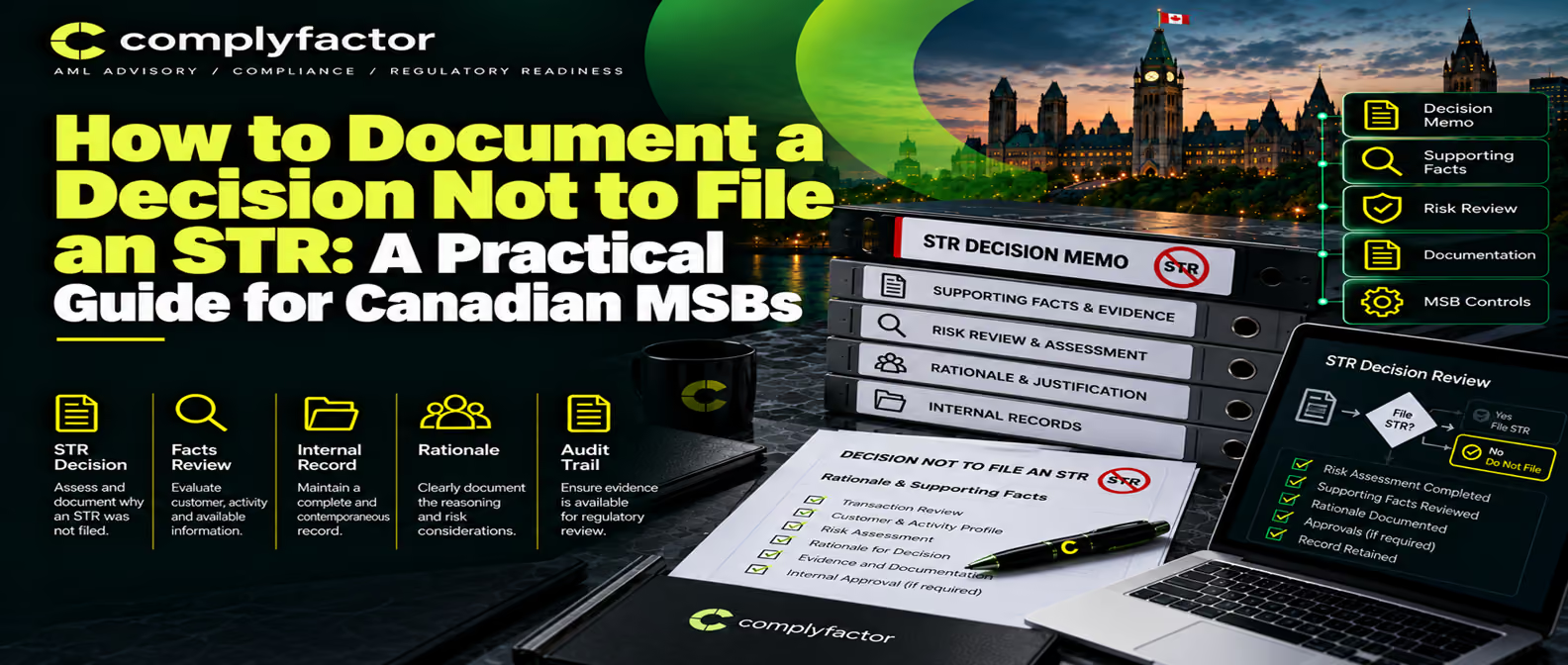



Key takeaways
- A defensible no-file decision must record what triggered the review, what activity was examined, which red flags were considered, and why the available facts did not meet the reporting threshold.
- A generic note such as "activity appears normal" is inadequate and creates regulatory risk during FINTRAC examinations and independent effectiveness reviews.
- Supporting evidence and reviewer reasoning must be retained to demonstrate a genuine assessment took place, rather than an attempt to justify a predetermined decision.
- A no-file decision remains open to reconsideration when new information appears — it is not a permanent free pass for a customer.
- Software-generated risk scores can assist, but they cannot replace compliance judgement in applying the reasonable grounds to suspect test.
Introduction
For Canadian Money Services Businesses (MSBs), deciding not to file a Suspicious Transaction Report (STR) requires immense discipline. When an alert triggers, the compliance team must conduct a review. If the conclusion is that an STR is not warranted, that decision cannot be a silent dismissal. It must be a documented, defensible conclusion based on available facts and the reasonable grounds to suspect standard.
A generic note such as "activity appears normal" is inadequate. Without comprehensive documentation, an MSB exposes itself to regulatory risk. Weak no-file documentation creates problems during FINTRAC examinations, independent effectiveness reviews, and internal quality assurance. It complicates staff handovers, undermines future investigations, and leaves the MSB vulnerable to law-enforcement requests targeting the same customer.
Supporting evidence and reviewer reasoning must be retained to demonstrate a genuine assessment took place, rather than an attempt to justify a predetermined decision not to report. Furthermore, a no-file decision should remain open to reconsideration when new information appears. While software-generated risk scores can assist, they cannot replace compliance judgement. This guide provides a practical framework for documenting decisions not to file an STR.
Quick Answer
A defensible no-file decision should record:
- What triggered the review.
- What activity was examined.
- Which red flags were considered.
- What customer and transaction context was checked.
- Which evidence supported the analysis.
- Why the available facts did or did not meet the reporting threshold.
- Who reviewed and approved the decision.
- What monitoring or follow-up action remains necessary.
What Does a Decision Not to File an STR Mean?
A decision not to file means that a transaction or activity was reviewed, and the reporting entity assessed whether reasonable grounds to suspect existed. The conclusion indicates that the available information did not support filing at that time.
This decision is an internal compliance record, not a report submitted to FINTRAC. Crucially, a no-file decision is not proof that the activity was legitimate, nor does it suggest that the customer has been cleared permanently. Closing an alert does not erase the underlying transaction history. The decision reflects the facts known at that exact moment and must explicitly acknowledge that the assessment may need to be revisited.
Alert Closure vs Decision Not to File an STR
It is vital to distinguish between operational alert handling and formal STR decision-making.
Understanding the Reasonable Grounds to Suspect Threshold
Based on FINTRAC guidance on reasonable grounds to suspect, reasonable grounds to suspect is determined by assessing facts, context, and money laundering indicators. Proof of a criminal offence is not required, nor is absolute certainty. A reporting entity must assess the totality of available information. While one unusual transaction may not always be sufficient, several lower-risk indicators may become significant when considered together. An internal monetary threshold must never replace the legal reporting test. The absence of one specific red flag is not enough to close a case; analysis must be holistic.
What Should Trigger a Documented No-File Review?
An alert is a trigger for review, not automatic proof of suspicion. Triggers include:
- Transaction-monitoring alerts detecting rapid funds movement.
- Unusual transaction patterns indicating potential structuring.
- Activity inconsistent with the documented customer profile.
- Transactions involving high-risk jurisdictions.
- Complex third-party transactions.
- Unexplained changes in transaction volume.
- Virtual-currency activity connecting to mixers.
- Agent or branch escalations.
- Law-enforcement inquiries or adverse media.
- Employee concerns.
- Repeated identity anomalies.
- Previous closed alerts involving the same customer.
Information to Review Before Closing the Case
The depth of review should be proportionate to the facts and risk. Key information includes:
- Customer identification and occupation.
- Expected account or transaction activity.
- Source of funds and purpose of transactions.
- Transaction history and counterparties.
- Geographic exposure and payment methods.
- Related accounts and third-party involvement.
- Beneficial ownership.
- Previous alerts and prior STRs.
- Customer explanations and supporting documents.
- Publicly available information.
- Agent observations and blockchain data.
- Internal risk rating.
How to Analyse Red Flags and Alternative Explanations
When analysing FINTRAC money laundering and terrorist-financing indicators, the reviewer must identify each relevant red flag and record why it applies. Compare the activity with the customer profile to identify inconsistencies. If a customer provides an alternative explanation, test that explanation against objective evidence. Avoid accepting explanations without verification. Conversely, avoid rejecting explanations solely because activity appears unconventional if evidence supports the claim. Consider whether several indicators are connected and if the explanation resolves all material concerns. Record unresolved issues separately.
Required Elements of a No-File Decision Record
A defensible no-file record must contain critical analysis. The structure should include:
- Case or alert reference number.
- Date opened and date decision made.
- Name and role of investigator and approver.
- Customer or entity information.
- Transactions reviewed.
- Alert or escalation reason.
- Relevant red flags.
- Customer profile and expected activity.
- Information and documents reviewed.
- Customer explanation and independent verification performed.
- Analysis of each material concern.
- Facts supporting the decision and unresolved concerns.
- Reasonable-grounds-to-suspect assessment and final decision.
- Approval or escalation record.
- Follow-up monitoring required.
- Date for reassessment.
- Links to supporting evidence.
Suggested No-File Decision Template
Each business should adapt this template to its risk profile and internal governance. It is an internal operational tool, not an official FINTRAC form.
Case Reference: [ID] | Date: [YYYY-MM-DD]
Review Trigger: [e.g., Velocity Alert / Agent Escalation]
Customer/Entity: [Name, ID, Risk Rating]
Transactions Reviewed: [Timeframe, Total Value, Volume]
Relevant Indicators: [List FINTRAC Red Flags]
Context Considered: [KYC profile vs actual activity]
Customer Explanation & Verification: [Summary of outreach and objective proof]
Analysis: [How the facts address the red flags]
Reasonable Grounds to Suspect Conclusion: [Why the threshold is NOT met]
Decision: Do Not File STR. Proceed with [Standard/Enhanced] Monitoring.
Follow-Up Action: [e.g., Review again in 90 days]
Investigator: [Name] | Approver: [Name]
How to Write the Decision Rationale
The rationale must state the issue reviewed, identify material facts, address red flags directly, and explain what evidence was checked. It must clarify which concerns were resolved, identify remaining concerns, and connect the analysis directly to the reporting threshold. Avoid vague language or copying the customer's explanation without adding critical analysis.
Weak example: "Customer explained the transactions were for renovation. Provided a receipt. No STR required." This is inadequate because it fails to list the transactions, specify the red flags, detail the verification, or address the legal threshold.
Stronger example: "Alert triggered for 5 outgoing EFTs totaling $45,000, deviating from expected volume ($5,000/month). Red flags considered: rapid movement of funds and inconsistent profile activity. Customer stated funds were for overseas property. Verified by reviewing notarized purchase agreement and bank statement showing legitimate source of funds (inheritance). Counterparty matches legal vendor. While volume was unusual, objective evidence resolves material concerns. Activity does not meet reasonable grounds to suspect threshold for money laundering. Case closed; profile updated. Standard monitoring resumes."
Practical No-File Decision Examples
Example 1: Remittance activity higher than expected
A retail customer doubles their monthly remittance. The investigator checks updated employment records showing a promotion matching the increased volume. The evidence resolves the velocity concern.
Example 2: Business customer with a sudden volume increase
A corporate client's inbound wire volume triples. The MSB reviews newly signed contracts, verified invoices, and confirms counterparties are legitimate. The documented economic purpose justifies the no-file decision.
Example 3: Multiple transactions below a reporting threshold
A client sends three $3,000 wires in one week, triggering a structuring alert. The MSB finds the wires paid three distinct, verified university tuition installments. A monetary threshold does not determine STR filing; the verifiable context dispels structuring suspicion.
Example 4: Third-party transaction
A client transfers funds for a relative. Through proper FINTRAC third-party determination, the MSB verifies the relative's identity, the source of funds, and the legitimate reason for the arrangement.
Example 5: Repeated alerts previously closed
A customer triggers structuring alerts for the third time in six months. The cumulative, repeated nature requires reconsideration. A no-file decision becomes harder to justify as historical patterns compound.
Example 6: Customer explanation that cannot be independently verified
A customer claims sudden large deposits are from freelance consulting but provides no invoices. An unverified explanation leaves material concerns unresolved. A no-file decision is highly inappropriate here.
Who Should Approve a No-File Decision?
Approval levels should align with the MSB's documented AML compliance program. Approval depends on the risk level, transaction value, customer risk rating, and the presence of high-risk jurisdictions. Typical roles include the Investigator, a Compliance Analyst, a Senior Compliance Reviewer, and the MLRO or Compliance Officer. Legal counsel may be involved in sensitive matters. Clearly distinguishing between a legal requirement and recommended governance, a tiered structure ensures high-risk decisions are heavily scrutinized.
When Should a Closed Case Be Reopened?
A previous no-file decision does not prevent a later STR filing. Cases must be reopened if triggers such as new transactions, new red flags, repeated similar alerts, new customer information, adverse media, or law-enforcement contact emerge. Regulatory information, failed verification, changes in beneficial ownership, new linked accounts, or quality-assurance findings dictate reassessment. The later review must synthesize both the newly discovered facts and historical information.
Ongoing Monitoring After a No-File Decision
Follow-up measures must be proportionate to the remaining risk. According to FINTRAC ongoing monitoring guidance, the MSB may continue standard monitoring, or apply enhanced monitoring if residual risk warrants it. Actions include updating customer information, requesting updated source-of-funds evidence after a defined period, reviewing transaction limits, or communicating with agents. If activity remains marginally unusual, management may consider restricting certain services or a relationship review. Not every no-file decision requires enhanced monitoring.
Common Documentation Weaknesses
Writing "No suspicion identified" without supporting analysis provides zero regulatory defense. Copying the customer's explanation verbatim without testing it demonstrates a lack of critical thinking. A record lacking a list of reviewed transactions, supporting evidence, or discussion of red flags is incomplete. Other failures include neglecting to compare activity with the customer profile, failing to explain why the legal threshold was not met, and omitting reviewer or approval records. Closing repeated alerts in isolation without looking at the cumulative pattern is a severe flaw. Using only a system-generated risk score without human narrative, failing to record follow-up actions, missing links to supporting documents, or changing the rationale after an examination begins will result in audit deficiencies. Treating a previous no-file decision as a permanent free pass must be corrected.
Quality Assurance and Independent Testing
An MSB should test no-file decisions through routine quality assurance. This involves sample reviews, risk-based selection of closed cases, reviewing high-risk customers, and comparing decisions across different analysts to identify inconsistent standards. Tracking overturned decisions helps tailor training. Internal quality assurance is a continuous operational check, whereas an independent AML effectiveness review is a formal, statutory assessment of the entire program's viability.
How Case-Management Software Can Support the Process
Integrated FINTRAC reporting software assists with alert assignment, maintaining case chronologies, attaching evidence, and enforcing approval workflows. It provides structured decision templates, related-case searches, follow-up reminders, and unalterable audit trails. However, its limitations must be understood. Software suffers from poorly configured rules, incomplete customer data, and overreliance on risk scores. Formulaic decision language generated by dropdown menus cannot replace bespoke narrative analysis. Software may support documentation, but it cannot make the legal reporting decision for the reporting entity.
Decision Not to File vs STR Narrative
There is a strict functional difference between an internal no-file rationale and an STR narrative submitted to the regulator. A no-file rationale explains why the available information did not meet the reporting threshold at that time. An STR narrative explains the suspicious activity and the specific grounds for suspicion. A no-file record should not be written as a draft STR. For cases where the decision is to report, refer to our comprehensive STR reporting guide.
Final No-File Documentation Checklist
Ensure every closed case meets these standards:
- ☐ Trigger recorded.
- ☐ Transactions identified.
- ☐ Relevant parties identified.
- ☐ Customer profile reviewed.
- ☐ Red flags documented.
- ☐ Historical activity reviewed.
- ☐ Customer explanation assessed.
- ☐ Supporting evidence retained.
- ☐ Independent verification completed.
- ☐ Unresolved concerns identified.
- ☐ Reasonable-grounds-to-suspect test applied.
- ☐ Decision rationale written.
- ☐ Reviewer and approver recorded.
- ☐ Follow-up action assigned.
- ☐ Reassessment trigger identified.
- ☐ Supporting records linked.
- ☐ STR decision made within the required timeframe where applicable.
Related Resources
FINTRAC & Compliance Resources
- FINTRAC Official Homepage
- STR Reporting Requirements & Guidance
- MSB Compliance & Examination Guidance
- Effectiveness Review Requirements
Frequently asked questions
Is an MSB required to document every decision not to file an STR?
Yes, if a transaction was flagged for review, the MSB must document why it concluded that the activity did not meet the reasonable grounds to suspect threshold.
What should a no-file STR rationale include?
It must include the facts reviewed, the red flags considered, the customer's explanation, independent verification evidence, and a clear conclusion explaining why suspicion was not established.
Is closing an alert the same as deciding not to file an STR?
No. Alert closure often deals with false positives. A formal decision not to file occurs after an investigation into genuinely unusual activity determines an STR is unwarranted.
Can a customer's explanation justify a no-file decision?
Only if it makes sense within their profile and is supported by objective verification. An unverified explanation is rarely sufficient to dismiss material red flags.
Who should approve a decision not to file an STR?
Approval levels depend on internal policies and the risk of the transaction. Complex or high-risk cases should typically be approved by the Compliance Officer or MLRO.
Can a closed case be reopened later?
Absolutely. If new transactions occur, or law enforcement inquiries arise, the MSB must reopen the case and assess the new facts alongside the historical activity.
How long should no-file decision records be retained?
Under FINTRAC recordkeeping guidance, records related to investigations and compliance decisions must generally be kept for at least five years, securely accessible for regulatory examinations.
Can compliance software decide whether an STR should be filed?
No. Software can assign risk scores, gather data, and flag anomalies, but the legal determination of reasonable grounds to suspect must be made by a human compliance professional.
ComplyFactor specializes in FINTRAC MSB and PSP registration, independent AML effectiveness reviews, and compliance program design for Canadian and foreign money services businesses, payment service providers, fintechs, and virtual asset service providers.
.svg)
.svg)
Related insights
Book a free Canada AML consultation
Tell us about your business and we'll confirm which services you need — free, no obligation, 30 minutes.