Swiss Advisers Under the Revised AMLA: How to Apply to an SRO Before 1 December 2026
Advisers active on 1 October 2026 must apply to a self-regulatory organisation by 1 December 2026. See who is covered, the professional thresholds, what you may do while the application is pending, and how to prepare it.



Key Takeaways
- Coverage depends on the activity, a professional level and the exemptions, not on the profession. Lawyers, accountants and brokers are not automatically in scope.
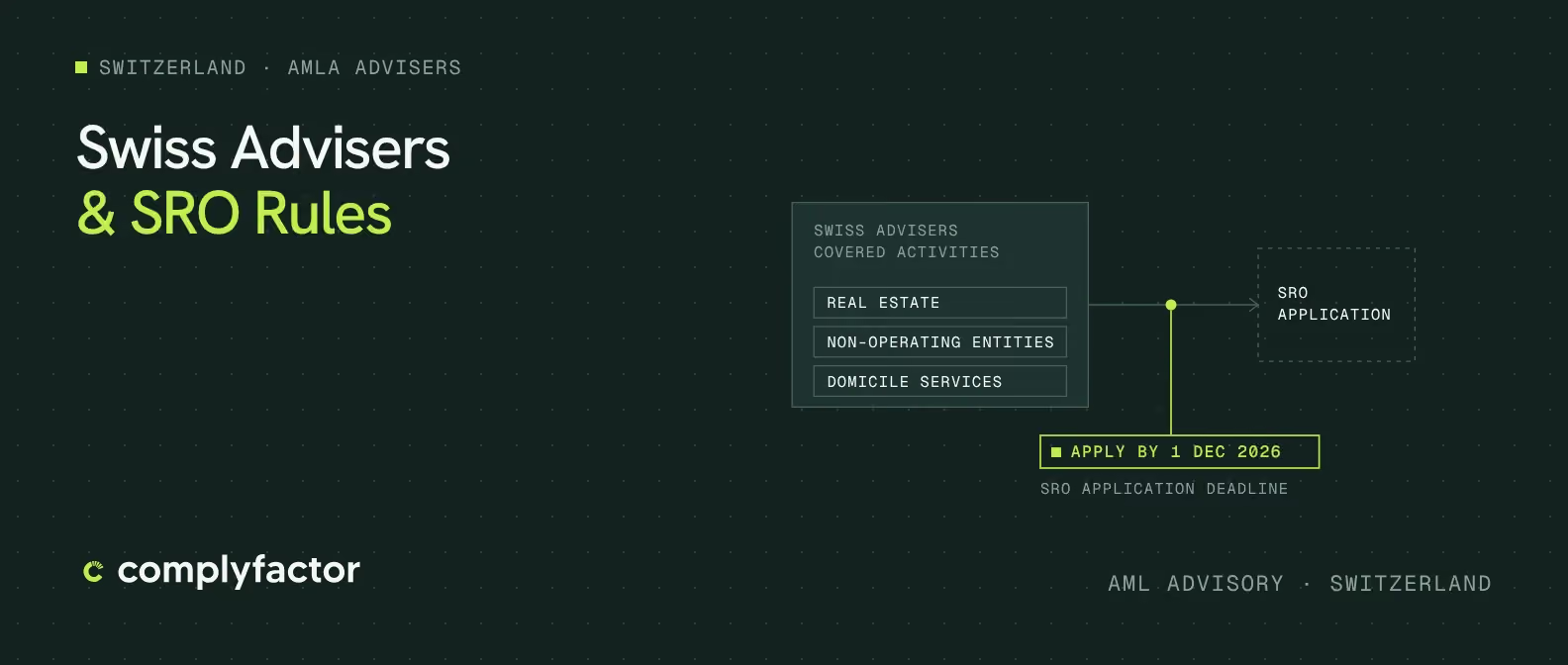
- An adviser already active on 1 October 2026 must file an SRO application by 1 December 2026 and, until the decision, may continue only within existing business relationships.
- Due diligence duties apply from 1 October 2026, before admission. Do not rely on any approval timeline or fee quoted outside the SRO's own documents.
Since 1 October 2026, certain advisers in Switzerland are subject to the Anti-Money Laundering Act (AMLA, German: GwG). An adviser who was already carrying out a covered activity on that date must file an application with a self-regulatory organisation (SRO) by 1 December 2026. Until the SRO decides, the adviser may continue only within existing business relationships. Not every adviser is covered: the activity, the professional threshold and the exemptions decide.
This guide explains how to check whether you are in scope, what the deadline means for you, and how to prepare an SRO application. It covers the adviser regime only. The separate revision of the FINMA Anti-Money Laundering Ordinance, which applies to supervised institutions from 1 January 2027, is covered in our article on the AMLO-FINMA revision.
Which advisers does the revised AMLA cover?
The law does not cover a profession. It covers activities. Under Art. 2 para. 3bis AMLA, an adviser is a natural or legal person who, professionally and for third parties, participates in financial transactions, including fundraising, relating to:
- buying or selling real estate;
- founding or setting up non-operating legal entities in Switzerland, or legal entities seated abroad;
- managing or administering non-operating legal entities;
- contributions to and distributions from non-operating legal entities;
- buying or selling legal entities where a non-operating entity is the buyer or seller.
Art. 2 para. 3ter adds a separate category: professionally providing an address or rooms as the domicile or seat of legal entities for more than six months.
Participation means a concrete contribution to the transaction. Abstract legal advice with no concrete transaction is not enough, and for real estate the duties start once both parties have declared their intention to conclude the contract (Art. 12d and 12e of the Anti-Money Laundering Ordinance, GwV).
Eligibility decision table
Exemptions that matter in practice
Art. 2 para. 4ter exempts, among others, transactions arising from family, marital, inheritance or gift situations or between closely connected persons; real estate or legal entities below CHF 5 million where the price flows exclusively through supervised financial intermediaries; owner-occupied residential property; agricultural holdings transferred to self-farming persons; and foundations established by testamentary disposition. The SRO FAQ notes that clients covered by an exemption do not need a GwG file. Document the basis for any exemption you rely on.
What counts as "professional"?
Art. 12f GwV treats advisory activity as professional if it is an independent economic activity aimed at lasting gain, whether as a main or a side activity. It is always treated as professional if any one of these is met in a calendar year:
- gross revenue above CHF 50,000;
- more than 20 clients or legal transactions;
- third-party assets above CHF 5 million at any time;
- transactions above CHF 2 million.
The SROs' joint FAQ, prepared with the State Secretariat for International Finance (SIF), assesses these thresholds per person rather than per file. It is a non-binding interpretive aid and FINMA has not endorsed it.
Deadlines and transitional rules
The transitional provision sets 1 December 2026 as the legal deadline. Applying a few days earlier is a practical precaution, not a legal requirement.
What you may do while the application is pending
The text of the transitional provision says an existing adviser may continue its activity until the decision "only within existing business relationships". Sources then diverge on new work:
- The SROs' joint FAQ says existing clients may be advised and may place new orders, and new clients may be accepted for services that are exempt under Art. 2 para. 4ter.
- VQF states that advisers subject to affiliation may not enter into new adviser-related business relationships until affiliation is confirmed.
- TREUHAND|SUISSE channels, as reported by SwissAccounting, say no new mandates subject to the advisory duties should be accepted until confirmation arrives.
The cautious position is to take no new client for a covered service before admission, and to ask your SRO in writing if you need to rely on a broader reading. If the deadline is missed or admission is refused, the ordinance says the person may not continue as an adviser.
What applies immediately and what depends on admission
Due diligence applies from 1 October 2026 whether or not your application has been decided. Under Art. 8b AMLA an adviser must identify the client, identify the beneficial owner, document the file, clarify the purpose of the requested business or service, and investigate background and purpose where risks are higher. Art. 8d requires organisational measures, including staff training and controls, and covers measures against breaches of Embargo Act sanctions. Advisers must report suspicions to the Money Laundering Reporting Office without delay (Art. 9 para. 1ter), with a narrower duty for lawyers and notaries, who report only when they carry out a financial transaction and the information is not covered by professional secrecy (Art. 9 para. 2).
SRO supervision, SRO audits, the SRO's own forms and its fees follow from admission. An AML gap analysis shows whether your current controls meet the duties that already apply.
Existing advisory business versus a new one
If you already carried out a covered activity on 1 October 2026 and cross the professional threshold, the 1 December 2026 date applies. If you cross the threshold later, the two-month period runs from the switch. In both cases, track the thresholds by calendar year and record the date on which they were met.
How to apply to an SRO
FINMA publishes the list of recognised SROs. Advisers are supervised by the SRO they join, not by FINMA. Eligibility differs by SRO:
- VQF accepts advisers and publishes guides for natural persons (doc. 801.2) and companies (doc. 801.3).
- PolyReg accepts advisers under Art. 2 paras 3bis and 3ter and publishes an onboarding guide and FAQ. Its FAQ gives a typical decision time of four to twelve weeks after a complete application, with no expedited route. This is PolyReg's own statement and not a promise of any outcome elsewhere.
- SRO TREUHAND|SUISSE takes advisers who belong to TREUHAND|SUISSE or a related industry association; check its current admission rules.
- SRO SAV/SNV is open only to Swiss lawyers and notaries (and their staff), including for their adviser activity under Art. 2 para. 3bis. It is not an option for other advisers.
Fees and forms change. Each SRO publishes its own fee schedule, so check the current one before filing. Our SRO affiliation support covers preparing the application pack.
Application document checklist
Exact lists differ. Based on the SRO guides we reviewed, prepare:
- the completed SRO application form for a natural person or a company;
- a current commercial register extract, or an explanation if the business is not registered;
- identification of owners and controlling persons;
- criminal record extracts and ID copies for persons holding the GwG functions, with CV and qualifications where requested;
- internal directives or a description of your AML framework;
- the names of the persons holding the required GwG roles and evidence of training;
- payment of the application or processing fee, because some SROs do not start review until it is paid.
Do not rely on any timeline for approval. Admission is a decision of the SRO and may require several exchanges.
Notes for lawyers, notaries, accountants, fiduciaries and corporate-service providers
- Lawyers and notaries: proceedings-related work is excluded. Transactional work, such as structuring a non-operating company or accompanying a land sale, can fall in scope. Check each mandate separately.
- Public-law notaries: the cantons supervise them, and the provision on them enters into force later.
- Accountants and fiduciaries: audit work by licensed auditors is excluded, but company formation, administration of non-operating entities and domicile services are not.
- Corporate-service providers: the six-month domicile rule and management of non-operating entities are the main triggers. The Swiss Transparency Register guide covers the parallel filing duties that also started on 1 October 2026.
Common compliance mistakes
- Treating the profession as the test instead of the activity and the threshold.
- Assuming the 1 December date also lets you take new clients freely.
- Counting thresholds per file instead of per person and calendar year.
- Relying on an exemption without documenting why it applies.
- Applying on 1 December and discovering the application is incomplete.
- Overlooking that due diligence applies from 1 October even though admission comes later.
- Confusing this regime with the AMLO-FINMA revision, which applies to supervised institutions.
How ComplyFactor can help
We are not FINMA, an SRO or a Swiss law firm, and we cannot guarantee admission. We can help you assess your perimeter, prepare the framework and prepare the application pack for the SRO you choose. See our AML regulatory advisory for scope questions and fractional AML officer support for ongoing capacity.
Frequently asked questions
Do I have to join an SRO if my advisory income is small?
Only if your activity is covered and professional. A small income does not exempt you by itself: meeting any one Art. 12f threshold makes the activity professional in every case, and below the thresholds the general definition still applies, so assess it against your facts. The thresholds are counted per calendar year.
I am already affiliated with an SRO as a financial intermediary. Do I apply again?
The ordinance requires you to notify your supervisor or SRO of the advisory activity by 1 December 2026. Confirm the form with your SRO.
Can I choose any SRO?
Not always. Some SROs limit membership to certain associations or professions, so check eligibility before you apply.
What happens if I miss the deadline?
The ordinance provides that the person may not continue as an adviser if the deadline is missed or admission is refused.
Does the CHF 5 million exemption apply to any large transaction?
No. It applies only below CHF 5 million and only where the price is paid and received exclusively through supervised financial intermediaries.
Is there an official English text?
The federal texts are authentic in German, French and Italian. English summaries, including this one, are not legal advice.
Sources
- GwG amendment of 26 September 2025 (AS 2026 322), Federal Chancellery publication.
- Anti-Money Laundering Ordinance as at 1 October 2026 (AS 2026 364).
- Federal Council press release, 12 June 2026.
- FINMA: notes on the AMLA and AMLO revision.
- FINMA: self-regulatory organisations.
- SRO FAQ on advisory activity (SROs with the SIF).
- VQF: information for advisers.
- PolyReg FAQ.
This article is general information, not legal advice. Confirm the current text on Fedlex and your SRO's requirements before acting.
ComplyFactor is a Canadian AML and regulatory compliance advisory firm serving MSBs, PSPs, fintechs and other regulated businesses.


Related insights
Book a free compliance consultation?
Tell us about your business and we'll confirm which services you need. Free, no obligation, 30 minutes.