FinCEN Form 107 Renewal: Common MSB Re-Registration and Filing Errors to Avoid
How FinCEN MSB registration renewal, re-registration and correction differ, how the two-calendar-year cycle sets your deadline, and what to check so the registration data on file stays accurate.



Key Takeaways
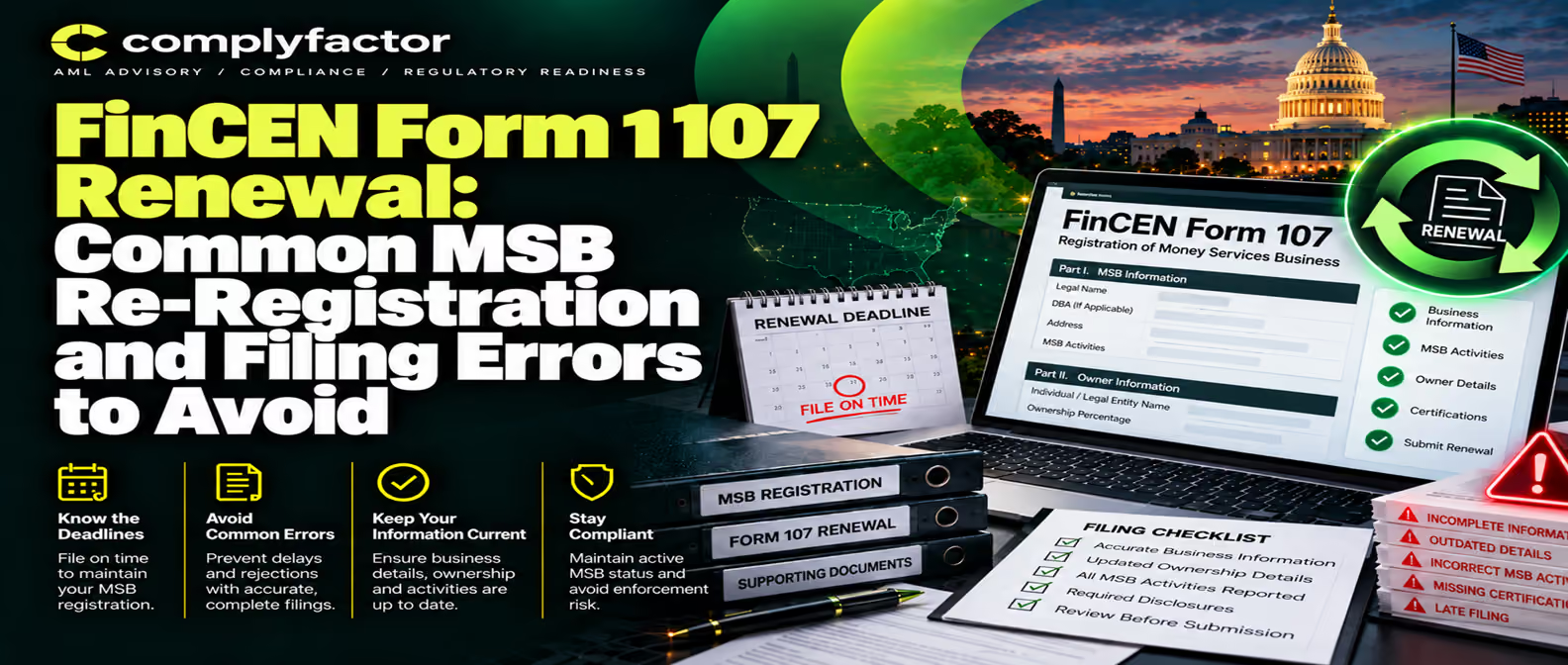
- Renewal is a new RMSB filing, not a separate application. FinCEN Form 107 (the Registration of Money Services Business, or RMSB) is filed through BSA E-Filing. For a renewal the filer checks the renewal box and enters the previous registration number (BSA ID).
- Renewal is not simply “two years from the filing date.” Under 31 CFR § 1022.380(b), registration runs in two-calendar-year periods, and the form for each renewal period is due on or before the last day of the calendar year before that period begins.
- Re-registration follows defined events only: a change in ownership or control that requires re-registration under state law, a transfer of more than 10 percent of voting power or equity interests (with an exception for MSBs that report such transfers to the SEC), or a more than 50 percent increase in agents. The form is due within 180 days, and the calendar year of the event begins a new two-year period.
- A correction is different from both. Fixing information on a previously filed registration is a correction filing, not a statutory re-registration event, and the whole form must be completed again.
- The agent count on Form 107 and the agent list are two tasks. The form reports a number. The list is a separate record that is revised each January 1, kept at a U.S. location and not filed with the form.
- FinCEN’s public listing reflects what the registrant submitted. FinCEN states that it does not verify the information and that inclusion is not a recommendation, certification of legitimacy or government endorsement. It generally appears about two weeks after electronic filing.
- Federal registration does not renew or replace state licenses. Each is a separate requirement with its own filing system and cycle.
A business may know that FinCEN registration runs on a two-year cycle and still get the next filing wrong, because renewal, re-registration and correction follow different rules. A renewal that is calculated from the wrong anniversary, a re-registration trigger that passes unnoticed, or an old owner still listed on the registration can each leave the public record out of line with the business.
This guide explains how the filing cycle works, how to tell which action applies, what to review before submitting, and what records to keep. It does not address whether a business is an MSB or how state licensing works. For those, see our article on FinCEN registration and state money transmitter licensing.
Terminology. FinCEN uses several names for one filing. Form 107 is the Registration of Money Services Business, abbreviated RMSB. FinCEN no longer accepts paper RMSB forms, and the report is filed through the BSA E-Filing System. The initial registration, renewal, correction and re-registration are options on that same report, so there is no separate “renewal form.” This article says “FinCEN MSB registration” and “registration renewal,” because it is a registration and not a license.
How FinCEN Form 107 renewal works
The legal basis is 31 CFR § 1022.380, issued under 31 U.S.C. 5330. FinCEN’s forms page sets out the practical steps: have a BSA E-Filing account, submit an RMSB, and for a renewal check item 1b on the form and provide the previous registration number or BSA ID. FinCEN notes that the previous number can be viewed on its MSB Registrant Search page.
In FinCEN’s electronic filing instructions, Part I, item 1 selects the type of filing: initial registration, renewal, correction (checked together with the type being corrected) or re-registration. A renewal must be submitted on a new RMSB. Photocopies of earlier forms are not accepted. Only one registration form is required for each registration period, and the owner or controlling person (for a corporation, the largest single shareholder, or a duly authorized officer) signs with the E-Filing PIN.
Filing is not approval. After submission, BSA E-Filing displays a tracking ID, which is not the registration number. FinCEN’s instructions say the filer should receive an acknowledgment message in the Secure Messaging inbox within approximately two business days, containing the registration number (BSA ID). FinCEN does not send acknowledgment letters.
FinCEN’s description of the public MSB listing is specific. The information on it is provided by the registrant and FinCEN does not verify it. Inclusion is not a recommendation, a certification of legitimacy or an endorsement by any government agency. For that reason, a listing should not be described as approval, licensing, vetting or certification, whether in marketing, bank questionnaires or investor materials.
When is your FinCEN MSB renewal due?
Section 1022.380(b) sets the structure:
- The initial registration period is the two-calendar-year period beginning with the calendar year in which the MSB is first required to be registered.
- Each two-calendar-year period after that is a renewal period.
- The form for the initial period is due by the end of the 180-day period beginning on the day after the business is established.
- The form for a renewal period is due on or before the last day of the calendar year preceding the renewal period.
That is why the due date is fixed to December 31 and not to the anniversary of the last filing. A business that files its initial registration in September will have its first renewal due about fifteen months later, not twenty-four. The examples below are derived from the rule text. The first row is FinCEN’s own published example, and the others are hypothetical.
Two cautions. First, a business established late in a year that files early the next year should confirm which calendar year anchors its initial period before relying on a date, because the rule starts the period in the year the MSB is “first required to be registered.” Second, where a re-registration window overlaps a scheduled renewal date, confirm the filing treatment before submitting.
Renewal, re-registration or correction?
These are not interchangeable. Each starts from a different cause and is selected differently on the RMSB.
The table below shows how common situations map to those actions. Where the rule or instructions do not classify a situation, the answer is “confirm the filing treatment before submitting.”
What to review before submitting
The review should follow the current RMSB. These areas come from FinCEN’s electronic filing instructions, and your live form on BSA E-Filing controls if labels differ.
Note that the annual estimate of business volume is not a field on the RMSB. FinCEN’s instructions treat it as supporting documentation that the registrant keeps at its U.S. location, and the signer certifies that it is maintained.
Practical filing errors to check before submission
FinCEN has not published a ranked list of renewal or registration errors, and this article does not present one. These are practical checks derived from the rule text and filing instructions.
Ownership changes and the 10% trigger
Section 1022.380(b)(4) contains two ownership-related triggers, and they are different.
- State-law re-registration. If an MSB registered under the laws of any state experiences a change in ownership or control that requires re-registration under state law, it must also be re-registered under the federal rule.
- Transfer of voting power or equity. If there is a transfer of more than 10 percent of the voting power or equity interests of the MSB, it must be re-registered, other than an MSB that must report such a transfer to the Securities and Exchange Commission.
The form must be filed not later than 180 days after the change or transfer, and the calendar year in which it occurs is treated as the first year of a new two-year period. A renewal filed on the normal schedule does not substitute for a re-registration that fell due earlier.
Three limits are worth stating. Not every ownership change is a trigger, and the rule does not say how a series of smaller transfers is measured, so confirm the treatment where transfers approach the threshold. This federal rule is separate from beneficial ownership reporting under the Corporate Transparency Act, which is not discussed here. And state change-of-control requirements are separate analyses. See our state licensing guide for that boundary.
Agent growth and the 50% trigger
A more than 50 percent increase in the number of agents during any registration period requires re-registration. Neither the regulation text nor FinCEN’s registration guidance that we reviewed states a baseline date for measuring the increase, so the measurement method should be chosen deliberately and documented.
Practical approach: Compare the current agent count to the number reported on the most recent filed registration. As arithmetic only, if that baseline were 40 agents, a count of 60 is a 50 percent increase and does not satisfy “more than 50,” while 61 does. Agent and branch are different terms under FinCEN’s instructions: an agent is a separate business entity authorized to sell the MSB’s services, and a branch is an owned location. Our article on authorized delegate oversight covers the agent controls themselves.
Agent list vs the Form 107 agent count
These are related but separate compliance tasks.
For each agent the list must include the agent’s name (including trade names), address, telephone number, services provided, the months in the prior 12 in which the agent’s gross transaction amount for the MSB’s products exceeded $100,000, the depository institution where the agent holds a transaction account for those funds, the year the agent began, and the number of branches or subagents. Agent volume information must be current within 45 days of the list due date.
Supporting documentation and record retention
FinCEN’s registration guidance says supporting documentation must be retained at a location in the United States for five years. That location is reported in Part II or Part VI of the form. The information includes:
- a copy of the filed registration form and any registration number assigned;
- the estimate of business volume for the coming year;
- information about ownership or control (FinCEN’s instructions describe, for example, shareholders holding more than 5 percent of stock, general partners, trustees, and directors or officers); and
- the agent list.
For a foreign-located MSB, the U.S. agent for service of process holds the records. FinCEN strongly recommends saving the original submission and the acknowledgment. Nothing in the rule requires a particular “renewal binder.” A consistent evidence set that ties each filing to its supporting records is enough.
Registration status and data accuracy are also among the items an independent review may test. See our independent BSA/AML audit checklist.
What happens if an MSB misses the renewal deadline?
FinCEN states that once a year it deletes from the MSB Registrant Search any entity that did not renew by its renewal deadline. It also states that an entity that has been deleted for non-renewal but continues to engage in activity requiring registration should renew immediately.
The legal requirement is stronger than the listing. Section 1022.380(b)(2) requires an MSB to be registered for the initial period and each renewal period, and the regulation states that it is unlawful to do business without complying with 31 U.S.C. 5330 and the section. A failure to comply includes filing false or materially incomplete information. Civil penalties can apply under 31 U.S.C. 5330(e), with the applicable maximum adjusted for inflation under 31 CFR 1010.821, and the regulation states that each day a violation continues constitutes a separate violation. A criminal penalty is also provided under 18 U.S.C. 1960.
This does not mean every late filing leads to enforcement, and FinCEN’s materials do not describe a fixed consequence. A practical response is to file promptly, confirm what the public record now shows, review whether any state or banking relationship depends on registered status, and obtain legal advice where there is a gap in coverage.
How long does the renewal take to appear?
FinCEN currently states that electronically filed RMSBs are generally added to the MSB Registrant Search approximately two weeks after filing, and that the page is updated weekly. The search page shows two dates: the authorized signature date and the received date, which is when FinCEN received the form through BSA E-Filing.
That timing is FinCEN’s description and not a guarantee. The submission date, the acknowledgment message and the public listing are three different events. Plan renewals so a filing made close to December 31 is not the only evidence of timeliness: keep the tracking ID, the acknowledgment and a dated print of the search result.
Does renewal update state money transmitter licenses?
No. FinCEN registration and state licensing are separate. FinCEN’s filing instructions state that the registration does not satisfy any state or local licensing or registration requirements.
See our article on FinCEN registration vs. state licensing for the full comparison, and our money transmitter licensing service for state work.
Illustrative scenarios
These hypothetical situations show how the analysis works. They are not legal conclusions, and each business should confirm the treatment against its own facts.
Renewal readiness checklist
This is ComplyFactor’s readiness checklist for preparing a filing. It is not an official FinCEN checklist, and completing it does not mean the registration is accurate or accepted.
☐ Current registration number (BSA ID) and last filed RMSB located
☐ Registration period identified and December 31 due date calendared
☐ Filing type chosen: renewal, re-registration or correction
☐ Equity and control changes since the last filing logged, with percentages and dates
☐ Agent count compared to the last filed number, with the method documented
☐ Agent list current as of the most recent January 1 revision
☐ Entity name, DBA, address, contacts and compliance contact reviewed
☐ Owner or controlling person information in Part III confirmed
☐ MSB activities, states, branches and prepaid program information reviewed
☐ Primary transaction account information reviewed
☐ U.S. location of supporting documents confirmed
☐ Estimate of business volume and ownership records on file at that location
☐ State license status and dates reviewed separately
☐ Signer identified and able to certify the information
☐ Tracking ID, acknowledgment and search result saved after filing
How ComplyFactor supports FinCEN MSB registration maintenance
ComplyFactor’s FinCEN MSB registration services cover the filing types in this article. That includes confirming whether registration applies, gathering the ownership, control and agent information a filing requires, preparing the RMSB, reviewing it for completeness before submission, supporting electronic submission through BSA E-Filing, and supporting renewals, corrections and re-registrations with deadline tracking.
The filing review is one part of a wider picture. The BSA/AML program that follows MSB status is separate work, covered in our BSA/AML compliance program services, and state licensing is scoped separately. Our U.S. AML consulting hub shows how these fit together. ComplyFactor cannot guarantee how FinCEN will treat a filing or how long it will take to appear publicly, because those are FinCEN’s processes.
Frequently asked questions
Who has to sign the renewal?
Any person who owns or controls the MSB is responsible for registering it, but only one form is required for each registration period. If several persons own or control the MSB, they may agree that one of them registers it, though a failure by the designated person does not relieve the others of liability. The designated owner or controlling person (or, for a corporation, a duly authorized officer) signs with the BSA E-Filing PIN. For a foreign-located MSB, the U.S. agent for service of process signs.
Does filing a correction change the renewal cycle?
The reset rule in § 1022.380(b)(4) is written for re-registration: the calendar year of the triggering event is treated as the first year of a new two-year period. Neither the regulation nor FinCEN’s filing instructions describe a correction as starting a new period. A correction is filed on a new RMSB with item 1c checked together with the type of registration being corrected, so the existing renewal due date stays calendared unless a re-registration trigger also occurred. If a correction is being filed alongside an ownership transfer or agent increase that may be a trigger, confirm the treatment before submitting.
Can an MSB file its renewal before December 31, and what period does it select?
The regulation sets a latest date: the form for a renewal period must be filed on or before the last day of the calendar year preceding that period, and FinCEN describes renewals as due on or before December 31. The sources we reviewed do not state an earliest filing date. FinCEN’s instructions also list no field for choosing a registration period. The filer marks the report as a renewal and enters the previous BSA ID, and the period follows from the rule. Filing ahead of year-end leaves room to fix problems, bearing in mind that the public listing can lag by about two weeks. If a business plans to file unusually early, particularly when an ownership or agent change may follow soon after, confirm the treatment first.
How do branches affect the filing?
One registration covers all branches, and branches are not registered separately, but the number of branches must be reported. FinCEN’s instructions count each owned location other than headquarters as a branch, including each mobile operation, and an MSB with only one location reports zero. An agent is a separate business and is not a branch.
What information from the registration appears publicly?
FinCEN describes the posted entry as reflecting information exactly as provided by the registrant, including legal name, any doing-business-as name, address, MSB activities, states of activity, number of branches, and the signature and received dates. The agent list is a record the MSB keeps and is not filed with the form. FinCEN says that if an error is seen on the public listing, the registrant should follow the instructions for correcting the RMSB.
Want a second set of eyes before you submit? Review your Form 107 filing with ComplyFactor. We confirm the filing type, check the data against your business, and agree the scope before any work begins.
ComplyFactor specializes in FINTRAC MSB and PSP registration, independent AML effectiveness reviews, and compliance program design for Canadian and foreign money services businesses, payment service providers, fintechs, and virtual asset service providers.
.svg)
.svg)
Related insights
Book a free Canada AML consultation
Tell us about your business and we'll confirm which services you need — free, no obligation, 30 minutes.