OFAC Sanctions Eight Canadian Money Services Businesses Over Iran Links: What U.S. and Canadian Firms Must Check
OFAC designated eight Canadian MSBs under its Iran program on Nov. 6, 2026. SDN details, U.S. blocking and reporting duties, and what Canadian MSBs should check.



Key takeaways
- OFAC added eight Canadian MSBs to the SDN list on November 6, 2026 under its Iran program (E.O. 13902).
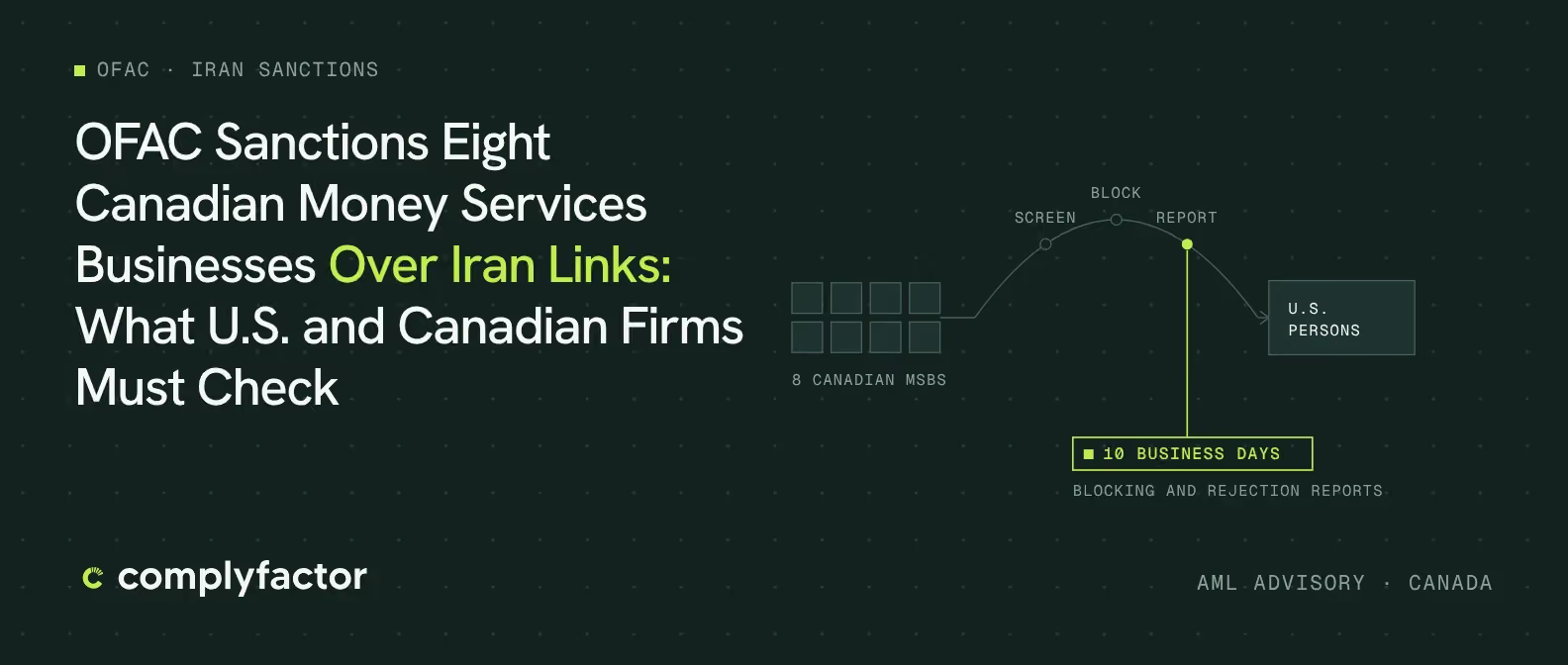
- U.S. persons must block property of the eight entities; blocking and rejection reports are each due within 10 business days.
- Weak aliases help confirm or rule out a hit but are not something OFAC expects you to screen against; six TRX addresses are also listed.
- The 50 Percent Rule tests ownership, so numbered companies and unnamed customers can still be caught.
- The allegations are Treasury's alone, and we found no FINTRAC action in the sources reviewed.
On November 6, 2026, the U.S. Treasury's Office of Foreign Assets Control (OFAC) added eight Canadian money services businesses (MSBs) to the Specially Designated Nationals (SDN) list under its Iran program. Treasury says the firms moved money for Iranian clients and, in some cases, for criminal networks, and that it coordinated the action with FinCEN, FINTRAC and the DEA. The listings bind U.S. persons now. The allegations behind them are Treasury's alone, and we found no court finding or independent confirmation.
What OFAC did
OFAC listed the eight entities on its November 6, 2026 recent actions page as "Iran-related Designations", tagged [IRAN-EO13902]. Each SDN entry carries the note "Secondary sanctions risk: See Section 2 of E.O. 13902". We confirmed on November 11 that all eight appear in OFAC's Sanctions List Search at a 100 match score. No later OFAC action amends them.
The designations follow a sequence that matters for anyone with Iran exposure:
The August determination is the legal basis. It applies Section 1(a)(i) of E.O. 13902 to the digital asset sector, which lets OFAC target firms operating in that sector of Iran's economy. Treasury's Nov. 6 press release lists the June and August actions as earlier steps and says Canada has hundreds of MSBs moving funds to and from Iran.
The eight designated entities
The table reproduces the SDN text as printed on November 11, 2026. Names in quotation marks are OFAC "weak" aliases, explained below the table. Spelling follows OFAC, including its "C EXCHANEG" entry for B Galaxy Inc.
Six Tron (TRX) addresses are listed across four of the entries. Pull the full address strings from the SDN entries themselves rather than from any secondary summary, because one wrong character breaks a match. OFAC labels the MSB numbers "Canada" and does not attribute them to FINTRAC, so we do not describe them as FINTRAC registration numbers.
Strong and weak aliases. OFAC puts weak AKAs in double quotation marks. Per OFAC FAQ 122 to 125, OFAC does not expect you to screen against weak AKAs, but expects them to help confirm or rule out a hit raised by another identifier. Here that matters: "C EXCHANGE" is a weak alias on two different entries, and "CANADA EXCHANGE" is a generic phrase that will match many harmless names. Treat a weak-alias-only match as a prompt to check addresses, websites and MSB numbers, not as a block.
What U.S. persons must do
OFAC's blocking duties apply to U.S. persons, meaning U.S. banks, MSBs, broker-dealers, crypto exchanges and other U.S.-organized firms, and to property in the United States or in a U.S. person's possession or control. U.S. persons are broadly prohibited from dealing with the eight entities. A U.S.-dollar payment does not by itself make a non-U.S. party subject to those duties. But dollar payments usually clear through a U.S. bank, which puts a U.S. person in the chain that must block or reject. A non-U.S. firm can also face exposure if it causes a U.S. person to breach the rules, and each entry's secondary sanctions note points to Section 2 of E.O. 13902. Which route applies depends on the facts, so take legal advice on any specific flow.
Two deadlines come from OFAC's reporting rules. A blocking report is due within 10 business days of blocking (31 CFR 501.603). A report of a rejected transaction is due within 10 business days of the rejection (31 CFR 501.604). Reports go through the OFAC Reporting System. OFAC amended several of its FAQs on these topics on October 26, 2026, so read the current versions on its Filing Reports and Blocking and Rejecting pages before you file.
The practical decision is block versus reject. If the entity has an interest in the property, you generally block. If a payment merely involves a designated name and nothing of theirs is in your hands, the answer may be a rejection. Escalating matches, documenting the call and choosing between the two is part of our OFAC sanctions compliance services, including review of blocked and rejected transactions.
Why the exposure goes past a direct customer
OFAC's 50 Percent Rule blocks entities owned 50% or more, individually or in aggregate, by blocked persons. FAQ 398 makes clear the test is ownership, not control. Several of these firms use numbered company names (1380079 BC Ltd, 2397639 Ontario Ltd) and trade under other brands, so a customer or counterparty may not show an obvious name match. Our guide to Russian sanctions compliance explains how the ownership test works in practice, and the rule applies in the same way to Iran-related designations.
Treasury ties several of the firms to Ryan Wedding's alleged criminal network and describes the sums involved only in broad terms. Those are Treasury's allegations. We have seen no court finding, no FINTRAC penalty and no registration revocation in any source we reviewed.
Wallet data is the second exposure point. Six TRX addresses are on the SDN list, and stablecoin flows can reach them without any visible name. If your business touches crypto, wallet screening needs to cover them, alongside the monitoring described in our crypto AML compliance services.
What Canadian MSBs need to check
The designation does not change Canadian law. It may change what U.S. counterparties ask of Canadian MSBs: U.S. banks and payment partners may want more detail on Iran-related exposure and sanctions screening. We found no source saying any firm has lost banking access because of this action, so treat that as something to prepare for, not a reported outcome. The secondary sanctions note on each entry, which refers to Section 2 of E.O. 13902, is a further reason for foreign firms to handle Iran-linked flows carefully.
Canada's own rules are separate. Our article on Canadian sanctions against Iran and the FINTRAC MSB obligations covers the SEMA and FINTRAC Ministerial Directive framework, and our guide for currency exchange and remittance MSBs covers the day-to-day program. If you need a program review after reading both, see our AML advisory services in Canada.
Checklist for U.S. firms
The timing groups below are our suggested sequence, not legal deadlines. The only fixed deadlines in this article are OFAC's 10-business-day reporting periods, which run from the date of each blocking or rejection.
Today
- Screen your customer, counterparty and correspondent files against the eight SDN names, their strong aliases, websites, MSB numbers and TRX addresses. Use the weak aliases only to confirm or rule out a hit raised by one of those identifiers. Record the screening date and list version.
- Search payment and transfer history for the same identifiers, back to the earliest possible dealing.
- Load the six TRX addresses into wallet screening and look back over on-chain activity.
This week
- Block property in which a designated entity has an interest, and reject transactions that are only prohibited. Keep the reasoning on file.
- Diary the legal 10-business-day reporting deadlines, which run from the date of each blocking or rejection and are separate from this suggested timeline.
- Check whether any customer is 50% or more owned by one of the eight, alone or with other blocked persons.
Within 30 days
- Review Canadian and other cross-border MSB relationships for Iran-linked flows and document the conclusion.
- Retest whether your screening tool picks up transliterated and numbered-company names.
Checklist for Canadian MSBs
- Confirm that none of the eight appears in your customer, agent, sub-agent or payee records.
- If you have U.S. banking or payment partners, be ready to explain your sanctions screening and Iran-related controls if they ask.
- Review any sarafi-style or informal-exchange counterparties you pay or receive from.
- Record your Canadian sanctions screening alongside any U.S. screening you perform, so one file answers both questions.
- Have an independent reviewer test the program. Our BSA/AML audit services cover U.S.-facing programs, and our Canadian advisory team handles FINTRAC-facing ones.
Common misunderstandings
- "This is a FINTRAC enforcement action." It is not. OFAC designated the firms. We found no FINTRAC action in the sources we reviewed, though Treasury says it coordinated with FINTRAC.
- "If we never dealt with the firm by name, we are clear." Aliases, numbered companies and 50% ownership can all hide a link, and wallet addresses carry no name at all.
- "OFAC's allegations are proven." Designation is an administrative decision. Treat the listing as binding, and treat the allegations as unproven.
- "A weak alias hit means we must block." It does not. Use it to confirm or clear a hit from another identifier.
Sanctions lists change without notice, so re-run your screening against the live SDN list before you rely on this article. ComplyFactor helps firms stay Secure. Compliant. Empowered.
Frequently Asked Questions
Are the eight firms still registered with FINTRAC?
We do not know. OFAC prints the MSB numbers with the label "Canada" and does not say whether they are FINTRAC registrations or whether they are active. Check FINTRAC's public MSB registry yourself before describing any firm's status. The registry result is a point-in-time fact and needs its own date.
What does "Secondary sanctions risk: See Section 2 of E.O. 13902" mean for a non-U.S. firm?
It flags that dealing with a designated person can expose even a foreign institution to U.S. sanctions consequences, not only U.S. persons. The note appears on all eight entries. Read Section 2 of the order itself before drawing conclusions for a specific relationship.
Does a penalty require that we knew the counterparty was designated?
No. Treasury's release describes civil liability as strict liability. Lack of knowledge may affect how OFAC treats a case, but it does not remove the violation. Criminal exposure is a separate question and depends on willfulness.
Can the eight firms be removed from the list?
OFAC has a delisting process and Treasury's release describes it, but it announced no plan to remove anyone. Until OFAC removes a name from the SDN list, the blocking obligations stay in force.
Could we be rewarded for reporting a violation?
Treasury's release points to whistleblower awards where penalties exceed $1,000,000. That is Treasury's description. Anyone considering a report should take legal advice on eligibility first.
Sources Referenced
ComplyFactor is a Canadian AML and regulatory compliance advisory firm serving MSBs, PSPs, fintechs and other regulated businesses.


Related insights
Book a free compliance consultation?
Tell us about your business and we'll confirm which services you need. Free, no obligation, 30 minutes.