FinCEN Cuts Off MEXC Global: What Section 9714 Means for U.S. Crypto Firms and Money Transmitters
FinCEN's Section 9714 order bars covered U.S. institutions from transmitting funds to or from MEXC Global from Dec. 10, 2026. What it means and what to review.



Key takeaways
- FinCEN's Section 9714 order bars covered U.S. financial institutions from transmitting funds to or from MEXC Global from December 10, 2026, with no end date.
- It is a FinCEN special measure, not an OFAC designation, and it does not modify other BSA or sanctions obligations.
- Funds include convertible virtual currency, and the prohibition runs in both directions.
- The order lists affiliates but publishes no MEXC wallet-address list, so address attribution comes from your own data and vendors.
- Whether flows routed through intermediaries are caught is not answered by the order's text and is a question for counsel.
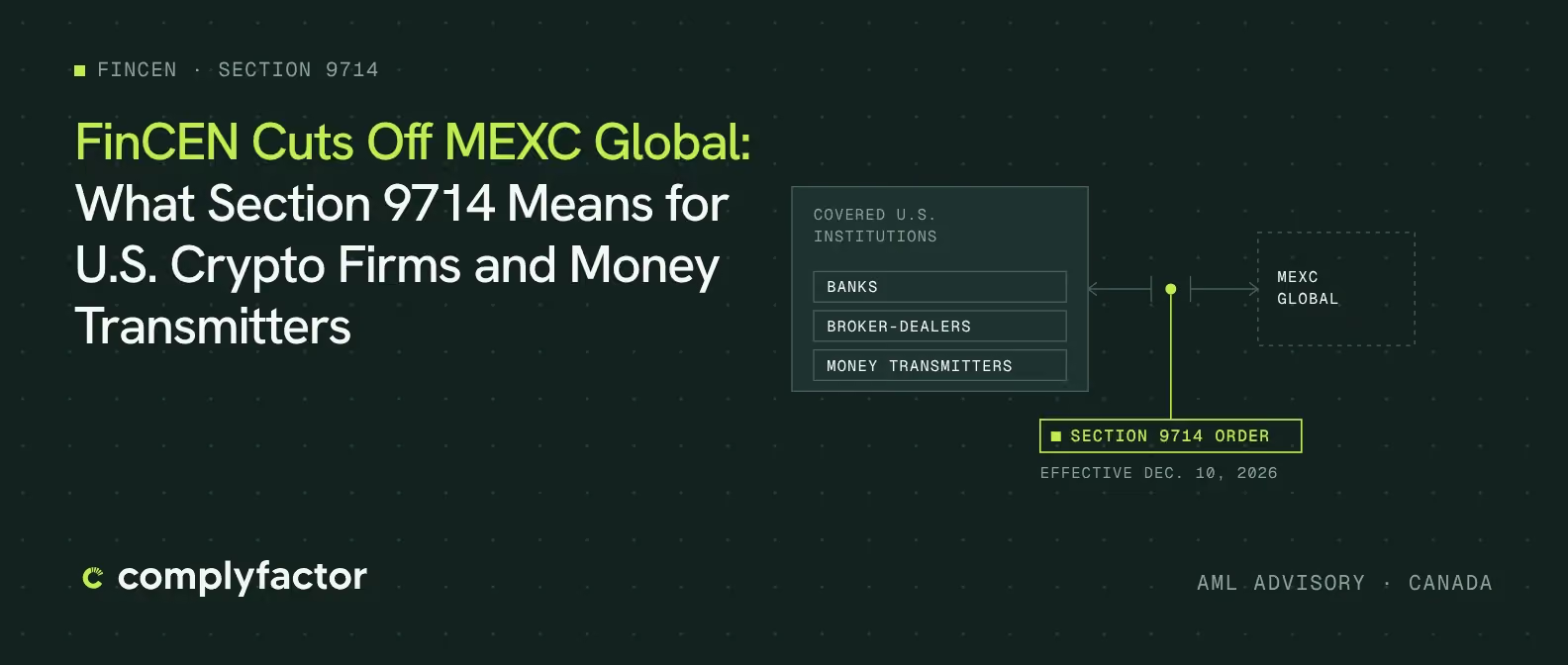
On November 6, 2026, FinCEN announced an order under Section 9714 of the Combating Russian Money Laundering Act that bars covered U.S. financial institutions from transmitting funds to or from MEXC Global. The order was published in the Federal Register on November 10 and takes effect December 10, 2026, with no end date.
The FinCEN MEXC Global order will cost U.S. exchanges, wallet providers and money transmitters the most operational work, but it binds banks and other covered institutions as well. This article covers what the order says, what it leaves open and what to review before it takes effect. It is general information, not legal advice.
What the FinCEN MEXC Global order does
The order is titled "Imposition of Special Measure Prohibiting the Transmittal of Funds Involving MEXC Global." FinCEN first finds that MEXC Global is a financial institution operating outside the United States that is of primary money laundering concern in connection with Russian illicit finance. It then prohibits any covered financial institution from engaging in any transmittal of funds "from or to MEXC Global."
The prohibition runs in both directions. "Funds" includes convertible virtual currency (CVC), and FinCEN defines a transmittal of funds for this order as the sending and receiving of funds, instead of using the narrower definition in 31 CFR 1010.100(ddd).
A "covered financial institution" is any "financial institution" as defined in 31 CFR 1010.100(t). That list includes banks, brokers or dealers in securities and money services businesses. The order treats a CVC exchanger as a money transmitter, so a U.S. exchange or wallet service that operates as a money transmitter is inside the definition.
The order defines MEXC Global as a Seychelles-based exchanger, including its branches, subsidiaries and offices operating as a financial institution outside the United States, and any successor. A successor is any person that replaces MEXC Global by acquiring its assets in whole or in part, or by carrying on its affairs under a new name. U.S.-located branches, subsidiaries and offices are expressly excluded. A footnote names these affiliates as examples, "including, but not limited to":
- MEXC Global Ltd / MX Global Ltd (Seychelles)
- MEXC Estonia OÜ (Estonia)
- GIDA Technology AG (Switzerland)
- MXC Global Ltd (United Kingdom)
- MEXC Global Foundation Ltd and MEXC Singapore Pte Ltd, formerly incorporated in Singapore
Event timeline
What FinCEN found
The figures below are FinCEN's assessments from blockchain analysis, covering May 2021 to May 2026 unless noted. Treasury's press release rounds the headline to "at least $16 billion"; the order itself says at least $16.7 billion in likely illicit activity.
- Russia: nearly $1.5 billion in direct and indirect exposure to transactions linked to Russian sanctions evasion, including $232 million in direct transactions with U.S., EU or UK-sanctioned entities. FinCEN counts about $129 million of activity with Garantex and $4.1 million with Grinex, continuing as recently as June 2026, and almost $200 million connected to the A7A5 token.
- Iran: nearly $2 billion connected to Iranian actors or suspected terrorist groups, including more than $1 billion in direct transactions with over 40 Iranian CVC exchangers.
- Cybercrime: at least $1.99 billion from illicit cyber actors.
- Scale: more than $1 billion in daily transactions as of June 2026 and roughly nine percent of centralized CVC exchange volume as of December 2025.
The order also records that MEXC Global has been found operating without a license in Seychelles, Hong Kong and Japan.
Section 9714 is not an OFAC designation
The most common mistake in early coverage is to treat this as a sanctions listing. It is a different instrument with a different legal effect, and neither the order nor Treasury's release describes MEXC Global as a Specially Designated National.
The order says it does not modify other BSA obligations or the sanctions OFAC administers. In practice you still need working list screening, and a transaction that involves a blocked party falls under OFAC rules whatever this order says. If that control needs an independent look, see our OFAC sanctions compliance services. For the Russia-specific regime that sits behind much of FinCEN's reasoning, our Russian sanctions compliance guide covers the ownership tests and red flags.
Who is directly and indirectly affected
The prohibition text does not use the words "direct" or "indirect." FinCEN did consider a correspondent-account measure and rejected it, partly because funds can reach a target through indirect correspondent relationships. Whether a transfer routed through an intermediary wallet or a third-party platform counts as a transmittal "from or to MEXC Global" is not answered by the text, and it is the question most firms will want counsel to resolve. Detection will depend on transaction monitoring and wallet risk data; our crypto AML compliance services page describes how we review that layer.
Compliance checklist: flows, wallets and rails
These are recommended practices. The only legal duty the order creates is the prohibition itself. FinCEN's own view is that compliance requires no tools beyond those already used in existing AML programs.
Before December 10
- Map exposure. Review current and historical flows to and from MEXC Global and its listed affiliates. The lookback period is your decision, not the order's.
- Settle address attribution. The order does not publish a list of MEXC Global wallet addresses. Ask your analytics provider how it labels MEXC clusters, affiliates and successors, and how fast labels update.
- Block outbound sending. FinCEN's footnote 50 notes that institutions can bar sending CVC to a given address or entity internally. Build the rule and test it before the effective date.
- Search fiat rails. Banks and money transmitters should search wire, ACH and payout-partner data for the affiliate names above and likely variants.
Incoming and held funds
- Write an inbound procedure. FinCEN acknowledges there are few, if any, readily available ways to reject incoming CVC before receipt. Decide in advance how deposits from MEXC Global addresses are quarantined, escalated and documented.
- Record your reasoning on discretion. In the preamble discussion, not the operative paragraphs, FinCEN says institutions may act with discretion where, for example, CVC from MEXC Global sat for an extended period in an unhosted wallet or where risk procedures would bar returning the funds. Treat that as FinCEN's stated approach and document each decision. Our summary of the FATF unhosted wallet report lists the control options for that wallet risk.
- Do not assume funds are frozen. Hold or return decisions come from your policies and legal advice.
Governance
- Update the risk assessment and policies to record the exposure, the new control and its owner. Our BSA/AML program services cover that update.
- Brief front-line and customer-support staff on what customers will ask and what staff may say.
- Keep SAR workflows running. For money services businesses, 31 CFR 1022.320 sets the SAR threshold at $2,000 and the filing deadline at 30 calendar days after initial detection. Decide how MEXC-linked activity feeds that review.
- Test the control independently. Put the new block rule into your next independent BSA/AML audit.
Common misunderstandings
- "We must reject every MEXC deposit." The prohibition covers transmittals from or to MEXC Global, but FinCEN itself concedes that rejection before receipt is often not possible.
- "The order lists the wallets to block." It does not. Attribution comes from your own data and vendors.
- "Customers who hold MEXC accounts are in breach." The prohibition is addressed to covered financial institutions.
- "FinCEN's numbers are court findings." They are the agency's assessments in an order, and should be attributed to FinCEN.
If you want an outside view on your readiness, ComplyFactor's advisory team can review your approach with you. Secure. Compliant. Empowered.
Frequently Asked Questions
What does "primary money laundering concern" mean, and how does Section 9714 differ from Section 311?
Section 5318A of Title 31, which Section 311 of the USA PATRIOT Act added, lets Treasury impose special measures on a foreign institution, jurisdiction, class of transactions or type of account that it finds to be of primary money laundering concern. Section 9714 lets FinCEN use that toolkit for Russia-related illicit finance, including an outright prohibition on certain transmittals of funds. FinCEN's FAQs on its first Section 9714 order describe a Section 9714 action as similar to a Section 311 action, but available only for primary money laundering concerns connected to Russian illicit finance.
What penalties apply if an institution breaches the prohibition?
The order says a covered financial institution, and any of its officers, directors, employees and agents, may be liable for civil or criminal penalties under 31 U.S.C. 5321 and 5322 for willfully violating the order. It sets no amounts, and this article does not estimate exposure. Anyone worried about a specific flow should take legal advice before deciding how to treat it.
Has FinCEN used Section 9714 before?
Yes. According to FinCEN's own FAQs, its first Section 9714 order was issued on January 18, 2023 and concerned the exchange Bitzlato. That earlier case involved a different exchange, so it shows how the tool works rather than how FinCEN will treat MEXC Global in practice. This article does not catalogue any later uses of the authority.
Can an institution give FinCEN information or ask for relief?
The order reserves FinCEN's authority to impose conditions on certain transmittals from or to MEXC Global and to grant exemptions, and it directs inquiries to FinCEN's Regulatory Support Section through the contact form on fincen.gov. It does not describe an application process for exemptions, so firms should not assume one exists. The operative paragraphs contain no new recordkeeping, information-collection or reporting requirement; FinCEN reasoned that such measures alone would be insufficient.
Does FinCEN say all of MEXC Global's activity is illicit?
No. FinCEN says it lacks full insight into the platform's legitimate activity and assumes that part of the business is legitimate for the purposes of the action. It concludes that this is outweighed by the illicit-finance risk. The order also notes that MEXC publicly claims to have AML processes, and FinCEN assesses that any such processes are insufficient. Those are FinCEN's assessments; MEXC Global's own response is not covered in this article.
Sources Referenced
ComplyFactor is a Canadian AML and regulatory compliance advisory firm serving MSBs, PSPs, fintechs and other regulated businesses.


Related insights
Book a free compliance consultation?
Tell us about your business and we'll confirm which services you need. Free, no obligation, 30 minutes.