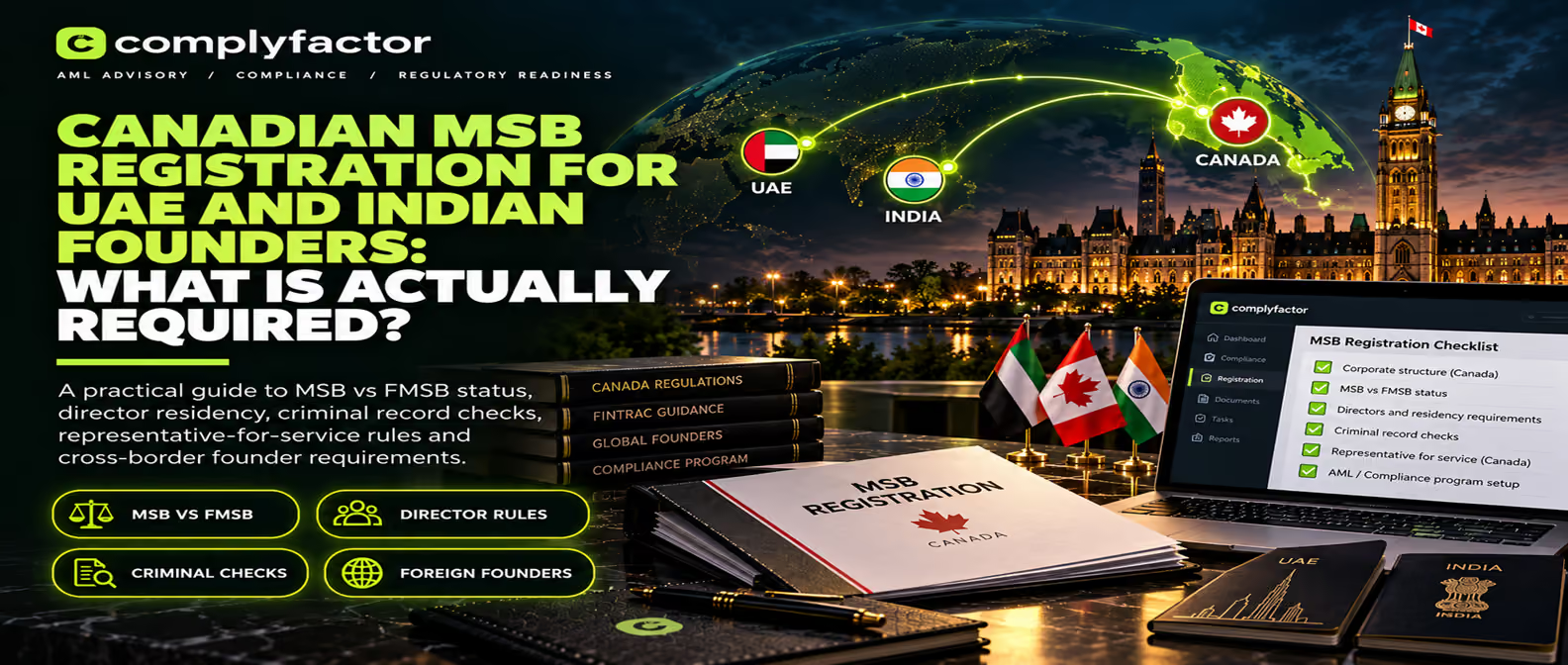
Canadian MSB Registration for UAE and Indian Founders: What Is Actually Required?
UAE and Indian founders can often register a Canadian MSB without relocating, but the route depends on the entity and its activities. Learn the MSB vs FMSB test, director residency rules, criminal record checks, required documents and home-country considerations.



Key Takeaways
- Foreign ownership and residency do not automatically prevent Canadian MSB registration.
- Canadian MSB versus FMSB depends on where the business operates and whom it serves, with separate corporate and representative requirements.
- A proper application and AML framework are necessary, and other Canadian or home-country requirements may apply.
Yes, founders based in the UAE or India can usually own a Canadian money services business, or arrange Canadian MSB registration for a foreign company, without relocating. What decides the route is not the founder's passport. It is which legal entity provides the service, where that entity has a place of business, and whether it directs and provides money services to clients in Canada.
That leaves three common routes:
- Foreign MSB (FMSB) registration. A UAE or Indian company with no place of business in Canada, but which serves Canadian clients, registers with FINTRAC directly.
- A Canadian subsidiary registered as an MSB. The subsidiary is incorporated in Canada and registers based on its own activities.
- No FINTRAC registration. A company that provides no covered money services, such as a pure software vendor, may not need to register.
"We have no Canadian customers" is not a general exemption. A Canadian-incorporated company that provides covered MSB services needs FINTRAC registration, even if all its clients are abroad, because incorporation in Canada gives it a place of business here. Only a business with no place of business in Canada is assessed on whether it directs and provides covered services to clients in Canada.
This guide covers what each route requires in practice for founders connected to the UAE or India: ownership, directors, documents, background checks, the role of the Canadian representative, and the home-country questions that sit outside Canadian law.
Can UAE and Indian nationals own an MSB in Canada?
FINTRAC's registration rules are the same whatever the owner's nationality. Ownership by UAE or Indian nationals is not itself a bar. FINTRAC focuses on eligibility instead. Its eligibility rules exclude entities whose "leaders" or "owners" have certain criminal convictions or are listed persons:
- Leaders include the chief executive officer, the president and directors.
- Owners include anyone who owns or controls 20% or more of the shares.
Four questions need to be kept apart:
- Shareholding. A foreign individual or company can generally hold shares in a Canadian corporation.
- Directors. Corporate law may require some directors to be resident Canadians. This is covered below.
- Place of incorporation. A Dubai or Indian company and a Canadian subsidiary are different legal entities with different registration routes.
- Home-country rules. An Indian citizen living in Dubai and an entrepreneur resident in India can be in different positions under India's overseas investment rules, even with the same passport.
Should you register a Canadian MSB or a Foreign MSB?
FINTRAC's guidance on whether you need to register treats a business as having a place of business in Canada if, for example, it is incorporated in Canada, has a physical location there, or has employees, agents or branches there.
A business without a place of business in Canada is an FMSB if it directs its services at persons or entities in Canada and provides them to clients in Canada. FINTRAC lists several indicators of directing services at Canada:
- marketing aimed at Canada
- a ".ca" domain
- a listing in a Canadian business directory
- pricing in Canadian dollars
- Canadian customer support
These are indicators, not automatic conclusions.
Founders do not get to choose a category. If the facts change, for example by hiring staff in Canada or opening an office there, the classification can change too.
Canadian incorporation: what foreign founders need to know
Founders who want a Canadian entity can incorporate federally, through Corporations Canada, or in a province.
Federal directors. Under the federal rules on directors and officers, "ordinarily, at least 25 percent of the directors of a corporation must be resident Canadians". If there are fewer than four directors, at least one must be a resident Canadian. A federal company run only by founders living in Dubai or India therefore generally needs at least one resident Canadian on its board.
Provincial rules. These differ. Some provinces do not require resident directors, while others do. Check the rules for the specific province before choosing it. Do not assume federal and provincial rules are the same.
Registered office. A Canadian corporation needs a registered office address in Canada. That is a corporate-law requirement, not FINTRAC's place-of-business test, and it is not an FMSB's representative for service. The distinction matters less than founders hope: FINTRAC expressly treats incorporation in Canada as an indicator of a place of business in Canada, so a Canadian company is assessed as a Canadian MSB whatever its office arrangements.
Corporate registration vs FINTRAC registration. Incorporating gives you a legal entity, not permission to provide money services. The new company must also register with FINTRAC before it starts operating as an MSB.
Ownership disclosure. FINTRAC requires a document showing the ownership, control and structure of the entity. Layered holdings through UAE free-zone companies or Indian holding companies need to be mapped clearly to the individuals behind them.
What documents do UAE and Indian founders need for FINTRAC?
FINTRAC's registration page describes a two-stage process. You first submit a pre-registration form. A FINTRAC compliance officer then provides the registration form and a secure upload link. FINTRAC warns that "incomplete applications will be closed".
The criminal record check follows residence, not nationality. An Indian citizen living in Dubai obtains the check from the competent authority where they live.
FINTRAC states that it "does not charge registration fees".
Do you need a Canadian resident director or representative?
These roles are often confused. They are not substitutes for each other.
The representative for service accepts notices on behalf of the FMSB:
- The representative is not automatically a shareholder or the compliance officer.
- Appointing one does not give the FMSB a place of business in Canada.
- The foreign business remains responsible for its AML obligations.
There is no Canadian citizenship requirement for the role. A representative for service is not a director: a federal Canadian company needs resident directors, while an FMSB needs a representative and no Canadian board at all.
Step-by-step registration process from the UAE or India
- Map the services and countries. Identify which services, such as remittance, foreign exchange or virtual currency, will be offered, and to whom.
- Decide between MSB and FMSB. Apply FINTRAC's place-of-business and directing-services tests to the entity that will provide the services.
- Choose the structure. If you need a Canadian entity, choose federal or provincial incorporation and plan for the director rules.
- Check eligibility. Confirm that no leader or 20% owner is ineligible.
- Gather the documents. Obtain criminal record checks from each person's country of residence, with certified translations where needed.
- Set up governance and contacts. Appoint the compliance officer, and the representative for service if you are an FMSB.
- Submit the pre-registration form. Provide the information FINTRAC asks for.
- Complete the application. Upload a complete application through the secure link. The page says the link expires within 15 days.
- Implement the AML program. Put in place the compliance officer, policies, risk assessment, training and two-yearly effectiveness reviews required for an MSB's obligations.
- Deal with other regimes before launch. These include RPAA registration, securities rules and banking.
- Set up ongoing duties. Report changes to FINTRAC within 30 days, and renew the registration every two years, as FINTRAC's update and renewal page requires.
Submitting the application does not authorize you to operate. The business must be registered before it starts.
Three realistic foreign-founder scenarios
All scenarios are hypothetical.
Scenario A: a founder in Dubai serving Canadians from abroad
- Facts: The founder's Dubai company plans to offer remittances to Canadian residents through an app, priced in Canadian dollars, with no Canadian office.
- Classification questions: The FINTRAC question concerns the company, not the founder. Does the company direct and provide money services to clients in Canada? Does anything create a place of business in Canada? Being incorporated in the UAE does not, by itself, decide the answer.
- Documents and people: The company's records; criminal record checks for its leaders and 20% owners; a representative for service resident in Canada; a compliance officer.
- Other regulators:
- Bank of Canada: relevant if the company's payment functions fall within the RPAA. A foreign PSP that directs services to end users in Canada may need to register even without a Canadian location.
- UAE regulators: the company needs its own UAE authorization only for the regulated activity it actually carries out in the UAE, and the authority depends on where. Onshore remittance is regulated by the Central Bank of the UAE (CBUAE). Activity in the DIFC or ADGM falls under the DFSA or the FSRA. Virtual-asset activity in Dubai outside the DIFC falls under VARA, whose jurisdiction excludes the DIFC.
- Next action: Confirm FMSB status and RPAA scope before marketing to Canada, and confirm the UAE licensing position for the outbound leg of each remittance.
Scenario B: an India-resident founder incorporating in Canada
- Facts: An Indian-resident founder wants a Canadian subsidiary for payments, funded from India.
- Classification questions: The subsidiary has a place of business in Canada through incorporation, so it would register as a Canadian MSB if it provides MSB services.
- Documents and people: Incorporation documents; a resident Canadian director if it incorporates federally; ownership charts; criminal record checks; a compliance officer.
- Other regulators: India's overseas investment framework, set out in the next part of this section. A Canadian registration does not authorize providing payment or remittance services inside India.
- Next action: Get Indian FEMA advice before funding, alongside the Canadian structuring.
Incorporating vs funding: two separate questions for India-resident founders
Incorporating a Canadian company is a question of Canadian company law. Putting money into it from India is governed by India's Foreign Exchange Management Act (FEMA), through the Overseas Investment Rules and Regulations, 2022, and the RBI's Master Direction on Overseas Investment (updated April 2026). Four points from that framework are relevant:
- Residence, not citizenship. The rules apply to a "person resident in India" as defined in FEMA. An Indian citizen who lives abroad may fall outside them, while a foreign national living in India may fall inside them.
- Unlisted equity counts as direct investment. Under the Directions, acquiring any unlisted equity capital of a foreign entity is overseas direct investment (ODI). A founder subscribing for shares in a new Canadian private company is therefore making ODI, not portfolio investment.
- Resident individuals face a specific financial-services restriction. RBI treats a foreign entity as engaged in financial services activity where its activities would require registration with, or regulation by, a financial-sector regulator if conducted in India. A Canadian remittance or payments MSB may fall within that classification. Under the ordinary overseas direct investment (ODI) route, a person resident in India generally cannot make ODI in a foreign entity engaged in financial services activity. RBI identifies a limited exception for investment in an Indian International Financial Services Centre (IFSC), which does not ordinarily cover a Canada-incorporated MSB. Have an Indian adviser confirm the business classification and legally available funding or investment route before subscribing for shares.
- Indian companies face separate conditions. Where an Indian entity not itself engaged in financial services invests in a foreign entity carrying on qualifying financial services other than banking or insurance, the RBI Master Direction generally requires net profits in the preceding three financial years, subject to other conditions and limited IFSC exceptions. Indian entities already engaged in financial services face separate rules and sector-regulator requirements. Do not assume that an individual founder and an Indian corporate investor use the same route.
The practical result is that an India-resident founder may be free to set up the Canadian company, yet unable to fund or own it as planned without a compliant FEMA route. This needs a transaction-specific assessment by an Indian adviser. Neither a general permission nor a general prohibition should be assumed.
Scenario C: an Indian citizen living in the UAE
- Facts: The founder is an Indian citizen resident in Abu Dhabi who plans to own a Canadian fintech company personally. No UAE company is involved.
- Classification questions: Citizenship decides nothing. The Canadian company's activities and place of business decide the FINTRAC route. Whether the founder is resident in India for FEMA purposes decides whether India's overseas investment rules apply.
- Documents and people: A criminal record check from the UAE, as the country of residence; the rest is the same as Scenario B.
- Other regulators: The founder's UAE residence does not make the Canadian company subject to a UAE regulator. UAE licensing becomes relevant only if a business, the founder's or another, carries out regulated financial activity in the UAE.
- Next action: Confirm the founder's residency status for FEMA purposes before structuring.
Timeline and cost: what to budget for
FINTRAC registration is free, but setting up the business is not. Incorporation, legal and compliance support, translations, banking and any PSP registration all carry costs.
FINTRAC registration vs Bank of Canada PSP registration
FINTRAC registration covers anti-money laundering obligations. The Retail Payment Activities Act (RPAA) is a separate regime, administered by the Bank of Canada, for retail payment activities. According to the Bank's registration criteria, a PSP without a place of business in Canada is in scope if it serves end users in Canada and directs its activities at them.
The Bank's FAQ says such PSPs must identify an agent or mandatary in Canada. New entrants must receive a registration decision before they start retail payment activities.
The RPAA's currency test refers to Canadian currency, foreign currency or units that meet prescribed criteria. Activities that involve only virtual currency need their own analysis. Crypto trading platforms may also fall under Canadian securities law.
Our article on Canadian MSB and PSP registration for foreign companies explains how the two regimes overlap.
Five mistakes international founders should avoid
- Choosing MSB or FMSB by passport. Assess the entity, not the founder.
- Using a representative for service in place of a resident director. They meet different legal requirements.
- Treating FINTRAC registration as a banking licence. It covers AML registration only; map each activity to the regime that applies.
- Funding a Canadian MSB from India without a FEMA route. Settle the investment route before transferring money.
- Assuming registration means you are ready to operate. Banks, payment partners and liquidity providers each make their own decisions.
International founder readiness checklist
- ☐ We have a written MSB or FMSB classification for the entity that will provide the services
- ☐ A resident Canadian director is identified, if we incorporate federally
- ☐ We have a list of every leader and 20% owner, with each person's country of residence
- ☐ Criminal record checks are dated within 6 months of the application, with certified translations ready
- ☐ The ownership chart traces UAE free-zone or Indian holding companies to individuals
- ☐ Each India-resident investor has written advice on the FEMA route
- ☐ The UAE licensing position is confirmed for any activity carried out in the UAE
Frequently asked questions
Can our FMSB appoint an external professional as its Canadian representative?
Yes, if the person resides in Canada and is authorized to accept notices on the FMSB's behalf. Our representative for service guide covers how the appointment works.
Does owning a Canadian MSB give us the right to work in Canada?
No. Owning shares, being a director or holding a FINTRAC registration gives no right to a visa, permanent residence or permission to work in Canada. Founders who want to work in Canada need to deal with immigration requirements separately.
Getting a Canadian registration route assessment
A short assessment can set out which entity should register, whether you are an MSB or an FMSB, who needs criminal record checks, how to meet the director and representative requirements, and whether RPAA or home-country rules also apply. ComplyFactor's Canadian MSB and FMSB registration services support that assessment and prepare the FINTRAC application.
ComplyFactor specializes in FINTRAC MSB and PSP registration, independent AML effectiveness reviews, and compliance program design for Canadian and foreign money services businesses, payment service providers, fintechs, and virtual asset service providers.


Related insights
Book a free Canada AML consultation
Tell us about your business and we'll confirm which services you need — free, no obligation, 30 minutes.