

Key Takeaways
- Canadian representative required for FMSBs. An FMSB must designate a Canada-resident individual authorized to accept FINTRAC notices; that individual is not automatically its compliance officer.
- Use the official registration process. Representative details go in the FINTRAC-provided registration form; no separate standardized appointment form is listed in current public guidance.
- Record the right contact information. Provide the representative’s name and Canadian address for service, together with the telephone number and email required by the Registration Regulations.
- Report changes within 30 days. Applicants and registered FMSBs must update changed registration information within 30 days after becoming aware; late representative name/address updates carry a mandatory denial or revocation consequence.
- Keep an auditable notice-handling trail. Written acceptance, receipt logs, forwarding procedures, backups and submission confirmations support reliable regulatory communication as internal controls.
- Distinguish similar-sounding roles. An authorized registration requester, FMSB representative for service, compliance officer and MSB agent have different responsibilities.
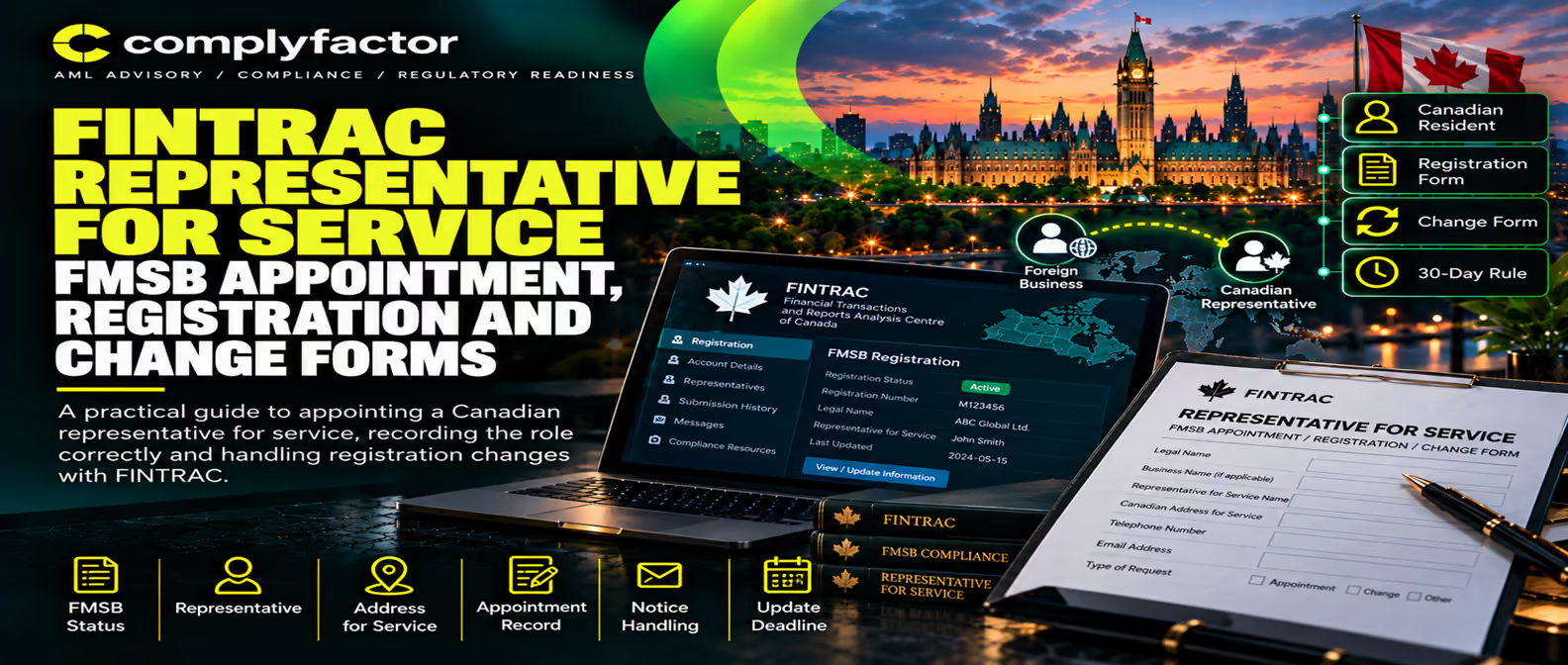
A foreign money services business (FMSB) registering with FINTRAC must name a representative for service: an individual who resides in Canada and is authorized to accept notices from FINTRAC on the business's behalf.
FINTRAC's current publicly available registration guidance does not list a separate, standardized representative appointment form. FINTRAC's registration guidance has the FMSB provide the representative's details in the registration form that a FINTRAC compliance officer sends after the pre-registration request. Later changes go through FINTRAC's Change form. Any appointment letter is the business's own supporting record.
Throughout, the FMSB, not its representative, remains responsible for its obligations under the Proceeds of Crime (Money Laundering) and Terrorist Financing Act (PCMLTFA).
Who needs a representative for service
The requirement applies only to FMSBs, as defined in paragraph 5(h.1) of the PCMLTFA. These are persons or entities that:
- do not have a place of business in Canada
- are engaged in the business of providing MSB services, such as foreign exchange dealing, remitting or transmitting funds, or dealing in virtual currency, that are directed at persons or entities in Canada
- provide those services to clients in Canada
Appointing a representative does not create a Canadian place of business, and it does not turn an FMSB into a Canadian MSB. The broader eligibility and application steps are covered in how to apply for FINTRAC MSB registration.
Who can serve
The verified minimum conditions come from the Act and FINTRAC's guidance. The representative must:
- be an individual. The Act refers to "a person who resides in Canada", and FINTRAC's guidance says the representative "must reside in Canada".
- reside in Canada. This is a residency test, not a citizenship test.
- be authorized to accept, on the FMSB's behalf, notices served by FINTRAC under the Act (PCMLTFA s. 11.12(1)(c.1)).
No citizenship, professional licence, AML certification, employment relationship or fee is prescribed. An external consultant, lawyer or other professional resident in Canada can act if properly authorized and practically able to receive notices.
Beyond the legal minimum, sensible diligence before appointment includes checking:
- Stability: a stable Canadian address, and contact details that are actually monitored
- Commitment: a written agreement to serve
- Cover: cover for absences
- Conflicts: no conflicts that would delay forwarding notices
- Understanding: a clear understanding that the role is limited
What the role does, and does not, include
Its legal function is to receive notices. Under section 72.1, service of a FINTRAC notice on an FMSB "is sufficient if it is served on the person who is indicated in the application for registration, or in accordance with subsection 11.13(1)", as authorized to accept notices.
In practice, a notice served on the named representative counts as served on the FMSB, whether or not head office reads it promptly.
The representative does not, by virtue of the role:
- act as compliance officer
- make suspicious transaction decisions or file reports
- conduct customer due diligence
- handle transactions
- give legal advice
- represent the business in court
FINTRAC states that "it is the foreign money services businesses, and not the representative for service in Canada" who must meet the Act's obligations. One person may hold more than one role if appropriately appointed to each. The roles stay distinct.
FINTRAC's current examination guidance does not set out a standard form for authorizing an outside adviser during an examination. Follow the instructions in the examination notice. Agents are a separate subject, covered in agent oversight.
Is there a "FINTRAC representative form"?
No separate, standardized representative appointment form is listed in FINTRAC's current publicly available registration guidance. The representative's details are recorded through the official processes below:
The person submitting a request is not the representative for service. The pre-registration and registration process identifies who is submitting on the applicant's behalf. The online request may offer a requester role such as "Authorized representative". Selecting it describes the preparer. It does not designate the statutory representative for service. The registration form must name the individual who resides in Canada and is authorized to accept notices.
An internal appointment letter is not required by any provision reviewed here. It is still useful evidence that the individual agreed to act and was authorized.
What details are recorded
All of this is registration information, so a change to any of it must be notified within 30 days. Only a change to the name or address for service triggers the mandatory consequence described below.
Illustrative appointment and acceptance record
Illustrative FMSB Representative-for-Service Appointment and Acceptance Record: not a FINTRAC form. Signing it does not register anything with FINTRAC.
Foreign business: [Legal name], incorporated in [jurisdiction], registration no. [placeholder]
Representative: [Full name], residing in Canada
Canadian address for service: [Street, city, province, postal code]
Telephone / email: [number] / [address]
Appointment: With effect from [date], [Foreign business] appoints the Representative as its representative for service in Canada. The Representative is authorized to accept, on its behalf, notices served by or on behalf of FINTRAC under the Proceeds of Crime (Money Laundering) and Terrorist Financing Act.
Scope: The appointment is limited to receiving notices. It does not appoint the Representative as compliance officer, agent or legal counsel, or give authority to transact or file reports.
Internal notice route: The Representative will forward any FINTRAC notice to [compliance officer name, email] and [backup name, email] on the business day it is received, and keep a receipt log. (Internal standard, not a FINTRAC requirement.)
Changes and termination: The Representative will notify the business in writing of any change to their name, address or contact details, or of any intention to resign, giving [number] days' notice where possible. The business is responsible for notifying FINTRAC.
Signed for [Foreign business]: [Name, title], [date]Accepted by the Representative: [Name], [date]
Handling notices
Receiving a notice and meeting its requirements are separate steps. Any deadline in the notice runs regardless of internal forwarding delays. For examination record requests, see producing records in a FINTRAC desk examination.
Changes: the 30-day rule and its mandatory consequence
Section 11.13(1) applies to applicants as well as registered MSBs and FMSBs. Each must notify FINTRAC of any change to the information in its application, or to its registration information, "within 30 days after the day on which" it "becomes aware of the change". For an FMSB still in the application process, a change of representative therefore has to be reported too.
Under section 11.13(2), if the name or address for service of the representative changes and the new information is not provided within that period, FINTRAC shall deny the application or revoke the registration, as the case may be, once it becomes aware of the failure. It then informs the business. FINTRAC's update page puts it directly: "Your registration will be revoked or denied if you fail to notify FINTRAC within the 30-day period."
Five dates are easy to confuse:
A change of phone number or email address is reportable within 30 days, but section 11.13(2)'s mandatory denial or revocation applies to the representative's name or address. There is no grace period. The wider update process is covered in FINTRAC MSB change of information.
When the representative stops responding
Warning signs include:
- no acknowledgement of test messages
- returned mail
- a FINTRAC follow-up about a notice nobody saw
- the representative moving away
Act immediately:
- Try every contact detail on file, and record the attempts.
- Check FINTRAC correspondence history for notices that may already have been served.
- Appoint a replacement who resides in Canada.
- Submit the Change form within 30 days of becoming aware of the change.
- Respond to any outstanding FINTRAC notice or clarification request within its own deadline. A new representative does not reset it.
- Take legal advice if the validity of service, or a possible revocation, is in question.
Notices properly served on the named representative are not invalid because overseas management did not see them.
Three worked examples
All fictional.
1. Initial registration by an overseas remittance company. A remittance company in [jurisdiction], with no Canadian office, serves Canadian senders online, so it is an FMSB. It identifies a Toronto-resident accountant willing to act. Before the registration form is completed, the company:
- confirms her residency and Canadian address
- has her sign the appointment and acceptance record
- agrees a same-day forwarding procedure, with a named backup
When FINTRAC's compliance officer provides the registration form, the company enters her name, address for service, telephone and email exactly as in the signed record. It saves a copy of the submission and adds a quarterly test message to its compliance calendar. She is not its compliance officer. That role sits with the company's own head of compliance.
2. The representative resigns and moves. On September 14, 2026, the FMSB's representative emails the company's monitored compliance inbox. She has resigned with immediate effect and is moving abroad. The FMSB records September 14 as its awareness date, so the statutory deadline is October 14, 2026. It appoints a replacement resident in Vancouver on September 22, and submits the Change form with the new name, address, telephone and email on September 24, saving the confirmation. Its internal target of 10 business days was met.
Had it missed October 14, section 11.13(2) would require FINTRAC to revoke the registration once it became aware of the failure.
3. A consultant mistaken for the representative. An FMSB hires a Canadian AML consultant to prepare its registration. The consultant submits the pre-registration request and identifies himself as the requester. Management assumes this makes him the representative for service.
It does not. The consultant is the person submitting on the applicant's behalf. The registration form must separately name an individual who resides in Canada and is authorized to accept FINTRAC notices. The consultant can be that person only if the FMSB appoints him and he accepts. The FMSB decides to appoint him, signs an appointment record, and enters his details in the representative fields before the form is submitted. The confusion is resolved before FINTRAC receives an incomplete application.
Checklists
Before appointment
- ☐ FMSB status confirmed against paragraph 5(h.1)
- ☐ Individual confirmed as residing in Canada
- ☐ Written authorization to accept FINTRAC notices
- ☐ Address for service, phone and email confirmed and monitored
- ☐ Signed acceptance obtained
- ☐ Notice-handling procedure and backup agreed
- ☐ Registration form entries match the appointment record
- ☐ Submission copy and appointment evidence retained
After a change
- ☐ Change and awareness date recorded
- ☐ Replacement appointed if needed
- ☐ Change form submitted, and confirmation saved, within 30 days of awareness
- ☐ Open FINTRAC notices and clarification requests checked
- ☐ Internal contacts and procedures updated
- ☐ New contact details tested
Frequently asked questions
Can one individual act as representative for service for several FMSBs?
Nothing in the provisions reviewed limits the number of FMSBs one individual can represent. The practical question is capacity. Each FMSB should be satisfied that notices will be logged and forwarded reliably, and that a backup arrangement exists.
What if FINTRAC serves a notice at the old address because a change was not reported?
Section 72.1 makes service sufficient when it is made on the representative indicated in the application, or as updated under section 11.13(1). It does not say that attempted delivery to an outdated address is automatically valid service. Whether a particular attempt was effective depends on the applicable legal requirements and the actual circumstances. The safer course is to prevent the question from arising. Report changes on time, correct any outdated details as soon as you find them, contact FINTRAC about any notice you learn was sent to an old address, and take legal advice if the validity of service is disputed.
Does the representative need to stay in Canada at all times?
The Act requires a person who resides in Canada, but does not define residence for this purpose. Short trips do not obviously change where someone resides. A move abroad does. Because the test is not defined, plan for absences with a backup who can forward notices. If residence becomes doubtful, appoint a replacement and report the change.
Getting the representative for service right is one part of preparing a complete FMSB registration. ComplyFactor supports foreign companies with FMSB registration with FINTRAC, including registration preparation, FINTRAC correspondence and the compliance documentation the application requires.

ComplyFactor specializes in FINTRAC MSB and PSP registration, independent AML effectiveness reviews, and compliance program design for Canadian and foreign money services businesses, payment service providers, fintechs, and virtual asset service providers.
.svg)
.svg)
Related insights
Book a free Canada AML consultation
Tell us about your business and we'll confirm which services you need — free, no obligation, 30 minutes.