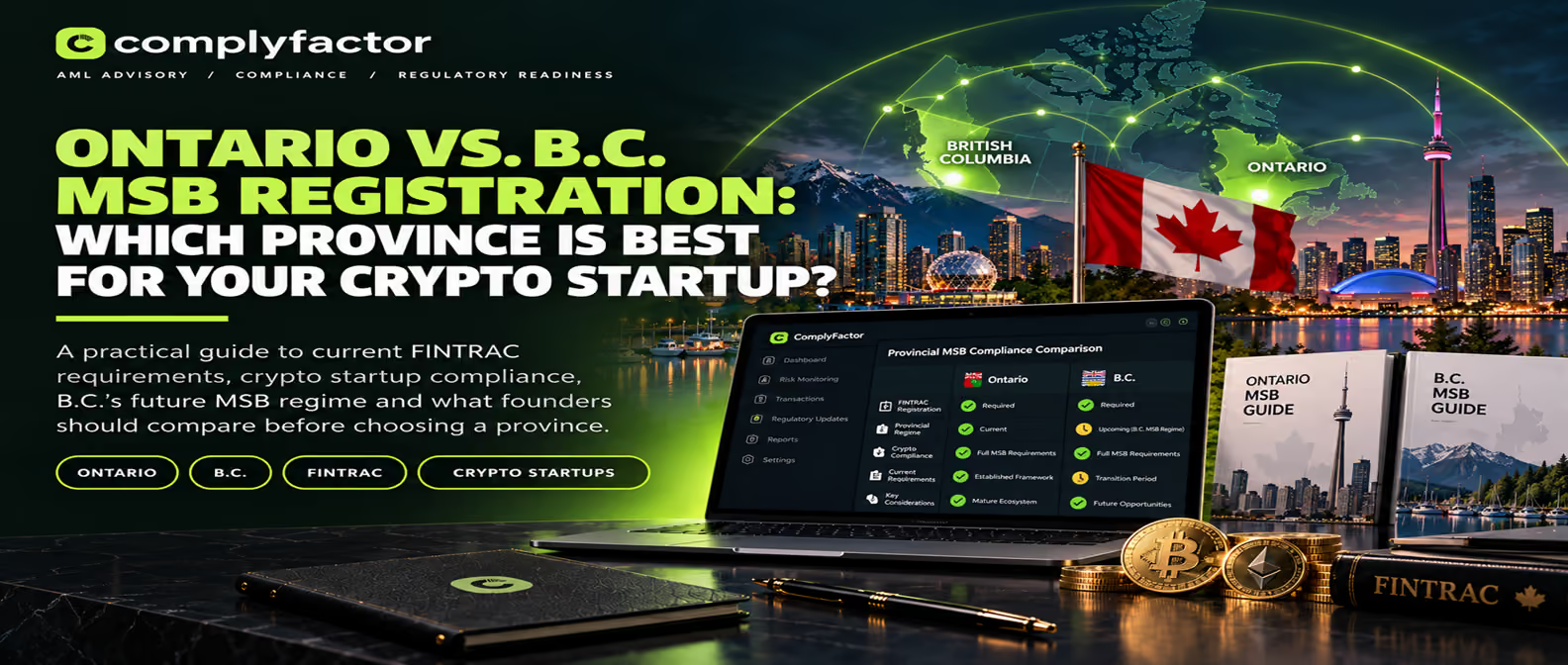
Ontario vs. B.C. MSB Registration: Which Province Is Best for Your Crypto Startup?
Ontario and British Columbia share federal FINTRAC requirements, but B.C. has enacted a provincial MSB law that is not yet in force. Compare today's crypto compliance obligations, securities oversight, future regulatory considerations and practical province-selection criteria.



Key Takeaways
- FINTRAC registration and AML obligations are federal; neither Ontario nor B.C. offers an automatic shortcut for a crypto MSB.
- B.C.'s Money Services Businesses Act was enacted in 2023 but its provincial MSB registration regime had not commenced by 23 October 2026.
- Startups should separately assess securities, RPAA, geographic footprint and future B.C. compliance before deciding where to establish operations.
For a crypto founder choosing between Toronto and Vancouver, an apparently simple question—where should we register our money services business?—can hide three separate regulatory decisions. FINTRAC registration is federal. Crypto trading activity may also engage provincial securities law. And British Columbia has enacted a separate Money Services Businesses Act, although its main registration regime had not come into force as of 23 October 2026.
This distinction matters. Ontario may be operationally attractive for a startup, but it is not automatically the faster or cheaper regulatory choice. Nor do crypto startups currently face mandatory BCFSA MSB registration simply because they are based in B.C. The better approach is to compare the business model, the customers served, applicable regulators and the cost of remaining compliant as the company grows.
The position in October 2026: what applies now?
FINTRAC states that covered MSBs and FMSBs must register before operating, regardless of any applicable provincial licence or registration. It also confirms that FINTRAC does not charge a government fee for MSB registration. The federal requirements do not change merely because the company's registered address is in Ontario rather than B.C. See FINTRAC's MSB guidance and registration instructions.
Is Ontario actually faster for a new crypto MSB?
There is a plausible planning advantage to choosing a province without an additional operational provincial MSB register. But for Ontario versus B.C. in October 2026, that does not establish a documented difference in FINTRAC processing time. B.C.'s new regime has not commenced, so it would be inaccurate to say that B.C. startups are already slowed down by mandatory BCFSA MSB registration or dual MSB reporting.
Founders should instead compare the factors they can verify:
- Business model: Is the company exchanging or transferring virtual currency for customers, or merely publishing non-custodial software? Does it also transmit fiat funds?
- Securities perimeter: Does the platform offer securities, derivatives or contractual rights to crypto assets that bring it within the securities framework?
- Actual footprint: Where are staff, decision-makers, counterparties and customers located? Which provinces will the business actively serve?
- Banking and infrastructure: Can the business obtain the accounts, custody, technology and service-provider relationships it needs?
- People and costs: Local hiring, incorporation, office and legal costs may differ by company; they cannot be inferred from the provincial MSB statute alone.
- Future compliance: Could the B.C. regime become applicable during the business's investment or launch horizon?
Bottom line: Ontario may be the more straightforward choice for some early-stage operating structures, but there is no sound basis for promising that an Ontario FINTRAC application will be approved sooner.
B.C.'s Money Services Businesses Act: passed, but not yet implemented
British Columbia's Money Services Businesses Act received Royal Assent on 11 May 2023. Its purpose is to establish provincial oversight for defined money-services activities, including registration and associated supervisory powers when implemented.
Crucially, the province's official legislation status still lists sections 1–52 and key transitional provisions as not in force. BCFSA's own 2026 Annual Risk Outlook says the law has not yet been implemented and describes BCFSA registration as something that will apply once the regime is brought into force.
That produces three distinct categories for a business planning to operate in B.C.:
The enacted Act describes activities such as foreign exchange dealing, remitting or transmitting funds, and issuing or redeeming specified negotiable instruments, with the possibility of including or excluding services by regulation. Do not assume that every crypto-only business will automatically fall within every future provincial requirement. Its precise coverage must be assessed against the final operative rules and actual business activities.
There is also no verified basis today to treat specific B.C. MSB capital thresholds, security-bond amounts, special audit schedules or a three-to-five-year rollout timetable as final requirements. These should not be presented to investors as established law.
The crypto-specific issue: securities oversight is not FINTRAC registration
A startup offering virtual currency exchange or transfer services may need to register with FINTRAC. A crypto-asset trading platform that facilitates transactions in securities, derivatives, or certain crypto contracts may separately need securities registration or authorisation. These are different regulatory questions.
In Ontario, securities questions involve the Ontario Securities Commission (OSC) and the applicable national Canadian Securities Administrators (CSA) and Canadian Investment Regulatory Organization (CIRO) framework. In B.C., the relevant provincial securities authority is the British Columbia Securities Commission (BCSC), alongside applicable CSA/CIRO requirements.
The BCSC's crypto guidance expressly explains that B.C. securities laws can apply when a crypto platform carries on relevant activity in B.C. or deals with B.C. investors. CSA and CIRO guidance also addresses the move toward investment-dealer registration and CIRO membership for covered crypto-asset trading platforms.
A FINTRAC registration number is therefore not permission to operate a securities-regulated crypto exchange. Equally, merely incorporating a platform in Ontario does not switch off applicable B.C. securities law if the platform serves B.C. clients.
Three startup models, three different answers
These examples describe regulatory screening questions, not automatic classifications. Custody, transaction flow, contractual rights and the roles of affiliated entities can change the answer.
What about payment services, RPAA and foreign founders?
For a startup moving both fiat funds and crypto assets, the Ontario/B.C. comparison can be incomplete without a separate Retail Payment Activities Act (RPAA) assessment. The Bank of Canada, not FINTRAC or BCFSA, supervises the federal RPAA registration regime. The RPAA generally concerns covered retail payment functions involving electronic funds transfers in Canadian or foreign fiat currencies, subject to exclusions; it is not a blanket licence for crypto transactions.
A company may need to assess FINTRAC and RPAA responsibilities separately. The Bank of Canada's supervisory framework explains the scope, including relevant foreign PSPs serving Canadian end users.
International founders should also distinguish foreign ownership of a Canadian entity from the foreign MSB (FMSB) route. FINTRAC considers whether the business has a place of business in Canada and whether a foreign business directs specified services at persons or entities in Canada. See the FINTRAC MSB and FMSB criteria.
Choosing an Ontario incorporation address does not, by itself, settle whether the Canadian entity, foreign parent, or both have regulatory obligations.
An operational comparison: two hypothetical founders
Scenario A — Ontario-based crypto remittance startup. A founder plans to operate from Toronto, exchange virtual currency for customers and remit funds overseas. The immediate tasks are to classify its MSB activities, prepare FINTRAC registration and AML controls, and determine whether its payment flow or trading arrangements also fall into other regulatory regimes. Incorporating in Ontario does not reduce the content of the federal AML obligations.
Scenario B — Vancouver-based crypto platform. A founder will operate from B.C., take custody of client assets and facilitate crypto contracts. The company needs the same relevant FINTRAC analysis. It also needs securities advice about the platform and its B.C. investors. It should follow BCFSA's future MSB regime, but cannot be described as already subject to mandatory registration under the not-yet-commenced Act.
Neither scenario proves that a particular province offers cheaper banking, faster regulatory processing or automatic market access. Those outcomes require company-specific evidence.
How to decide between Ontario and B.C.: a founder checklist
Before incorporation or market entry, create a written regulatory map:
- ☐ Describe each product, custody arrangement, funds flow and customer type.
- ☐ Determine whether the Canadian MSB or foreign MSB framework applies.
- ☐ Identify the responsible FINTRAC reporting entity and required registration information.
- ☐ Build the AML programme: compliance officer, policies, risk assessment, training and two-year effectiveness review plan, as applicable.
- ☐ Assess whether the products or platform engage securities or derivatives law and the relevant OSC/BCSC, CSA and CIRO requirements.
- ☐ Assess the RPAA independently if the business performs covered retail payment functions.
- ☐ Document where customers will be served, not only where the head office will be registered.
- ☐ For B.C. exposure, monitor commencement and final scope of the Money Services Businesses Act.
- ☐ Compare actual banking, personnel, incorporation, tax and professional-service costs.
- ☐ Set a launch decision based on all applicable approvals and operational readiness, not just receiving a FINTRAC registration number.
FINTRAC's compliance programme guidance describes the required programme elements and effectiveness reviews for covered reporting entities.
So which province is better for a crypto startup in 2026?
Choose Ontario when its market access, team, banking relationships and operating infrastructure suit your business, and a documented regulatory assessment confirms the planned activity can be conducted lawfully. Ontario does not presently have the forthcoming B.C.-specific MSB regime, but that fact alone does not establish a faster federal registration.
Choose British Columbia when the business has genuine operational, commercial or staffing reasons to locate there and can monitor and prepare for the future provincial MSB regime. Do not assume a B.C. crypto startup already faces BCFSA MSB registration; do not ignore currently applicable B.C. securities law.
If you will serve customers across Canada, do not treat provincial incorporation as a shortcut around other jurisdictions' applicable rules. Map the actual activities and geographic exposure before choosing either province.
The practical answer is not “Ontario always wins.” It is: the best province is the one where your specific crypto model can meet every applicable requirement and operate sustainably, with a credible plan for foreseeable regulatory change.
Frequently asked questions
Is a BCFSA MSB licence mandatory for crypto startups in October 2026?
No. As of 23 October 2026, the B.C. Money Services Businesses Act's main registration regime had not come into force. BCFSA describes the regime as not yet implemented. A crypto business may nevertheless have FINTRAC, securities and other obligations under existing law. Recheck B.C.'s commencement and implementing regulations before launch.
Does FINTRAC charge more to register an MSB in B.C. than in Ontario?
No. FINTRAC says it does not charge a government fee for MSB or FMSB registration. The firm's total costs may differ because of incorporation, advice, staffing, software, securities registration, applicable PSP requirements or future provincial obligations. FINTRAC processing time should not be represented as province-specific without reliable evidence.
Can an overseas founder register in Ontario and serve clients in British Columbia?
Potentially, but incorporation location alone does not determine the full regulatory perimeter. Assess FINTRAC MSB/FMSB classification, securities rules if the platform trades regulated instruments, applicable payment-services obligations, and the business's actual activities in each province. Foreign ownership also raises separate corporate and operational questions.
If you're deciding where to establish a Canadian crypto, payments or remittance business, ComplyFactor's MSB registration services can help assess the FINTRAC route, business-model requirements and appropriate compliance preparation before launch.
ComplyFactor specializes in FINTRAC MSB and PSP registration, independent AML effectiveness reviews, and compliance program design for Canadian and foreign money services businesses, payment service providers, fintechs, and virtual asset service providers.


Related insights
Book a free Canada AML consultation
Tell us about your business and we'll confirm which services you need — free, no obligation, 30 minutes.