Cheque Cashing AML Requirements in Canada: FINTRAC Compliance Guide
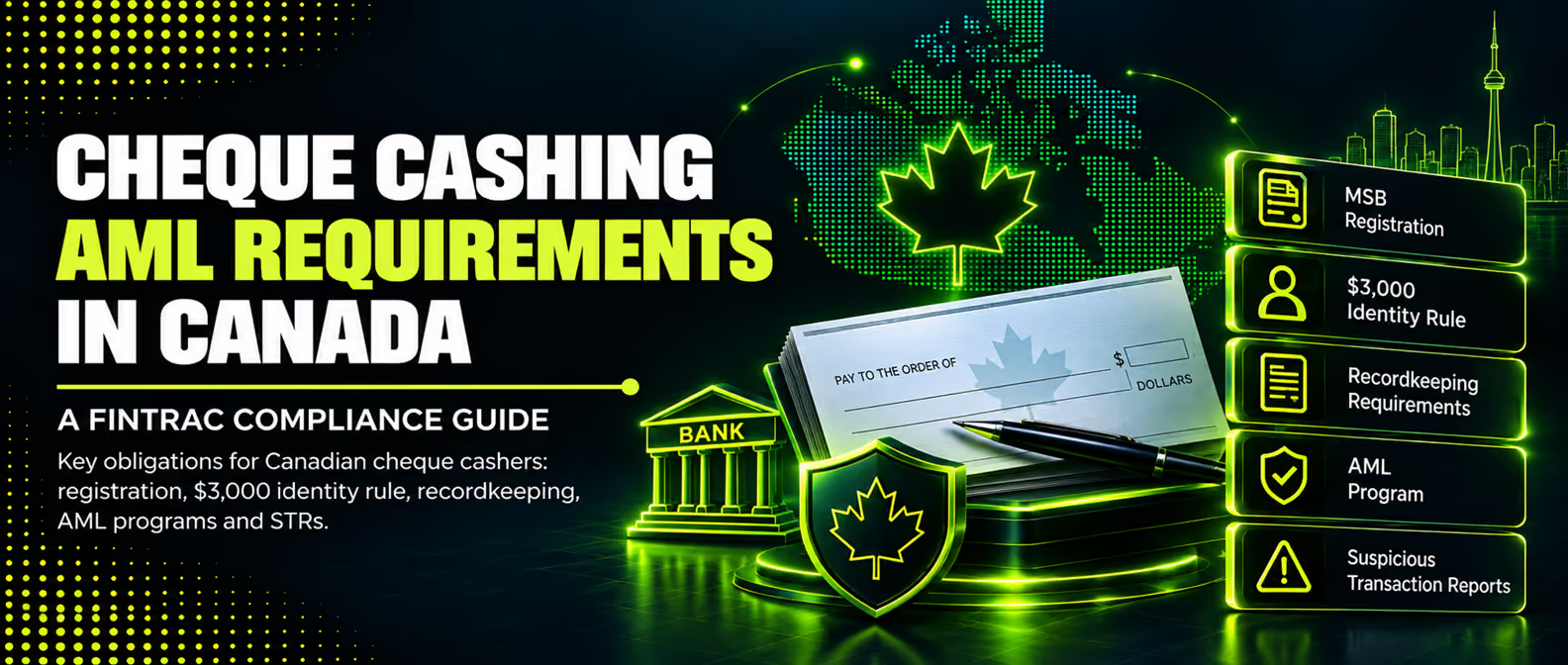
FINTRAC compliance for Canadian cheque cashers: MSB registration, the $3,000 identity and recordkeeping rule, AML programs and STR obligations.



Key takeaways
- Cheque cashers became subject to FINTRAC's MSB framework effective April 1, 2025.
- Cashing one or more cheques totalling $3,000 or more can trigger identity-verification and cheque-casher recordkeeping duties; it is not automatically a FINTRAC transaction-reporting threshold.
- Cheque cashers must register with FINTRAC as an MSB or FMSB, as applicable, and keep their registration information current.
- The compliance program must cover cheque-cashing-specific risks, procedures, training, ongoing monitoring and a two-year effectiveness review.
- STRs and other FINTRAC reports depend on their own legal triggers; cheque cashing by itself does not automatically create an LCTR, LVCTR or EFTR.
Cheque cashing AML requirements in Canada changed significantly once cheque cashing became a regulated money services business (MSB) activity under FINTRAC's framework. For a business that cashes cheques for clients, or offers cheque cashing alongside another MSB service such as remittance or currency exchange, this brings real obligations that go well beyond simply registering with FINTRAC. This guide walks through what registration actually confirms, when the $3,000 identity-verification and recordkeeping rule applies, what an AML compliance program needs to cover, ongoing monitoring and business-relationship obligations, and when a suspicious transaction report is required. It is written for Canadian cheque-cashing businesses and for MSBs considering adding cheque cashing to their existing services.
Are Cheque Cashers Regulated by FINTRAC in Canada?
Yes. Effective April 1, 2025, cheque cashers are regulated as an MSB activity under the Proceeds of Crime (Money Laundering) and Terrorist Financing Act (PCMLTFA). FINTRAC defines a cheque casher as a person or entity engaged in the business of offering to cash cheques for clients in exchange for funds. A business meeting this definition must fulfil the obligations that apply to MSBs or foreign MSBs (FMSBs), as applicable.
What Counts as a Cheque Cashing Business?
In practical terms, this covers a storefront that cashes payroll, government or personal cheques for clients, as well as a business that adds cheque cashing to an existing service line such as remittance or currency exchange. Where a business is unsure whether a particular service brings it within FINTRAC's cheque casher definition, it should assess its actual activities against current FINTRAC guidance rather than relying on how the service happens to be marketed or priced.
Do Cheque Cashers Need to Register With FINTRAC?
Cheque cashers must register as an MSB, or FMSB where applicable, with FINTRAC. Registration is not a licence, endorsement or certification — it confirms that FINTRAC has recorded the business as a reporting entity subject to the PCMLTFA and its regulations. It does not certify that the business's compliance program is adequate, and it does not guarantee acceptance by banks or other financial institutions. Once registered, a business must keep its registration information up to date and inform FINTRAC of changes, including added activities, within 30 days.
What AML Compliance Program Does a Cheque Casher Need?
Like other MSBs, cheque cashers must implement a compliance program built around five core elements: a designated compliance officer, written policies and procedures, a documented risk assessment, an ongoing training program, and an effectiveness review conducted at least once every two years. What matters most for a cheque casher is not the five-element list itself but whether the policies, risk assessment and training actually reflect cheque-cashing activity rather than a generic MSB template. For the full build-out of a FINTRAC-compliant AML program, covering all five elements in detail, see our AML compliance program service.
Cheque Cashing Risk Assessment: What Should the Business Consider?
A risk assessment for a cheque casher should reflect the business's actual operations rather than a generic MSB template. Relevant factors can include the types of cheques cashed (payroll, government, personal, third-party), the mix of individual and business clients, typical and maximum transaction values, frequency of repeat business, the business's geographic footprint, whether cheque cashing is offered in person or through another delivery channel, and any patterns suggesting fraud, altered cheques or third-party involvement. None of these factors automatically makes a client or transaction high-risk; the assessment should document how each is actually weighed given the business's own risk profile.
When Must a Cheque Casher Verify a Client's Identity?
FINTRAC requires a cheque casher to verify the identity of every person or entity that requests the cashing of one or more cheques totalling $3,000 or more, at the time of the transaction. A narrower exemption applies to public bodies, very large corporations or trusts, and their consolidated subsidiaries. Separately, when a cheque casher creates an information record for a corporate or other entity client, that entity's identity must be verified at the time the record is created, regardless of the transaction amount — subject to the same exemption for public bodies, very large corporations or trusts, and their subsidiaries. Identity verification is also required, regardless of amount, for any transaction that is suspicious. This section covers when verification is triggered in the cheque-cashing context; for the accepted verification methods themselves, see FINTRAC identity verification requirements.
What Records Must Cheque Cashers Keep?
When a cheque casher cashes one or more cheques totalling $3,000 or more, FINTRAC requires a cheque cashers record containing: the date each cheque was cashed; the name, address, and nature of principal business or occupation of the person or entity presenting the cheque, and date of birth if a person; the total amount of the cheque or cheques; the name of the issuer of each cheque; details of any account affected by the transaction; and any reference number connected to it. These records must be kept for at least five years from the date the record was created. This is a recordkeeping and identity-verification obligation tied to the specific cheque-cashing transaction — it is not, on its own, a transaction report filed with FINTRAC.
Business Relationships and Ongoing Monitoring for Cheque Cashers
A cheque casher enters into a business relationship with a client the second time, within a five-year period, that it is required to verify that client's identity. A business relationship also begins when an MSB enters into a service agreement with an entity to provide an MSB service; for an FMSB, the entity must be in Canada. Once a business relationship exists, ongoing monitoring obligations apply: keeping client identification information up to date, understanding the client's expected activity, reviewing actual activity against what would reasonably be expected, and applying enhanced measures where the client's risk profile calls for it. Detecting unusual or suspicious activity through that monitoring can lead to a Suspicious Transaction Report; for the mechanics of building and running a monitoring program, see AML transaction monitoring.
When Does a Cheque Casher Need to File an STR?
A cheque casher must submit a Suspicious Transaction Report to FINTRAC when it has reasonable grounds to suspect that a transaction, or an attempted transaction, is related to the commission or attempted commission of a money laundering or terrorist financing offence. The report must be filed as soon as practicable, and the reasoning behind the suspicion should be documented. This obligation to report suspicious transactions applies both to the business and, specifically, to its employees. A fraudulent cheque or an unusual client interaction is not automatically irrelevant, but it does not by itself establish reasonable grounds to suspect ML/TF — the facts, context and any applicable indicators surrounding the situation need to actually support that threshold before an STR is warranted. Writing that reasoning clearly is a skill in itself; see how to write an effective FINTRAC STR narrative for detailed guidance.
What Other FINTRAC Reports Can Apply?
Cheque cashing creates sector-specific identification and recordkeeping duties, while other FINTRAC reports depend on separate thresholds tied to what else occurs in the transaction or what other services the business provides. Cashing a $3,000 cheque does not, by itself, create any of the following:
- A Large Cash Transaction Report (LCTR), which generally applies when a reporting entity receives $10,000 or more in cash in a single transaction, or when qualifying cash receipts are aggregated under FINTRAC's 24-hour rule.
- A Large Virtual Currency Transaction Report (LVCTR), which generally applies when a reporting entity receives virtual currency equivalent to $10,000 or more in a single transaction, or when qualifying virtual-currency receipts are aggregated under FINTRAC's 24-hour rule.
- An Electronic Funds Transfer Report (EFTR), which applies to reportable international electronic funds transfers of $10,000 or more when the MSB is the initiator or final receiver, with the 24-hour rule applying where relevant.
A cheque casher that separately receives reportable cash, receives reportable virtual currency, or carries out reportable international electronic funds transfer activity may trigger those reports through those other activities. Cheque cashing itself is governed by the $3,000 identity-verification and recordkeeping rule described above, not by those reporting thresholds. Separately, a Listed Person or Entity Property Report must be filed immediately when the applicable disclosure obligation for listed or sanctioned property arises.
Common Compliance Risks for Cheque Cashers
- Assuming cheque cashing alone does not qualify as a regulated MSB activity
- Not registering, or not updating an existing registration, promptly once the business began offering the service
- Treating the $3,000 rule as a reporting threshold rather than an identity-verification and recordkeeping trigger
- Incomplete cheque cashers records missing required fields, such as the cheque issuer's name
- Failing to verify identity once the $3,000 total is reached
- A risk assessment that was never updated to address cheque cashing specifically
- Slow or inconsistent escalation of unusual cheque-cashing activity
- Frontline staff who were never trained on cheque-cashing-specific red flags
What Should an Existing Cheque Cashing Business Do Now?
- Confirm FINTRAC registration correctly lists cheque cashing among the registered activities
- Update compliance policies and the risk assessment to address the service specifically
- Review whether client-verification procedures capture the $3,000 cheque-cashing trigger
- Confirm cheque cashers records are complete and retained for the required period
- Refresh frontline staff training on cheque-cashing obligations and red flags
- Review escalation procedures for unusual cheque activity
- Confirm when the next effectiveness review is due
Bottom Line
Cheque cashing in Canada now sits within FINTRAC's regulated MSB framework, and compliance involves more than registering the business. A cheque casher needs a compliance program, a risk assessment and procedures that actually reflect its cheque-cashing activity: verifying identity when the $3,000 threshold is reached, keeping complete cheque cashers records, monitoring business relationships on an ongoing basis, and escalating genuinely suspicious activity through a properly documented STR. Where an existing program hasn't caught up with these requirements, AML advisory support can help close the gap.
Frequently Asked Questions
Do cheque cashers have beneficial ownership obligations for corporate clients?
Yes, when the cheque casher is required to verify the identity of an entity. In that situation, it must obtain the applicable beneficial ownership information and take reasonable measures to confirm its accuracy. The exact information depends on whether the client is a corporation, trust, partnership or another type of entity.
Can a cheque casher rely on identity verification completed for a returning client?
Generally, yes. A cheque casher does not need to re-identify a person or entity if it previously verified their identity using the methods required at the time and kept the associated records, provided it has no doubts about the information on file. This is a reliance exception, not a general rule that identity never needs to be reconfirmed — doubts about the existing information would still require fresh verification.
Do cheque cashers need to make third-party determinations?
Yes, where applicable. Cheque cashers have third-party determination obligations when they are required to submit certain reports or keep certain records, meaning they must take steps to determine whether the person giving instructions for a transaction is actually acting on someone else's behalf.
Does a cheque cashing business have to update its FINTRAC registration when it adds another MSB service?
Yes. A business must keep its FINTRAC registration information current and must inform FINTRAC of changes, including new activities such as adding remittance or currency exchange to an existing cheque-cashing registration, within 30 days.
Can cheque cashing be covered by the same AML program as remittance or currency exchange?
Each MSB service carries its own applicable identity-verification, recordkeeping and reporting triggers, and every service actually offered should be reflected in the business's FINTRAC registration and addressed specifically within its compliance program, risk assessment and procedures, rather than assumed to be covered by whichever service was registered first.
Sources Referenced
- FINTRAC — Cheque cashers: FINTRAC's requirements
- FINTRAC — When to verify the identity of persons and entities: MSBs and FMSBs
- FINTRAC — Record keeping requirements for MSBs and FMSBs
- FINTRAC — Business relationship requirements
- FINTRAC — Compliance program requirements
- FINTRAC — Beneficial ownership requirements
- FINTRAC — Reporting transactions: 24-hour rule
- FINTRAC — Reporting electronic funds transfers
- FINTRAC — Reporting listed person or entity property
ComplyFactor specializes in FINTRAC MSB and PSP registration, independent AML effectiveness reviews, and compliance program design for Canadian and foreign money services businesses, payment service providers, fintechs, and virtual asset service providers.
.svg)
.svg)
Related insights
Book a free Canada AML consultation
Tell us about your business and we'll confirm which services you need — free, no obligation, 30 minutes.