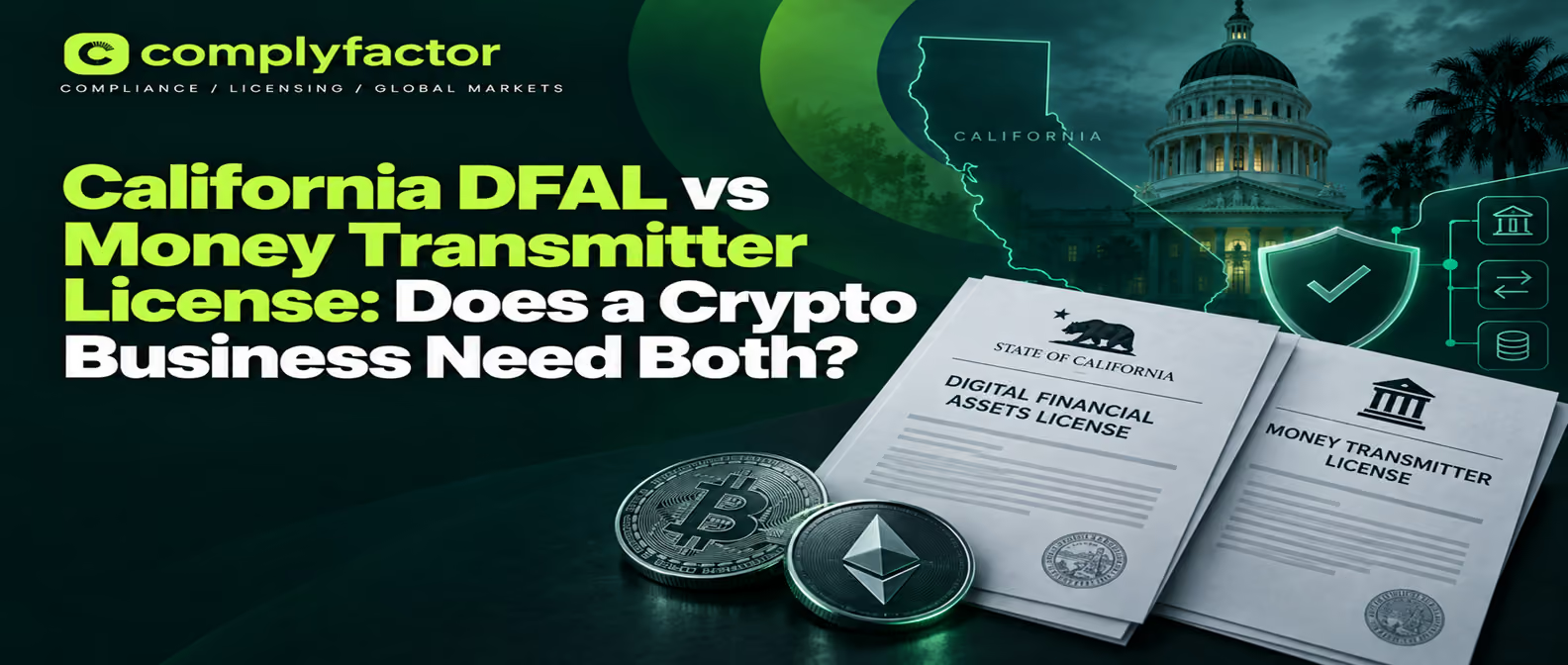
California DFAL vs Money Transmitter License: Does a Crypto Business Need Both?
See when a California crypto business may need a DFAL license, a money transmitter license, both, or neither under the final 2026 DFPI rules.



Key takeaways
- California's DFAL licensing requirement has been operative since July 1, 2026.
- Final 2026 regulations created three specific MTA exemptions for qualifying Digital Financial Asset Law Persons.
- DFAL, California MTA licensing and federal FinCEN MSB registration remain separate frameworks.
- General-purpose fiat transmission outside the final exemptions may still require a separate California MTA analysis.
California's Digital Financial Assets Law (DFAL) licensing requirement is now operative. Since July 1, 2026, a person generally may not engage in digital financial asset business activity with or on behalf of a California resident unless licensed by the Department of Financial Protection and Innovation (DFPI), awaiting a decision on a timely application, or exempt. DFPI's related rulemaking (PRO 02/23), which addresses DFAL license applications and an exemption from California's Money Transmission Act (MTA), reached final adoption with an effective date of June 29, 2026.
For crypto businesses, this raises a separate question DFAL does not answer on its own: does holding, or applying for, a California crypto license under DFAL also cover California's older money transmission licensing regime — or is a business still exposed to a separate MTA analysis? The honest answer depends on the specific activity: what the business does, whether it moves legal tender as well as digital assets, and whether that fiat movement fits within the scope of the MTA exemption DFPI adopted alongside DFAL. This article works through that overlap and where a business should focus its licensing review.
What Is California's DFAL?
DFAL was enacted through AB 39 and SB 401 (signed October 13, 2023) and later delayed by AB 1934, which pushed the licensing date from July 1, 2025 to July 1, 2026. It is administered by the DFPI and creates a dedicated licensing and supervision regime for "digital financial asset business activity" involving California residents.
Under Financial Code section 3102(i), that activity includes exchanging, transferring, or storing a digital financial asset, engaging in digital financial asset administration (issuing an asset redeemable for legal tender or another digital asset), holding electronic certificates representing interests in precious metals on another person's behalf, and exchanging certain in-game digital representations of value for a digital financial asset or for legal tender outside the game ecosystem.
DFAL applications are processed through the Nationwide Multistate Licensing System (NMLS), which DFPI began accepting DFAL applications through in 2026. Among the core California DFAL requirements, Financial Code section 3103 exempts several categories from licensure, including certain banks, persons who contribute only connectivity software or computing power to a network, and persons who reasonably expect to earn less than $50,000 annually from activity that would otherwise require a DFAL license.
What Does California's Money Transmission Act Cover?
The California MTA (Financial Code section 2000 et seq.) is a separate, older licensing framework that can apply to a business regardless of whether it also touches crypto. At a high level, the MTA can be triggered by receiving money for transmission, issuing or selling stored value, or issuing or selling payment instruments. It was not written with digital assets in mind, and DFPI has historically addressed the boundary between crypto activity and money transmission through individual opinion letters — a case-by-case approach that DFAL's 2026 rulemaking was intended to bring more structure to for DFAL-covered businesses specifically. This article does not attempt a full MTA guide; see ComplyFactor's Money Transmitter Licensing service for that broader analysis.
DFAL vs Money Transmitter License: What's the Difference?
Does a Crypto Business Need Both DFAL and a California Money Transmitter License?
There is no single answer that fits every crypto business. The right answer depends on the specific activities performed, whether the business ever holds or moves legal tender separately from digital-asset activity, and whether an exemption applies on either side. Three scenarios illustrate how this plays out in practice.
Scenario 1 — DFAL Coverage May Extend to Certain Crypto-Related Fiat Flows
DFPI's final PRO 02/23 rulemaking amended 10 CCR § 80.3002, effective June 29, 2026, to add three specific exemptions from California MTA licensing for "Digital Financial Asset Law Persons" — a defined term under 10 CCR § 80.159.30 that covers both a DFAL licensee and an applicant who submitted a completed DFAL application on or before July 1, 2026 and is awaiting approval or denial. That distinction matters: the exemption is written for DFAL licensees and qualifying timely applicants specifically, not for every business that happens to touch crypto.
For those Digital Financial Asset Law Persons, § 80.3002(a) now exempts three categories of activity from separate MTA licensure:
- § 80.3002(a)(5): transmitting payment for the purchase or exchange of a digital financial asset, or transmitting the proceeds of a sale or exchange of a digital financial asset;
- § 80.3002(a)(6): selling or issuing stored value in California that can be used exclusively for the purchase, sale, or exchange of digital financial assets; and
- § 80.3002(a)(7): engaging in money transmission in California where the person's average daily outstanding money-transmission liability is $50,000 or less on a monthly basis, and the person complies with Chapter 5 of the MTA governing outstanding money-transmission liability as though it were licensed.
Separately, the same rulemaking added 10 CCR § 80.126.40, stating that "monetary value" under the MTA does not include a digital financial asset — the digital-asset side of a transaction is not itself MTA-relevant "money." These exemptions do not cover every dollar a DFAL-covered business handles: fiat activity outside the three categories above — general-purpose remittance, unrelated stored-value products, or fiat custody beyond what a digital-asset transaction requires — still needs its own MTA analysis.
Scenario 2 — Separate MTA Analysis May Still Be Needed
A business that transmits fiat outside the § 80.3002(a)(5)–(7) exemptions — for example, a broader payments or remittance function not tied to a digital-asset purchase, exchange, or sale — may still require a separate MTA license or exemption analysis. This could include a crypto platform that also offers general-purpose money transfer, a stored-value feature usable beyond digital-asset purchases, or fiat custody extending beyond what the digital-asset transaction itself requires. These situations require their own MTA review; DFAL status does not resolve them.
Scenario 3 — A Business May Be Exempt From DFAL Itself
Some businesses fall outside DFAL entirely. Financial Code section 3103 exempts, among others, certain banks, persons who contribute only connectivity software or computing power to a network (without otherwise engaging in covered activity), and persons who reasonably expect to earn less than $50,000 annually from activity that would otherwise be licensable. A DFAL exemption, however, says nothing about MTA status — a business exempt from DFAL because it falls under the $50,000 threshold, for instance, could still need to evaluate MTA exposure if it separately handles customer fiat.
What Changed in California in 2026?
DFPI's final PRO 02/23 regulations — covering DFAL license application requirements and the related MTA exemption — took effect June 29, 2026, shortly before the July 1, 2026 DFAL licensing deadline. DFAL applications are submitted through NMLS, which DFPI opened for DFAL filings earlier in 2026. Businesses that had not obtained a license or submitted a timely, complete application by July 1, 2026 lost the ability to continue serving California residents without exposure to DFPI enforcement, including civil penalties.
Which Crypto Business Models Need the Closest Licensing Review?
- Crypto exchanges — Exchange activity generally falls within DFAL's defined scope when conducted with or on behalf of California residents, subject to applicable statutory exemptions; fiat on-ramp and off-ramp flows raise the § 80.3002(a)(5) exemption question directly.
- Digital asset trading platforms — Similar to exchanges; the closer the platform's fiat handling sits to pure trade settlement described in § 80.3002(a)(5), the more likely it falls inside the exemption, but this should not be assumed without review.
- Custodial wallet providers — Custody of digital assets is core DFAL activity; if the provider also holds customer fiat balances, that fiat function needs its own look against § 80.3002.
- Crypto payment companies — Payment-processing activity that extends beyond transmitting payment for, or proceeds from, a digital-asset transaction falls outside the § 80.3002(a)(5) exemption and may require separate MTA analysis.
- Stablecoin-related businesses — DFAL's current FAQ states that stablecoin requirements depend on the characteristics of the stablecoin and directs businesses to Chapter 6 of DFAL.
- Fiat-to-crypto / crypto-to-fiat platforms — The fiat leg tied directly to a digital-asset purchase or sale is what § 80.3002(a)(5) is aimed at, but the platform's other fiat services, if any, may not be covered.
- Crypto kiosks — Subject to DFAL's separate kiosk provisions in addition to the general licensing analysis (see below).
What About Crypto Kiosks?
DFAL contains kiosk-specific provisions layered on top of the general licensing requirement. Kiosk operators have been required since January 1, 2024 to report kiosk locations to DFPI and to limit daily transactions to $1,000 per customer; since January 1, 2025, pre-transaction disclosures and fee caps have applied; and by July 1, 2026, kiosk operators became subject to the same DFAL licensing requirement as other covered businesses. A kiosk operator's licensing analysis still runs through the same DFAL and MTA framework described above — the kiosk rules are additional operational requirements, not a separate licensing track.
Do You Still Need FinCEN MSB Registration?
DFAL, the California MTA, and FinCEN's federal money services business (MSB) framework are three separate regimes. A DFAL license does not satisfy federal registration, and California licensure of any kind does not replace obligations under the Bank Secrecy Act where a business's activities meet FinCEN's MSB or money transmitter definitions. A crypto business operating in California should evaluate its federal registration obligations independently of its state licensing posture. See ComplyFactor's FinCEN MSB Registration service for that separate analysis.
What Should a Crypto Business Check Before Applying?
This is a practical pre-application checklist, not legal advice:
- Are we serving California residents, directly or through a platform they can access?
- What specific digital-asset activities do we perform — exchange, transfer, custody, administration?
- Do we hold or control customer digital assets at any point?
- Do we transmit fiat, and if so, is that transmission limited to the purchase, exchange, or sale proceeds of a digital financial asset?
- Does the current MTA exemption at 10 CCR § 80.3002(a)(5)–(7) apply to our specific fiat flows, as confirmed against DFPI's current published text?
- Do we conduct any fiat money transmission separate from our digital-asset activity?
- Do we qualify for a DFAL exemption under Financial Code section 3103?
- Do we have a federal FinCEN MSB obligation independent of our California analysis?
- Do other states' money transmitter licenses apply to our activity outside California?
How ComplyFactor Supports U.S. Crypto Licensing
Determining whether a crypto business needs a DFAL license, a California money transmitter license, both, or neither requires mapping the business's actual activities against overlapping statutory frameworks — not applying a template answer. ComplyFactor supports crypto and digital-asset businesses with licensing-scope assessment across state and federal frameworks, state money transmitter licensing strategy and NMLS preparation, FinCEN MSB registration, BSA/AML program readiness, application documentation, and multi-state licensing planning. ComplyFactor does not guarantee licensing approval or outcomes; every engagement starts with an activity-based scoping review specific to the business.
FAQ
Does the MTA exemption apply while a timely DFAL application is pending?
Yes. Under 10 CCR § 80.159.30, "Digital Financial Asset Law Person" includes both a DFAL licensee and an applicant who submitted a completed DFAL application on or before July 1, 2026 and is awaiting approval or denial. A qualifying pending applicant, not only a licensee, can rely on the § 80.3002(a)(5)–(7) exemptions.
Does the final MTA exemption cover stored value?
Yes, in a limited way. Under § 80.3002(a)(6), a Digital Financial Asset Law Person is exempt from MTA licensure for selling or issuing stored value in California, but only where that stored value can be used exclusively for the purchase, sale, or exchange of digital financial assets. Stored value with any broader use falls outside this exemption.
Is there a $50,000 MTA-liability exemption for a DFAL business?
Yes, but it is a different $50,000 figure from DFAL's own exemption. Under § 80.3002(a)(7), a Digital Financial Asset Law Person is exempt from MTA licensure where its average daily outstanding money-transmission liability is $50,000 or less on a monthly basis and it complies with Chapter 5 of the MTA on outstanding liability. This is separate from the Financial Code section 3103 exemption for businesses reasonably expecting less than $50,000 in annual DFAL-covered activity — the two thresholds measure different things and do not substitute for each other.
Does being exempt from DFAL automatically make a business exempt from the MTA?
No. A DFAL exemption under Financial Code section 3103 and an MTA exemption under 10 CCR § 80.3002 are separate determinations. A business that qualifies for one is not automatically covered by the other and should analyze both frameworks independently.
Is DFAL the same as New York's BitLicense?
No. DFAL is California's own licensing framework under Financial Code Division 1.25, created by AB 39 and SB 401 and administered by DFPI. It has its own definitions, application process, and exemptions, and is not an adoption of New York's BitLicense regime.
Can a crypto company offering general-purpose fiat remittance still need a California MTA license?
Yes. Fiat remittance activity that falls outside the § 80.3002(a)(5)–(7) exemptions — for example, general-purpose money transfer not tied to a digital-asset purchase, sale, or exchange — requires its own separate MTA licensing analysis, regardless of the company's DFAL status.
---
ComplyFactor specializes in FINTRAC MSB and PSP registration, independent AML effectiveness reviews, and compliance program design for Canadian and foreign money services businesses, payment service providers, fintechs, and virtual asset service providers.
.svg)
.svg)
Related insights
Book a free Canada AML consultation
Tell us about your business and we'll confirm which services you need — free, no obligation, 30 minutes.