BOI Reporting Requirements 2026: Who Still Has to File?
FinCEN’s August 2026 final rule permanently exempted U.S. companies from BOI reporting. Here’s who still has to file, what changed, and what businesses should do now.
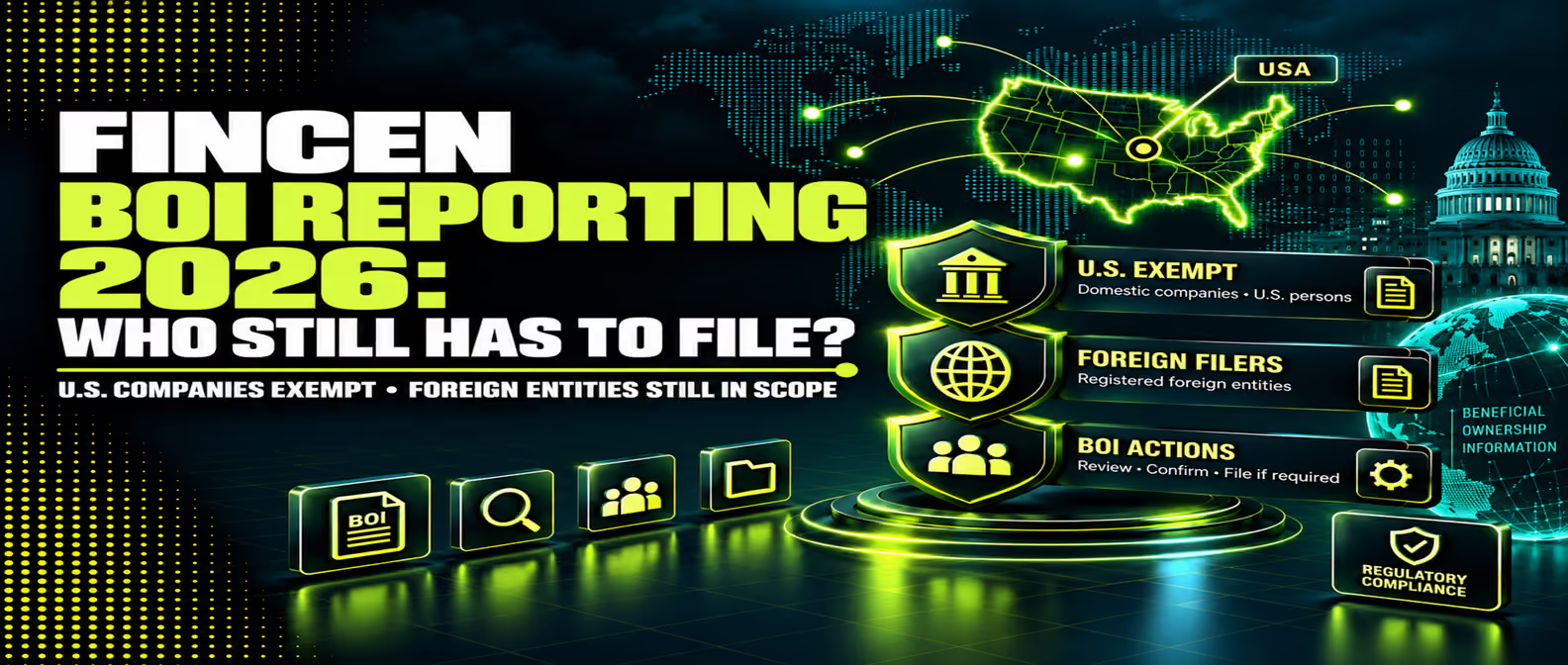



Key takeaways
- As of September 2026, U.S. companies and U.S. persons are exempt from federal BOI reporting under FinCEN's August 11 final rule, effective August 14, 2026.
- Only certain foreign-formed entities registered to do business in the U.S. remain potentially in scope, subject to the CTA's applicable exemptions.
- Reporting companies do not report BOI for U.S.-person beneficial owners or U.S.-person company applicants, and U.S. persons with FinCEN IDs do not need to update or correct them.
- The BOI exemption does not remove separate FinCEN MSB, BSA/AML, sanctions, licensing, or applicable state-law obligations.
As of September 2026, most U.S. companies no longer have to file beneficial ownership information (BOI) reports with the Financial Crimes Enforcement Network (FinCEN). On August 11, 2026, FinCEN issued a final rule permanently exempting U.S. companies and U.S. persons from BOI reporting under the Corporate Transparency Act (CTA). The rule took effect on August 14, 2026, upon publication in the Federal Register. The FinCEN BOI reporting rules now apply primarily to certain foreign entities registered to do business in the United States.
If your business was created in the United States, this rule almost certainly ends your BOI filing obligation. If your business was formed abroad and registered to operate here, you may still have one.
This article works through what changed, who is exempt, who remains in scope, and what to do with a BOI report you already filed.
What Changed in FinCEN's 2026 BOI Final Rule?
The Corporate Transparency Act took effect on January 1, 2024, and was written around a broad reporting-company population: most corporations, LLCs, and similar entities created or registered to do business in the United States, along with their beneficial owners.
That population narrowed well before this year's final rule. FinCEN suspended enforcement against U.S. citizens and domestic reporting companies in March 2025, then issued an interim final rule on March 21, 2025 that removed most domestic entities from the reporting regime and confined BOI reporting to foreign reporting companies. The August 11 final rule makes that interim relief permanent and extends it further.
Before this rule (under the March 2025 interim rule): U.S. companies and U.S. persons were not being enforced against, but the underlying regulatory text and some open questions — including whether U.S. persons serving as company applicants for a foreign reporting company still had to be reported, and whether U.S. persons with FinCEN identifiers had to keep those identifiers updated — had not been fully resolved.
Under the final rule: those questions are closed. FinCEN confirmed that:
- Reporting companies do not need to report BOI for U.S. person beneficial owners or U.S. person company applicants.U.S. persons are not required to provide BOI to a reporting company.
- U.S. persons who previously obtained a FinCEN identifier are not required to update or correct that information.Foreign pooled investment vehicles registered in the United States do not need to report the BOI of a U.S. person who controls the vehicle.
- FinCEN will delete BOI previously submitted by U.S. persons from its database.
The final rule primarily removes or narrows BOI reporting obligations rather than adding new ones. Businesses should still distinguish this change from separate federal or state requirements that may apply to their activities.
Is BOI Reporting Still Required for U.S. Companies in 2026?
No. Under the current final rule, corporations, LLCs, and other entities created under the law of a U.S. state or tribal jurisdiction are exempt from BOI reporting. This is a permanent exemption, not an enforcement pause — FinCEN has removed the requirement itself, not simply declined to act on it.
This also means U.S. persons generally do not need to provide beneficial ownership information to a reporting company where they are a beneficial owner or company applicant.
One caveat worth stating plainly: this is a federal exemption from CTA reporting to FinCEN specifically. It does not automatically eliminate separate state-level beneficial ownership disclosure requirements. New York, for example, has a separate beneficial ownership disclosure regime that applies to certain LLCs formed under foreign-country law and authorized to do business in New York, subject to its own exemptions and filing rules. Businesses should check whether any state where they operate has an independent disclosure requirement before assuming no state filing applies.
Who Needs to File a BOI Report in 2026?
Under the final rule, “reporting companies” are limited to entities formed under the law of a foreign country that are registered to do business in any U.S. state or tribal jurisdiction. This is the group the current rule is built around.
Being a foreign-formed, U.S.-registered entity does not automatically mean a filing obligation applies — the CTA's existing exempt entity categories still apply to foreign reporting companies. So the practical question for a foreign entity registered in the U.S. is: (1) are we a reporting company under the foreign-entity definition, and (2) does an exemption apply to us?
This determination depends on the specific entity's formation jurisdiction, registration status, and activities — not something to conclude from a general description of the business. A payments company, remittance provider, or crypto platform with a foreign parent or foreign holding structure that is separately registered to do business in a U.S. state should have this assessed rather than assumed.
What Information Must a Foreign Reporting Company Provide?
Where a foreign entity is a reporting company, the information it must report is narrower than it would have been before this rule because of the U.S.-person exemptions:
- The company reports required beneficial ownership information for its non-U.S.-person beneficial owners.Where company-applicant reporting otherwise applies, required non-U.S.-person company applicants may still need to be reported.
- It does not need to report BOI for a beneficial owner who is a U.S. person.It does not need to report BOI for a U.S. person acting as a company applicant.
- A foreign pooled investment vehicle registered in the U.S. is not required to report the BOI of a U.S. person who exercises control over it.
In practice, a foreign reporting company should identify the non-U.S. persons who are reportable under the current rule while excluding U.S. persons from the beneficial-owner and company-applicant fields covered by the final rule. Because the exact reporting population can depend on formation, registration timing, ownership, and exemption status, current FinCEN guidance should be checked rather than relying on a pre-August-2026 filing checklist.
What Happens to BOI That U.S. Companies Already Filed?
FinCEN has announced that it will delete beneficial ownership information previously submitted by U.S. persons — now exempt from the reporting requirement — from its BOI database. This applies to information filed by U.S. companies and U.S. persons under the earlier version of the rule, before the exemptions took hold.
FinCEN has not published a specific mechanical timeline for completing this deletion process, and businesses should check FinCEN's own BOI page for the current status of that process rather than assume it has already happened for their specific filing. What is clear from FinCEN's own statements is the intent: U.S. person BOI is being removed from the database because it is no longer required to be there.
Do Existing FinCEN IDs Still Need to Be Updated?
No — not for U.S. persons. The final rule specifically exempts U.S. persons who have already obtained a FinCEN identifier from any obligation to update or correct the information they submitted when they applied for it. Before this rule, this point was not fully settled; the final rule closes it.
This matters for individuals who obtained a FinCEN ID to simplify their inclusion in a reporting company's BOI filing. If that person is a U.S. person, they do not need to go back and correct or refresh that FinCEN ID information now, even if some of it has changed since they filed it.
BOI Reporting vs. Other FinCEN Requirements
BOI reporting under the Corporate Transparency Act is a separate legal framework from a business's other FinCEN and Bank Secrecy Act (BSA) obligations. Being exempt from BOI reporting does not exempt a business from anything else FinCEN or the BSA requires of it.
If a business is a Money Services Business under FinCEN's MSB categories — a money transmitter, currency dealer, check casher, or similar — it still needs to assess whether FinCEN MSB registration applies, maintain a BSA/AML program calibrated to its activity, and meet its recordkeeping and reporting obligations under the BSA. None of that is affected by the CTA's BOI exemption. BOI reporting is a corporate-transparency registry requirement; BSA/AML obligations exist to detect and prevent money laundering through the business's operations.
What Should Businesses Do Now?
If you're a U.S.-formed entity: Confirm the domestic exemption applies to you and stop relying on any pre-August-2026 guidance, checklist, or filing reminder that tells you to submit or renew a BOI report. Check whether any state where you operate has its own beneficial ownership disclosure law that is not affected by the federal exemption.
If you're a foreign entity registered to do business in the U.S.: Have your reporting-company status and any applicable exemption assessed against the current rule rather than assumed from a general description of your structure. If you are a reporting company, confirm your BOI report correctly excludes U.S.-person beneficial owners and U.S.-person company applicants.
If you previously filed a BOI report as a U.S. company or U.S. person: Check FinCEN's current guidance on the status of previously submitted information rather than assuming it has already been deleted, and do not submit a correction you no longer need to file.
If you have other FinCEN or BSA obligations: Treat those separately. MSB registration, BSA/AML program requirements, and sanctions-screening obligations are unaffected by the BOI exemption and should be reviewed on their own terms.
None of the above is legal advice, and reporting-company status for a specific entity depends on facts that vary — formation jurisdiction, registration history, ownership structure, and which statutory exemptions might apply.
Why So Much BOI Information Online Is Now Outdated
The Corporate Transparency Act's reporting requirement has changed several times since it took effect in January 2024 — first through litigation and injunctions, then through FinCEN's enforcement pause and interim rule in March 2025, and now through this year's final rule. A large amount of BOI guidance published online was written for an earlier version of the rule and still tells U.S. LLCs and corporations to file.
FinCEN's own BOI FAQ page currently warns that some material on its site may not yet reflect the final rule and should be disregarded where it conflicts. When checking BOI guidance, look at the publication or last-updated date and confirm it reflects the August 2026 final rule specifically. For the regulator's current position, see FinCEN's BOI reporting page.
FAQs
Is a BOI report required for an LLC in 2026?
No. A U.S.-formed LLC is exempt from BOI reporting under the current final rule, regardless of its size or industry — the exemption turns on formation jurisdiction, not entity type.
Is there a BOI filing deadline in 2026?
Not for exempt U.S. entities — there is no deadline because there is no filing requirement. For an in-scope foreign reporting company, the applicable deadline depends on when it registered to do business in the U.S.: entities registered before March 26, 2025 had an April 25, 2025 deadline; entities registered on or after that date generally have 30 calendar days from the earlier of actual notice or public notice that their U.S. registration is effective. Confirm the exact deadline against current FinCEN guidance for the entity's specific registration date.
Does a DBA need to file a BOI report?
Not on its own. A “doing business as” name is not a separate legal entity, so it does not independently trigger a filing obligation. Reporting status attaches to the underlying entity that was formed or registered.
Can a foreign company be exempt from BOI reporting even if it is registered in the United States?
Yes. Being a foreign entity registered to do business in the U.S. makes a company a potential reporting company, but the CTA's exempt entity categories still apply. Registration alone does not settle the question; the applicable exemptions have to be checked against the specific entity.
What if a foreign reporting company has both U.S. and non-U.S. beneficial owners?
Under the current rule, the company reports BOI for reportable non-U.S.-person beneficial owners. A beneficial owner who is a U.S. person is not reported, and that U.S. person is not required to provide their information for this purpose.
Does the federal BOI exemption override state beneficial ownership laws?
No. The federal exemption applies to the CTA reporting obligation to FinCEN. Separate state laws can still apply. New York, for example, requires certain LLCs formed under foreign-country law and authorized to do business in New York to file beneficial-ownership disclosures or exemption attestations, subject to its own rules.
Is BOI reporting the same as FinCEN MSB registration?
No. BOI reporting under the CTA is a corporate-ownership transparency requirement. FinCEN MSB registration is a separate Bank Secrecy Act filing for businesses that meet FinCEN's Money Services Business definition. A company can be exempt from one and still be subject to the other.
Do previously filed U.S. BOI reports need to be withdrawn or corrected?
No. FinCEN has said it will delete BOI previously submitted by U.S. persons because that information is no longer required. FinCEN has not published a specific completion date for that deletion process, so do not assume a specific filing has already been removed. There is nothing the filer needs to submit simply to “undo” a report that is no longer required.
Need Help With Other U.S. FinCEN or BSA Obligations?
BOI reporting is separate from the registration, AML program, audit, licensing, and sanctions obligations that can apply to MSBs, fintechs, payment businesses, and digital-asset companies. Explore ComplyFactor's U.S. AML/BSA compliance support for help with those confirmed service areas.
ComplyFactor specializes in FINTRAC MSB and PSP registration, independent AML effectiveness reviews, and compliance program design for Canadian and foreign money services businesses, payment service providers, fintechs, and virtual asset service providers.
.svg)
.svg)
Related insights
Book a free Canada AML consultation
Tell us about your business and we'll confirm which services you need — free, no obligation, 30 minutes.