🎯 Expert RPAA Compliance Support
Navigating Bank of Canada PSP registration requirements? ComplyFactor provides comprehensive compliance solutions for payment service providers under the Retail Payment Activities Act, including MLRO services, operational risk frameworks, safeguarding policies, and registration application support.
Understanding the Retail Payment Activities Act: What Canadian PSPs Must Know in 2026
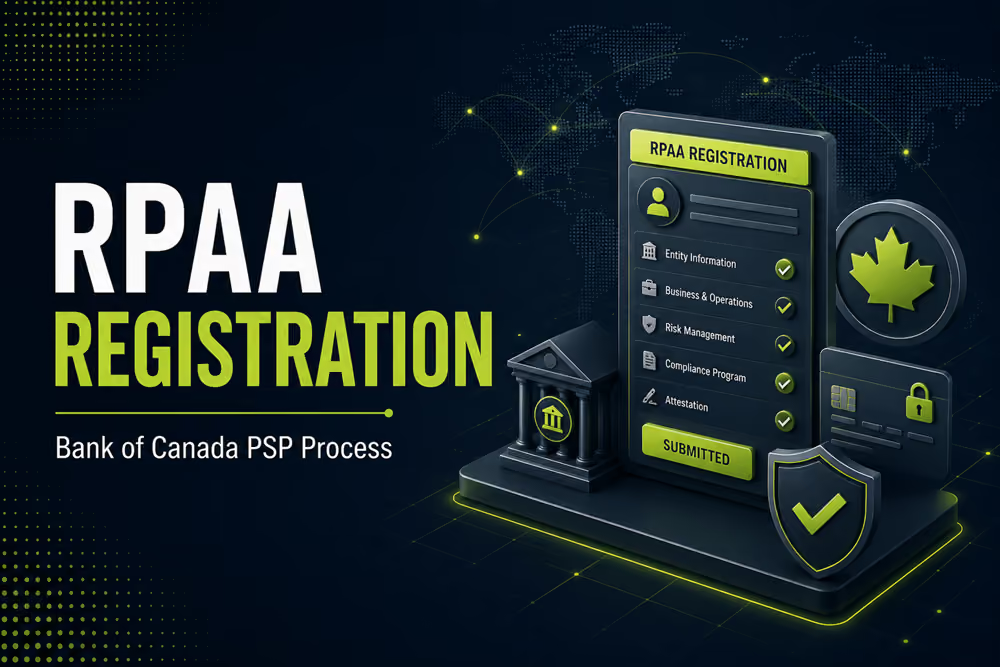
The Retail Payment Activities Act (RPAA) represents Canada’s most comprehensive regulatory framework for payment service providers. As of January 2026, the transition period has ended—any payment service provider (PSP) not yet registered with the Bank of Canada is operating illegally and faces substantial penalties.
Critical Status Update: The RPAA transition period concluded September 7, 2025. PSPs who applied during the transition may continue operating pending their registration decision. PSPs applying now must receive approval before commencing any retail payment activities. Operating without registration exposes organizations to administrative monetary penalties potentially exceeding $100,000 per violation, plus potential criminal prosecution.
If your business initiates electronic funds transfers, maintains end-user accounts, authorizes payments, or transmits payment instructions, you likely require RPAA registration. This comprehensive guide clarifies registration criteria, compliance requirements, and implementation strategies for the Bank of Canada’s supervisory framework.
Who Must Register as a Payment Service Provider Under RPAA?
Domestic PSPs: Core Registration Triggers
The RPAA mandates registration for any individual or entity with a place of business in Canada performing retail payment activities. According to the Bank of Canada’s supervisory criteria, registration is required if you perform any of these payment functions in relation to an electronic funds transfer (EFT):
Core Payment Functions:
- Initiating electronic funds transfers – sending payment instructions on behalf of payers or payees
- Maintaining accounts – providing account facilities through which EFTs are initiated
- Authorizing electronic funds transfers – approving or authenticating payment transactions
- Transmitting payment instructions – routing payment messages between parties
- Providing clearing services – calculating positions between financial institutions
- Providing settlement services – effecting final transfer of funds
Critical Distinction: These activities must be performed “in relation to” an electronic funds transfer and cannot be merely incidental to another primary business activity. For example, an e-commerce platform processing its own payment acceptance is likely performing incidental functions. A platform processing payments for third-party merchants is performing non-incidental payment functions requiring registration.
Foreign PSPs: Cross-Border Registration Requirements
Foreign payment service providers without a Canadian physical presence must register if they satisfy both conditions:
Condition 1: Serve Canadian End Users
- Perform retail payment activities for individuals or entities physically located in Canada
- Physical location determines end-user status—Canadian citizens temporarily abroad are not Canadian end users
Condition 2: Direct Activities at Canada
- Market payment services to Canadian individuals or entities
- Maintain a Canadian website or localized content
- Accept Canadian currency
- Provide customer support in Canadian languages or time zones
- Advertise in Canadian media or through Canadian channels
- Target Canadian businesses specifically
Example: A UK-based payment processor serving a Canadian merchant is not automatically subject to RPAA if they don’t actively market to Canadian businesses. However, if they maintain a .ca website, advertise “solutions for Canadian merchants,” or provide CAD settlement, they likely meet the “directing activities” threshold. <div style=”border-color:#e7484899;border-style:solid;border-width:1px;border-radius:16px;color:#1e1e1e;background:linear-gradient(86deg,rgb(255,240,242) 6%,rgb(255,255,255) 100%);margin-top:16px;margin-bottom:32px;padding:24px;font-family:-apple-system,BlinkMacSystemFont,’Segoe UI’,Roboto,Oxygen-Sans,Ubuntu,Cantarell,’Helvetica Neue’,sans-serif”> <div style=”display:flex;align-items:center;gap:12px;margin-bottom:12px”> <span style=”font-size:20px”>⚠️</span> <p style=”color:#e74848;font-size:16px;font-weight:600;line-height:1.5;margin:0″>COMMON MISTAKE</p> </div> <p style=”color:#1e1e1e;font-size:18px;font-weight:500;line-height:1.5;margin:0″>Foreign PSPs incorrectly assume they’re exempt because they partner with a registered Canadian PSP. This is false. You remain independently responsible for registration regardless of your partner’s status. The RPAA holds both entities accountable—partnership doesn’t transfer compliance obligations.</p> </div>
Entity-Based Exclusions: Who Doesn’t Need RPAA Registration
Section 9 of the RPAA excludes specific entities already subject to federal or provincial prudential regulation:
Federal Financial Institutions:
- Banks and authorized foreign banks under the Bank Act
- Federal credit unions
- Federally regulated insurance companies
- Federally regulated trust and loan companies
Provincial Financial Institutions:
- Credit unions and caisses populaires under provincial regulation
- Provincially regulated insurance companies
- Provincially regulated trust and loan companies accepting deposits transferable by order
Important: These exclusions are entity-based, not activity-based. If an excluded entity establishes a separate legal entity to perform payment activities, that new entity may require registration.
Activity-Based Exclusions: Exempt Payment Functions
Even if your entity doesn’t qualify for exclusion, certain payment activities are excluded:
Designated System Activities (Section 7): Payment functions performed using systems designated under Section 4 of the Payment Clearing and Settlement Act are excluded. However, functions performed outside these designated systems remain in scope.
Incidental Activities (Section 8): Payment functions incidental to another service or business activity are excluded. The Bank assesses whether functions are truly incidental based on:
- Whether payment functions generate separate revenue
- Whether payment services are marketed independently
- The prominence of payment services in your business model
- Whether you hold end-user funds
Securities and Derivatives (Section 6): Payment functions performed for carrying out securities transactions or eligible financial contracts are excluded, but only to the extent they directly facilitate those transactions.
For detailed comparison of MSB vs PSP licensing requirements, see our comprehensive guide.
RPAA Registration Timeline: Critical Dates for PSP Compliance
The Transition Period: Now Concluded
November 1, 2024 – September 7, 2025: Transition period during which existing PSPs could submit applications while continuing operations.
Current Status (January 2026): The transition period has ended. Different rules now apply based on your application timing:
If You Applied Before September 8, 2025:
- Section 108 of the RPAA allows continued operations until receiving a registration decision
- You may continue performing retail payment activities pending the Bank’s decision
- Registration decisions began issuing September 8, 2025
- No communication about your application status was permitted during the transition period
If You’re Applying After September 8, 2025:
- You must be registered before performing any retail payment activities
- You cannot operate while your application is pending
- Processing times vary but expect 60-90 days minimum for straightforward applications
- Applications requiring national security review may take 180+ days
Critical Deadline for New Market Entrants: Plan for 4-6 months from application submission to potential registration approval. Build this timeline into your Canadian market entry strategy.
Application Processing Timeframes
Understanding realistic timeframes helps with business planning:
Standard Processing: 60-90 days for applications with:
- Complete information submitted initially
- No national security review triggers
- Straightforward corporate structures
- No complex safeguarding arrangements
Extended Processing: 90-180+ days for applications involving:
- Incomplete initial submissions requiring additional information
- Complex corporate structures with multiple affiliates
- Foreign beneficial ownership
- Novel safeguarding arrangements requiring legal opinion review
- National security review
Refusal Decision Timing:
- 45 days after additional information period expires
- 45 days after application deemed complete (for prescribed refusal reasons)
- 30 days for refusals under subsection 48(2)
- Immediately following ministerial directive
The $2,500 application fee is non-refundable regardless of outcome or processing time.
Core RPAA Compliance Requirements for Registered PSPs
1. Operational Risk Management and Incident Response Framework
Every registered PSP must establish, implement, and maintain a comprehensive operational risk framework. The Bank of Canada’s operational risk guideline establishes minimum expectations.
Framework Documentation Must Include:
- Risk Identification and Assessment: Systematic processes for identifying operational risks across all business lines, technology systems, and third-party dependencies
- Risk Monitoring and Measurement: Key risk indicators, monitoring thresholds, and escalation triggers
- Risk Mitigation and Control: Preventive and detective controls addressing identified risks
- Incident Classification: Criteria defining incident severity levels and classification methodology
- Incident Response Procedures: Step-by-step response protocols for different incident types
- Business Continuity Planning: Recovery time objectives, recovery point objectives, and continuity strategies
- Disaster Recovery Planning: Technology recovery procedures and testing schedules
- Third-Party Risk Management: Due diligence, ongoing monitoring, and contingency plans for material service providers
- Testing and Validation: Framework testing frequency, methodologies, and documentation requirements
Senior Officer Designation and Responsibilities:
Section 1 of the Retail Payments Activities Regulations defines “senior officer” as:
- A board member who is also a full-time employee (e.g., executive board members)
- C-suite executives: CEO, COO, President, CRO, CFO, Chief Accountant, Chief Auditor, or functional equivalents
- Any officer reporting directly to the board, CEO, or COO
Key Points:
- Senior officers need not be Canadian residents
- Senior officers need not be direct employees (can be outsourced)
- Senior officers must report directly to board/CEO/COO to satisfy the definition
- Senior officers require sufficient seniority and authority to fulfill their responsibilities
Senior Officer Responsibilities Include:
- Receiving operational incident reports
- Being notified of material framework deficiencies
- Overseeing framework implementation and effectiveness
- Approving material framework changes
- Ensuring adequate resources for risk management
For organizations requiring comprehensive AML compliance programs that integrate with RPAA operational frameworks, ComplyFactor provides integrated solutions addressing both requirements.
2. Safeguarding End-User Funds: Three Approved Methods
PSPs holding end-user funds face strict safeguarding requirements under subsection 20(1) of the RPAA. You must protect end-user funds through one of three approved methods—you cannot mix methods for the same funds.
Option A: Trust Arrangement
Establish a valid express trust under common law or the Civil Code of Québec meeting these requirements:
Trust Structure Requirements:
- Funds held in dedicated safeguarding account at eligible Canadian financial institution
- Account used exclusively for safeguarding (no operational expenses, no settlement activities, no corporate payments)
- Trust clearly segregates end-user funds from all corporate funds
- Trust documented with appropriate legal instruments
Legal Opinion Requirements: The Bank expects written legal opinions from qualified counsel confirming:
- A valid express trust has been established under applicable law
- Trust terms satisfy all RPAA and RPAR requirements
- No structural issues compromise trust validity
- Trust arrangement will function effectively during PSP insolvency
Common Trust Pitfalls to Avoid:
- Using trust accounts for settlement with payment networks (compromises trust integrity)
- Retaining interest earned on trust funds (may invalidate trust depending on terms)
- Commingling even temporarily with corporate funds
- Paying any expenses from trust account other than trust administration costs
Option B: Insurance Product
Obtain insurance from an eligible provider with these characteristics:
Insurance Policy Must Ensure:
- Coverage value equals or exceeds end-user funds held
- Coverage adjusts as fund amounts fluctuate
- Proceeds payable to end users (not forming part of PSP estate)
- Payout triggered by PSP insolvency events defined in subsection 14(3) RPAR
- Proceeds payable “as soon as feasible” after insolvency event
- Policy survives PSP insolvency and creditor compromises
- PSP receives minimum 30-day cancellation notice
PSP Insolvency Events (subsection 14(3) RPAR) include:
- Bankruptcy orders
- Receivership appointments
- Winding-up orders
- Proposals under Bankruptcy and Insolvency Act
- Arrangements under Companies’ Creditors Arrangement Act
Monitoring Obligations: PSPs using insurance must:
- Monitor coverage daily against end-user fund balances
- Implement systems detecting when coverage falls below required amounts
- Adjust coverage promptly when fund amounts increase
- Maintain documented methodology for determining coverage values
Option C: Guarantee Instrument
Secure a guarantee from an eligible provider ensuring:
Guarantee Terms Must Include:
- Value equal to or exceeding end-user funds held
- Guarantee survives PSP insolvency, creditor compromises, debt restructuring
- Proceeds benefit end users exclusively
- Payout triggered by same insolvency events as insurance
- Proceeds payable “as soon as feasible” after trigger event
- Minimum 30-day cancellation notice to Bank of Canada
- Guarantee remains valid despite PSP obligation extinguishment
Guarantee Format: While the RPAR doesn’t prescribe guarantee format, the Bank expects:
- Legal agreement between PSP and guarantee provider
- Clear terms demonstrating subsection 14(2) compliance
- Explicit provisions addressing each required element
- Legal opinions confirming guarantee validity and enforceability
Eligible Insurance/Guarantee Providers:
Providers must be:
- Canadian financial institutions listed in paragraphs 9(a) to 9(h) of RPAA; or
- Foreign financial institutions prudentially regulated under comparable capital, liquidity, governance, supervision, and risk management standards to Canadian institutions
Providers cannot be affiliated with the PSP.
Critical Clarification on Deposit Insurance:
CDIC (Canada Deposit Insurance Corporation) coverage or provincial deposit insurance does not satisfy RPAA safeguarding requirements. Here’s why:
- Deposit insurance protects account holders (the PSP) if the financial institution fails
- RPAA safeguarding protects end users if the PSP fails
- These are fundamentally different protection scenarios
- Deposit insurance alone provides no protection when the PSP becomes insolvent
You may hold safeguarded funds in CDIC-insured accounts, but you must also implement trust, insurance, or guarantee arrangements protecting end users from PSP insolvency.
COMPLIANCE ALERT
The Bank of Canada expects legal opinions on safeguarding arrangements during periodic assessments. Prepare for this by obtaining written legal opinions from qualified counsel when establishing your safeguarding method. Opinions should address validity, compliance with all RPAA/RPAR requirements, and effectiveness during insolvency scenarios.
3. Safeguarding-of-Funds Framework: Operational Documentation
Beyond selecting a safeguarding method, subsection 15(1) of RPAR requires a comprehensive written framework ensuring:
Framework Objectives:
- End users have reliable access without delay to their funds during normal operations
- Insurance/guarantee proceeds pay to end users “as soon as feasible” following PSP insolvency
Required Framework Elements:
Operational Procedures:
- Daily reconciliation processes for end-user fund balances
- Safeguarding account monitoring and control procedures
- Processes for adding/removing funds from safeguarding arrangements
- Controls preventing unauthorized use of safeguarded funds
Insolvency Procedures:
- How insolvency administrators will be informed of events triggering payout
- Procedures for calculating each end user’s entitlement
- Methods for returning funds to individual end users
- Timeline expectations for completing distribution
- Documentation requirements for claims processing
Risk Identification: Subsection 15(3) requires identifying legal and operational risks that could hinder framework objectives, including:
- Risks related to insurance/guarantee policy terms
- Risks from third-party service provider dependencies
- Technological risks affecting fund access
- Legal risks affecting trust validity or insurance/guarantee enforceability
- Operational risks during business transitions or system failures
For guidance on implementing robust safeguarding frameworks, see our detailed regulatory framework resources.
4. Annual Reporting to the Bank of Canada
Registered PSPs must submit annual reports by March 31 each year, beginning March 31, 2026.
First Annual Report (Due March 31, 2026):
- Covers calendar year 2025
- Financial metrics based on your most recent financial year-end
- Submitted through PSP Connect portal
- Reporting form available in early 2026
Report Categories:
Operational Risk and Incident Response:
- Significant incidents experienced
- Framework testing results
- Material framework changes
- Control deficiencies identified and remediation
Safeguarding End-User Funds (if applicable):
- Average and peak end-user fund balances
- Safeguarding method(s) used
- Insurance/guarantee coverage values
- Safeguarding account details
Retail Payment Activity Metrics:
- Electronic funds transfer volumes by type
- Electronic funds transfer values by currency
- Number of end-user accounts maintained
- Cross-border transaction statistics
- Geographic distribution of activities
The Bank will publish detailed reporting guidance outlining specific metrics, definitions, and calculation methodologies.
The PSP Registration Application Process
Step 1: Confirm Registration Requirement
Before investing in application preparation, definitively confirm your registration obligation using this methodology:
Analysis Framework:
- Place of Business Test:
- Do you have offices, employees, or operations in Canada?
- If yes → Domestic PSP registration likely required
- Foreign PSP Test (if no Canadian place of business):
- Do you serve end users physically located in Canada?
- Do you actively market to Canadian individuals or entities?
- If yes to both → Foreign PSP registration likely required
- Payment Function Test:
- Do you initiate EFTs, maintain accounts, authorize payments, transmit instructions, or provide clearing/settlement?
- If yes → Continue analysis
- Incidental Activity Test:
- Are payment functions your primary business or a marketed service?
- Do you generate separate payment services revenue?
- Do you hold end-user funds?
- If any yes → Likely non-incidental (registration required)
- Exclusion Test:
- Are you an entity listed in section 9 of the RPAA?
- Do you perform functions only using designated systems under Section 4 PCSA?
- Are your activities truly incidental to another primary business?
- If no to all → Registration required
The Bank provides a self-assessment questionnaire to assist with this analysis. However, the questionnaire provides guidance only—not an official determination. Seek legal counsel if uncertainty remains.
Step 2: Prepare Required Information and Documentation
Section 29 of the RPAA and Section 24 of RPAR prescribe mandatory application information:
Corporate and Governance Information:
Basic Corporate Data:
- Legal name, all trade names, and business number (BN)
- Incorporation/formation jurisdiction and date
- Corporate registry information
- Head office and all operational locations
Organizational Structure:
- Ultimate beneficial owners (individuals with 25%+ ownership or control)
- Corporate organization chart showing all affiliated entities
- Parent companies and subsidiaries
- Ownership percentages for all material stakeholders
Governance:
- Board of directors (all members with full details)
- All officers
- Senior officer designation with justification of qualifications
Operational and Business Information:
Payment Activities:
- Detailed description of each payment function performed
- Payment products and services offered
- Technology platforms and systems used
- Payment networks and systems accessed
Business Profile:
- All business activities (payment and non-payment)
- Revenue breakdown by activity type
- Client types and geographic markets served
- Business plans for next 12-24 months
Retail Payment Metrics:
- Historical electronic funds transfer volumes (if operating)
- Historical values by currency
- Number of end-user accounts (if applicable)
- Cross-border transaction statistics
- Projected volumes and values for next 12 months
Third-Party Relationships:
Material Third-Party Service Providers: Must report any provider with material impact on:
- Operational risk management
- Safeguarding of end-user funds
- Core payment functionality
Required details:
- Provider legal name and location
- Services provided
- Materiality assessment
- Alternative provider arrangements (if any)
Agents and Mandataries:
- Legal name and business information
- Payment functions performed on your behalf
- Authority scope
- Locations where agents/mandataries operate
Affiliated Entities:
- Relationship type and nature
- Ownership percentage
- Business activities
- Involvement in your payment operations
Safeguarding Information (if holding end-user funds):
Method Selection:
- Safeguarding method chosen (trust, insurance, or guarantee)
- Detailed explanation of how method satisfies RPAA requirements
Supporting Documentation:
- Trust documents and legal opinions (if trust)
- Insurance policies and coverage calculations (if insurance)
- Guarantee agreements and legal opinions (if guarantee)
- Safeguarding-of-funds framework document
For Foreign PSPs Without Canadian Presence:
Canadian Agent/Mandatary (Required under paragraph 29(1)(o)):
- Name and address in Canada
- Authority to accept notices and orders on your behalf
- Contact information
This representative serves as your official contact point for Bank of Canada communications and service of legal documents.
Step 3: Complete PSP Connect Application
Access the Bank’s PSP Connect portal to submit your application:
Account Setup:
- One email address per application
- Create organizational profile
- Designate primary contact
Authorized Users and Delegates: You may designate individuals to:
- Complete application sections
- Submit supporting documents
- Respond to Bank information requests
- Pay application fees
- Receive application status updates
Consultants and Third-Party Assistance: If using consultants, add them as delegates rather than sharing login credentials. Delegates can access your application while maintaining clear accountability.
Application Sections: Complete all required sections:
- Corporate information
- Governance and management
- Business activities
- Payment functions
- Third-party relationships
- Operational framework
- Safeguarding arrangements (if applicable)
- Financial information
Supporting Documentation: Upload required documents:
- Corporate registry extracts
- Organizational charts
- Operational risk framework
- Safeguarding-of-funds framework
- Insurance policies or guarantee agreements
- Legal opinions
- Business plans
- Financial statements
Application Fee Payment:
- $2,500 non-refundable fee
- Payable via PSP Connect
- Application not considered submitted until fee received
Step 4: Bank of Canada Review Process
After submission, your application enters a multi-stage review:
Completeness Review: The Bank assesses whether your application contains all required information. If incomplete:
- You receive an information request under subsection 29(3)
- You have a prescribed period to respond
- Failure to respond may result in refusal
Substantive Review: The Bank evaluates:
- Whether you meet registration criteria
- Framework adequacy and completeness
- Safeguarding arrangement effectiveness
- Third-party risk management sufficiency
- Governance and accountability structures
Parallel Reviews:
FINTRAC Review: If you’re also subject to the Proceeds of Crime (Money Laundering) and Terrorist Financing Act, FINTRAC reviews your application concurrently for AML/CFT risks. The Bank will not issue a registration decision until FINTRAC completes its review.
National Security Review (if applicable): The Minister of Finance may initiate a 180-day national security review if deemed necessary. You’ll be notified if selected.
Additional Information Requests: Common reasons for requests include:
- Unclear safeguarding arrangements requiring clarification
- Missing beneficial ownership details
- Incomplete third-party service provider information
- Framework gaps requiring remediation plans
- Financial stability concerns requiring additional documentation
- Novel business models requiring detailed explanation
Respond comprehensively and promptly. The Bank may request clarification on your responses.
Step 5: National Security Review (if Triggered)
If the Minister of Finance initiates national security review:
Review Timeline:
- Up to 180 days initially
- Extendable for additional 180-day periods at Minister’s discretion
- Extensions have no practical limit
Information Requirements: You must provide prescribed information under paragraphs 24(9)(a)-(p) of RPAR, including:
- Foreign ownership details
- Foreign government relationships or influence
- Critical infrastructure involvement
- Sensitive technology or data access
- National security sensitive contracts
- Other prescribed factors
Designated Review Authorities: The Minister may designate these authorities to conduct review:
- Royal Canadian Mounted Police (RCMP)
- Communications Security Establishment (CSE)
- Canadian Security Intelligence Service (CSIS)
Possible Outcomes:
Ministerial Directive to Refuse: The Minister may direct the Bank to refuse your registration if national security concerns exist.
Conditions or Undertakings: The Minister may impose conditions on your registration, such as:
- Restrictions on certain activities
- Enhanced reporting requirements
- Limitations on data storage or access
- Prohibitions on specific third-party relationships
Approval Without Conditions: The review concludes with no restrictions.
Review Rights: You may request review of ministerial decisions within 30 days under RPAR procedures.
Step 6: Registration Decision
If Approved: You receive written notice of registration including:
- Registration confirmation
- Registry information
- Ongoing obligations summary
- Next reporting deadlines
You appear in the public PSP Registry within days.
If Refused: You receive written refusal notice including:
- Specific refusal reasons
- Right to request independent review
- Review request timeline and procedures
Refusals appear on the Bank’s public list of refused/revoked entities.
For organizations requiring comprehensive PSP compliance development, ComplyFactor provides end-to-end registration support and framework implementation.
Changes Requiring New Registration Applications
Acquisitions and Control Changes
Subsection 24(1) of the RPAA mandates new registration applications before acquisitions of control take effect.
What Constitutes “Acquisition of Control”:
While the RPAA doesn’t define “control” explicitly, the Bank assesses based on:
- Legal ownership percentages
- Voting rights
- Board representation
- Operational control
- Veto rights on key decisions
- Management influence
- Economic interest
Common Acquisition Scenarios:
Merger or Acquisition: If Company A acquires PSP B, PSP B must submit a new application reflecting the acquisition before closing.
Ownership Change: If new investors acquire controlling stakes in a PSP, the PSP must submit a new application.
Corporate Restructuring: If a PSP reorganizes in a manner changing control, a new application is required.
Application Timing:
- Submit new application before acquisition completes
- Continue operating under existing registration until new registration approved
- Don’t close acquisition until new registration received
Prescribed Changes
Subsection 24(2) requires new applications before “prescribed changes” occur. While RPAR doesn’t currently prescribe specific changes, monitor regulatory updates as the Bank may prescribe:
- Material business model changes
- Major operational system changes
- Significant third-party relationship changes
- Other material changes affecting risk profile
Material Changes Requiring Notification (Not New Applications)
While new applications aren’t required for all changes, you must notify the Bank within 30 days of:
Governance Changes:
- New or departing directors or officers
- Senior officer changes
- Material changes to governance processes
Relationship Changes:
- New material third-party service providers
- Termination of material provider relationships
- Material changes to provider services
- New agents/mandataries or terminations
- Material affiliated entity changes
Operational Changes:
- New payment functions performed
- Cessation of payment functions
- Material operational system changes
- Geographic expansion
- Material business activity changes
Corporate Changes:
- Legal name changes
- Trade name changes
- Address changes
- Business number changes
- Corporate structure changes not rising to “control” level
Safeguarding Changes:
- Changes to safeguarding methods
- New insurance policies or guarantees
- Safeguarding account changes
- Material framework modifications
Submit changes through PSP Connect. The Bank updates the registry promptly to maintain accuracy.
Post-Registration Compliance Obligations
Ongoing Operational Framework Maintenance
Registration is not a one-time event—it triggers continuous compliance obligations:
Framework Updates:
- Review and update frameworks annually minimum
- Update whenever material operational changes occur
- Enhance frameworks based on lessons learned from incidents
- Incorporate regulatory guidance as published
Testing and Validation:
- Test business continuity plans annually minimum
- Test disaster recovery procedures regularly
- Validate incident response procedures
- Review third-party contingency arrangements
Documentation:
- Maintain current framework documentation
- Retain testing results and findings
- Document framework changes and rationale
- Keep audit trails of significant decisions
Independent Reviews
PSPs must commission periodic independent reviews assessing:
Operational Risk Framework Review:
- Framework design adequacy
- Implementation effectiveness
- Control testing
- Gap identification
- Remediation recommendations
Safeguarding Framework Review (if applicable):
- Safeguarding method effectiveness
- Legal arrangement validity
- Operational procedure adequacy
- Insolvency readiness
- End-user entitlement accuracy
Review Characteristics:
Independence:
- Reviewers must be independent of operations reviewed
- External third parties preferred
- Internal audit acceptable if independent
Qualifications:
- Reviewers must possess relevant expertise
- Understanding of payment systems
- Familiarity with RPAA requirements
- Industry experience
Frequency:
- Risk-based frequency (typically annually or biennially)
- Higher risk PSPs require more frequent reviews
- Reviews after major changes or incidents
Scope:
- Design adequacy assessment
- Operating effectiveness testing
- Compliance verification
- Best practice benchmarking
For independent AML audit services that can be combined with RPAA framework reviews, ComplyFactor offers integrated assessment solutions.
Incident Reporting and Management
When operational incidents occur:
Immediate Response:
- Activate incident response procedures
- Contain and mitigate impacts
- Assess scope and severity
- Notify senior officer
Bank of Canada Notification: The Bank expects notification of:
- Material operational disruptions
- Cybersecurity incidents affecting operations
- Safeguarding arrangement issues
- Major third-party provider failures
- Incidents affecting end users
While formal incident reporting requirements continue developing, proactive communication demonstrates sound risk management.
Incident Documentation:
- Maintain detailed incident logs
- Document response actions taken
- Conduct post-incident reviews
- Implement lessons learned
Remediation:
- Address root causes
- Enhance controls
- Update frameworks
- Report remediation to Bank
Annual Reporting Compliance
March 31 Annual Deadline: Submit complete annual reports through PSP Connect.
Quality Expectations:
- Accurate data
- Complete responses to all questions
- Consistency with operational records
- Timely submission
Consequences of Late or Incomplete Reports:
- Potential violations under RPAA
- Enhanced supervisory scrutiny
- Possible administrative monetary penalties
Bank of Canada Supervisory Engagement
Expect regular supervisory activities:
Periodic Assessments:
- Scheduled reviews of RPAA compliance
- Framework effectiveness evaluations
- Safeguarding arrangement verification
- Third-party risk management review
Information Requests:
- Ad hoc data requests
- Clarification questions
- Thematic review participation
On-Site Examinations:
- Physical location visits
- Staff interviews
- System demonstrations
- Document reviews
Intensity Factors: Supervisory intensity increases based on:
- Volume of end-user funds held
- Number of end users served
- Operational complexity
- Geographic scope
- Incident history
- Compliance track record
Interplay with Other Canadian Regulatory Regimes
FINTRAC Anti-Money Laundering Requirements
RPAA and FINTRAC obligations are independent. Bank of Canada PSP registration doesn’t exempt you from FINTRAC registration if you operate as a money services business (MSB).
Concurrent Obligations:
If you provide services meeting the MSB definition under the Proceeds of Crime (Money Laundering) and Terrorist Financing Act, you must:
- Register with FINTRAC as an MSB
- Implement AML/CFT compliance programs
- Conduct customer due diligence
- Report suspicious transactions
- Maintain required records
- Comply with all FINTRAC obligations
FINTRAC’s Role in RPAA Process: FINTRAC reviews PSP applications for AML/CFT risks. The Bank of Canada doesn’t issue registration decisions until FINTRAC completes its review.
For comprehensive guidance on FINTRAC MSB registration and compliance, including detailed requirements and timelines, see our complete guide.
Provincial Payment Services Regulation
Depending on your activities and location:
Quebec:
- Act respecting financial services cooperatives may apply
- Additional provincial requirements possible
Other Provinces:
- Provincial money transmission licensing may apply
- Provincial consumer protection legislation
- Provincial privacy laws
Key Point: RPAA registration doesn’t replace provincial obligations. Conduct jurisdictional analysis for each province where you operate.
Securities Regulatory Requirements
The RPAA includes a limited exclusion for payment functions performed “for carrying out securities transactions or for carrying out eligible financial contracts.”
Narrow Exclusion Scope:
- Applies only to functions directly facilitating the securities transaction
- Other payment functions by the same entity remain in scope
- Payment platforms serving securities industry likely still require registration
Privacy and Data Protection Laws
PSPs must comply with:
Federal:
- Personal Information Protection and Electronic Documents Act (PIPEDA)
- Privacy obligations for customer and transaction data
Provincial:
- Quebec’s Act respecting the protection of personal information in the private sector
- British Columbia’s Personal Information Protection Act
- Alberta’s Personal Information Protection Act
For detailed guidance on data protection compliance for Canadian PSPs, see our comprehensive privacy framework guide.
Consequences of RPAA Non-Compliance
Administrative Monetary Penalties
The Bank may issue notices of violation with administrative monetary penalties (AMPs) for RPAA violations.
Violation Classifications:
Minor Violations:
- Lower penalties (thousands range)
- Technical compliance issues
- Limited impact violations
Serious Violations:
- Moderate penalties (tens of thousands range)
- Compliance framework deficiencies
- Safeguarding issues
- Reporting failures
Very Serious Violations:
- Substantial penalties ($100,000+ potential)
- Operating without registration
- Material safeguarding failures
- Persistent non-compliance
- False or misleading information
Penalty Calculation Factors:
Aggravating Factors (increase penalties):
- Prior violation history
- Intentional or reckless conduct
- Failure to cooperate with Bank supervision
- Harm to end users or payment system stability
- Attempted concealment
- Senior management involvement
Mitigating Factors (reduce penalties):
- Voluntary disclosure
- Prompt remediation
- Cooperation with Bank
- First offense
- No harm to end users
- Good compliance history
Penalty Payment:
- Payable within specified timeframe
- Failure to pay may result in additional enforcement
- Outstanding penalties may affect registration status
Registration Refusal
The Bank may refuse registration under subsection 48(1) if:
Prescribed Reasons:
- You don’t meet prescribed registration requirements
- Information provided is false or misleading
- Required information isn’t provided despite requests
Public Interest Grounds:
- Registration would be contrary to public interest
- Bank determines you pose unacceptable risks
Refusal Consequences:
- Application denied
- $2,500 fee not refunded
- Name published on refused entities list
- Cannot perform retail payment activities
- May reapply after addressing deficiencies
Registration Revocation
The Bank may revoke existing registration under section 51 if:
Grounds for Revocation:
- False or misleading information provided (initial application or ongoing)
- RPAA or RPAR violations
- Failure to comply with Bank orders or directives
- Cessation of retail payment activities
- Revocation would be in the public interest
Revocation Consequences:
- Registration immediately terminated
- Must cease all retail payment activities
- Published on revoked entities list
- May trigger safeguarding arrangement payouts
- Must notify end users and facilitate fund return
Revocation Process:
- Written notice from Bank
- Opportunity to respond
- Right to request independent review
- Potential appeal to Federal Court
Criminal Offenses
Section 91 of the RPAA creates criminal offenses for:
Prohibited Conduct:
- Knowingly providing false or misleading information
- Destroying, mutilating, or falsifying required records
- Obstructing Bank officials performing duties
- Failing to comply with ministerial orders or directives
Penalties Upon Conviction:
- Fines up to $500,000
- Imprisonment
- Both fine and imprisonment
Prosecution:
- Summary conviction or indictment possible
- Serious violations typically pursued by indictment
- Corporate officers may be personally liable
Special Considerations for Different PSP Types
Using Designated Payment Systems (Interac e-Transfer)
Key Question: Do I need to register if I use Interac e-Transfer?
Short Answer: Yes, almost always.
Detailed Explanation:
Section 7 of the RPAA excludes payment functions performed using systems designated under Section 4 of the Payment Clearing and Settlement Act. Interac e-Transfer uses such a system.
However, the exclusion is narrow:
- Only functions performed on the designated system are excluded
- Most PSPs perform functions outside the designated system
- Those external functions require registration
Common Functions Outside the Designated System:
- Initiating the electronic funds transfer (sending initial instruction)
- Maintaining the account from which transfers originate
- Transmitting certain payment instructions
- Account management functions
Result: Most PSPs using Interac e-Transfer must register because they perform payment functions outside the designated system as part of delivering the service.
Agent and Mandatary Structures
Section 10 of the RPAA provides a limited exclusion for agents and mandataries.
Exclusion Requirements:
Agents/mandataries are excluded if:
- They perform retail payment activities on behalf of a registered PSP
- Functions performed are within the scope of their authority as agent/mandatary
- They appear on the registered PSP’s agent/mandatary list
Key Implications:
For Agents/Mandataries:
- Must be listed on principal PSP’s registration
- Exclusion applies only to agency/mandatary functions
- Any non-agency payment functions require separate registration
- Subject to principal’s liability for violations
For Principal PSPs:
- Maintain current agent/mandatary lists
- Update lists when relationships change
- Ensure agents/mandataries understand scope of authority
- Implement oversight and monitoring
Liability Considerations:
Section 87 of the RPAA states:
- Principal PSP is liable for violations by agents/mandataries acting within authority
- Liability exists whether or not the specific agent/mandatary is identified
- Agents/mandataries may also be directly liable
Best Practices:
- Define agent/mandatary authority clearly in written agreements
- Provide training on RPAA requirements
- Monitor agent/mandatary compliance
- Implement quality assurance programs
- Update principal PSP about relationship changes
Foreign PSPs Without Canadian Physical Presence
Foreign PSPs face unique compliance challenges:
Canadian Representative Requirement:
Paragraph 29(1)(o) mandates designating a Canadian agent/mandatary to:
- Accept notices from the Bank of Canada
- Accept orders and directives
- Serve as official contact point
Representative Characteristics:
- Must have Canadian address
- Need not be employee
- Must have authority to accept service on your behalf
- Should be responsive and reliable
Operational Considerations:
Safeguarding Arrangements:
- Can you effectively protect Canadian end users from foreign jurisdiction?
- Will insurance/guarantee providers pay to Canadian end users?
- Do arrangements address cross-border insolvency complexities?
Framework Accessibility:
- How will Bank of Canada access your operations for examination?
- Can you produce records promptly?
- Do you have Canadian representation for meetings?
Independent Reviews:
- Can reviewers assess your foreign operations effectively?
- Do reviewers understand both Canadian requirements and your home jurisdiction?
Legal Opinions:
- Ensure counsel understands Canadian law requirements
- Address cross-border legal issues
- Confirm enforceability in Canada
For organizations expanding internationally, our guide to global MLRO services addresses multi-jurisdictional compliance challenges.
PSPs Holding Minimal End-User Funds
If you hold end-user funds briefly or in minimal amounts:
No Exemption: Safeguarding requirements apply regardless of amount or duration.
Practical Approaches:
- Minimize holding periods to reduce exposure
- Use same-day settlement where possible
- Implement trust arrangements for any holding period
- Monitor balances continuously
Alternative: Structure operations to avoid holding end-user funds entirely, if feasible.
Best Practices for Sustainable RPAA Compliance
1. Build Frameworks Before Applying
Don’t treat registration as the compliance endpoint. The Bank expects operational frameworks when you register—not plans to develop frameworks.
Pre-Registration Implementation:
- Develop complete operational risk framework
- Create safeguarding-of-funds framework
- Implement policies and procedures
- Train staff on requirements
- Test controls and procedures
- Conduct gap analysis against Bank guidelines
Benefit: Demonstrates readiness and may accelerate approval.
2. Invest in Qualified Legal Counsel
RPAA compliance involves complex legal issues:
Legal Opinion Requirements:
- Trust validity under common law or Quebec civil law
- Insurance/guarantee policy effectiveness
- Corporate structure implications
- Cross-border enforceability (for foreign PSPs)
Counsel Selection:
- Canadian law expertise essential
- Payment systems knowledge valuable
- RPAA-specific experience ideal
- Responsiveness and availability critical
3. Implement Robust Third-Party Oversight
Third-party service providers create significant risk:
Due Diligence:
- Assess provider stability and capabilities
- Evaluate business continuity arrangements
- Review security and operational controls
- Verify regulatory compliance
Ongoing Monitoring:
- Regular performance reviews
- Incident monitoring
- Control testing
- Financial health monitoring
Contingency Planning:
- Identify alternative providers
- Document transition procedures
- Test contingency arrangements
- Update plans regularly
4. Establish Proactive Bank Communication
Don’t wait for Bank to contact you:
Regular Updates:
- Notify Bank of material changes promptly
- Provide context for complex changes
- Seek clarification on unclear requirements
- Raise concerns early
Incident Communication:
- Report material incidents proactively
- Provide regular status updates
- Share post-incident analysis
- Demonstrate remediation effectiveness
5. Maintain Comprehensive Documentation
Documentation proves compliance:
Document Everything:
- Policy and procedure development
- Framework testing and validation
- Incident response and remediation
- Third-party due diligence
- Training delivery
- Control testing
- Management reviews and approvals
Retention:
- Maintain records for reasonable periods
- Organize for efficient retrieval
- Protect confidentiality
- Ensure accessibility for Bank reviews
6. Conduct Regular Compliance Self-Assessments
Don’t wait for Bank assessments:
Self-Assessment Process:
- Quarterly or semi-annual compliance reviews
- Gap analysis against Bank guidelines
- Control effectiveness testing
- Issue tracking and remediation
- Senior management reporting
Independent Reviews:
- Annual or biennial third-party reviews
- Qualified reviewer selection
- Comprehensive scope
- Management response to findings
- Remediation tracking
For organizations requiring independent compliance assessments, ComplyFactor provides regulator-ready review services.
7. Monitor Regulatory Developments Actively
The RPAA framework continues evolving:
Stay Informed:
- Subscribe to Bank’s retail payments newsletter
- Monitor guidance publications
- Participate in industry consultations
- Review enforcement actions
- Track registry updates
Adapt Proactively:
- Update frameworks based on new guidance
- Enhance controls based on industry incidents
- Implement best practices as they emerge
- Engage with industry associations
8. Integrate RPAA with Broader Compliance
RPAA compliance shouldn’t exist in isolation:
Integration Opportunities:
- Combine with AML/CFT compliance programs
- Align with cybersecurity frameworks
- Incorporate into enterprise risk management
- Coordinate with privacy compliance
- Leverage existing control frameworks
Efficiency Benefits:
- Reduced duplication
- Consistent governance
- Shared resources
- Holistic risk view
- Better risk mitigation
For organizations implementing comprehensive compliance frameworks, ComplyFactor provides integrated solutions addressing multiple regulatory requirements.
Frequently Asked Questions About RPAA Compliance
Q: I applied before September 8, 2025, but haven’t received a decision. Can I still operate?
Yes. Section 108 of the RPAA allows PSPs who applied during the transition period to continue operations until receiving a registration decision (approval or refusal). This provision remains in effect regardless of processing duration.
Q: I’m registered with FINTRAC as an MSB. Do I still need Bank of Canada PSP registration?
Yes, unless you qualify for a specific RPAA exclusion. FINTRAC and Bank of Canada registration requirements are independent. FINTRAC registration addresses anti-money laundering and terrorist financing concerns. Bank of Canada registration addresses operational resilience and safeguarding. Most MSBs require both registrations.
For comparative analysis, see our MSB vs PSP licensing guide.
Q: Can I use my parent company’s operational risk framework?
Yes, if the framework:
- Adequately addresses your specific operations and risks
- Includes appropriate governance and oversight for your entity
- Meets all RPAA and RPAR requirements
- Is appropriately tailored to your risk profile
Document how the parent framework applies to your operations and ensure your senior officer has appropriate oversight.
Q: How do I verify if a PSP is registered?
Check the Bank of Canada’s public PSP Registry. The registry includes:
- All registered PSPs
- Registration dates
- Payment functions performed
- Contact information
- Agents and mandataries lists
Q: What happens if my insurance/guarantee provider cancels my policy?
You must:
- Notify the Bank of Canada within 30 days (per paragraph 14(2)(d) of RPAR)
- Establish alternative safeguarding arrangements before cancellation effective date
- Ensure no gap in end-user fund protection
- Update your safeguarding-of-funds framework
Failure to maintain continuous safeguarding constitutes a serious violation.
Q: How long does PSP registration remain valid?
RPAA registration doesn’t expire. However, the Bank may revoke registration for:
- RPAA violations
- False or misleading information
- Cessation of retail payment activities
- Public interest grounds
Maintain ongoing compliance to preserve registration.
Q: Can I appeal a registration refusal?
Yes. The refusal process includes:
- Written refusal notice from Bank (includes reasons)
- Right to request independent review of refusal
- Review conducted by reviewer independent of Bank
- Review decision issued
- Right to appeal review decision to Federal Court
Refusal notices explain the process, timelines, and requirements.
Q: Do third-party service providers need their own PSP registration?
Only if they independently perform retail payment activities meeting registration criteria. Providing services to a PSP doesn’t automatically require registration. However:
- Assess whether the provider performs payment functions
- Determine if functions are performed “in relation to” EFTs
- Evaluate whether functions are incidental to other services
- Consider whether any exclusions apply
If registration is required, both you and the provider must register.
Q: What’s the difference between agents/mandataries and third-party service providers?
Agents/Mandataries:
- Act on your behalf with authority to bind you
- Perform payment functions within their authority scope
- Excluded from registration if properly authorized and listed
- Create liability for the principal PSP
Third-Party Service Providers:
- Provide services to you under contract
- Don’t act as your legal representative
- Require registration only if they independently meet PSP criteria
- Don’t automatically create liability for you (though operational risk exists)
Determine the correct categorization based on legal relationship and authority.
Q: How do I update my registration information after changes occur?
Submit updates through PSP Connect within 30 days of material changes. Updates are required for:
- Governance changes (directors, officers, senior officer)
- Relationship changes (third parties, agents, affiliates)
- Operational changes (payment functions, locations)
- Corporate changes (name, address, structure)
- Safeguarding changes (methods, arrangements)
The Bank updates the public registry to reflect changes.
Q: What happens to end-user funds if my registration is revoked?
If You Hold Funds in Trust:
- Trust continues despite revocation
- Trustees must return funds to end users
- Court may appoint trustee if necessary
If You Use Insurance/Guarantee:
- Revocation may trigger payout provisions
- Insurance/guarantee provider pays end users
- Follow procedures documented in safeguarding-of-funds framework
Your Obligations:
- Notify end users promptly
- Facilitate fund return process
- Cooperate with trustees/administrators
- Maintain records of fund ownership
Q: Can I operate in Canada while my foreign home jurisdiction registration is pending?
No. RPAA registration is independent of foreign registrations. You cannot perform retail payment activities in Canada until you receive Bank of Canada registration approval (unless you applied before September 8, 2025 and are covered by section 108).
Q: Are there different RPAA requirements based on PSP size?
The RPAA applies equally to all PSPs regardless of size. However, the Bank applies risk-based supervision, meaning:
- All PSPs must meet the same baseline requirements
- Higher-risk or larger PSPs face more intensive supervision
- Framework sophistication should be proportionate to your risk profile
- Independent review frequency may vary based on risk
Larger or higher-risk PSPs should implement more robust controls.
Understanding RPAA Cost Recovery Framework
While not yet implemented, the RPAA includes provisions for cost recovery:
Registration Fee:
- $2,500 non-refundable application fee (currently implemented)
Annual Assessment Fees:
- Bank will recover supervisory costs through annual fees levied on registered PSPs
- Fee formula methodology pre-published in Canada Gazette, Part I (February 2023)
- Final regulations pending
- Implementation timing to be determined
Cost Recovery Principles:
- PSPs pay proportionate shares based on size and risk
- Fees fund Bank’s RPAA supervision activities
- Formula considers factors like transaction volumes, end-user funds held, and operational complexity
Monitor Bank communications for cost recovery implementation announcements.
Conclusion: Implementing Effective RPAA Compliance
The Retail Payment Activities Act fundamentally reshapes Canada’s payment services landscape. While compliance demands significant investment in frameworks, governance, and resources, it also delivers meaningful benefits:
Regulatory Clarity:
- Clear expectations for operational resilience
- Defined safeguarding standards
- Transparent supervisory framework
Market Confidence:
- Enhanced credibility with Canadian financial institutions
- Demonstrated commitment to end-user protection
- Competitive differentiation through regulatory compliance
Operational Excellence:
- Stronger operational risk management
- Better incident preparedness
- More robust third-party oversight
- Improved business continuity
Strategic Opportunities:
- Potential access to designated payment systems
- Foundation for expansion into new payment services
- Platform for innovation with appropriate risk management
Success under the RPAA requires embedding compliance into your organizational DNA. Organizations that view RPAA as an opportunity to strengthen operations—rather than merely a regulatory burden—will thrive in Canada’s evolving payment ecosystem.
Critical Next Steps:
- Determine registration status definitively – Don’t assume exclusions apply
- Develop comprehensive frameworks immediately – Don’t wait for registration
- Secure qualified legal counsel – Ensure opinions support your arrangements
- Implement robust governance – Assign clear accountability
- Establish Bank communication – Be proactive and transparent
- Plan for ongoing compliance – Registration is just the beginning
For organizations requiring expert guidance through RPAA registration, operational framework development, or ongoing compliance support, ComplyFactor offers tailored solutions combining deep regulatory expertise with practical implementation experience. Our team has guided numerous PSPs through successful registration and compliance implementation across multiple jurisdictions.
Additional RPAA Compliance Resources
ComplyFactor Guides and Services
- Complete Guide to Canada MSB License and Compliance 2025
- MSB vs PSP Licenses in Canada: Complete Guide for Fintechs
- RPAA Compliance Guide: Canadian PSP Requirements
- PSP and MSB Regulatory Framework for Canada
- Data Protection Laws for Canadian MSBs and PSPs
- Complete Guide to Compliance Documentation for Canadian PSPs
- Global MLRO Services
- AML Compliance Program Development
- Independent AML Audit Services
- Understanding AML Compliance: Comprehensive Guide
Official Bank of Canada Resources
- Retail Payment Activities Act (RPAA)
- Retail Payments Activities Regulations (RPAR)
- Criteria for Registering Payment Service Providers
- Operational Risk and Incident Response Guideline
- Safeguarding End-User Funds Guideline
- PSP Registry (Search Registered PSPs)
- Retail Payments Supervision Newsletter
- Frequently Asked Questions
- How to Complete Registration Application Guide