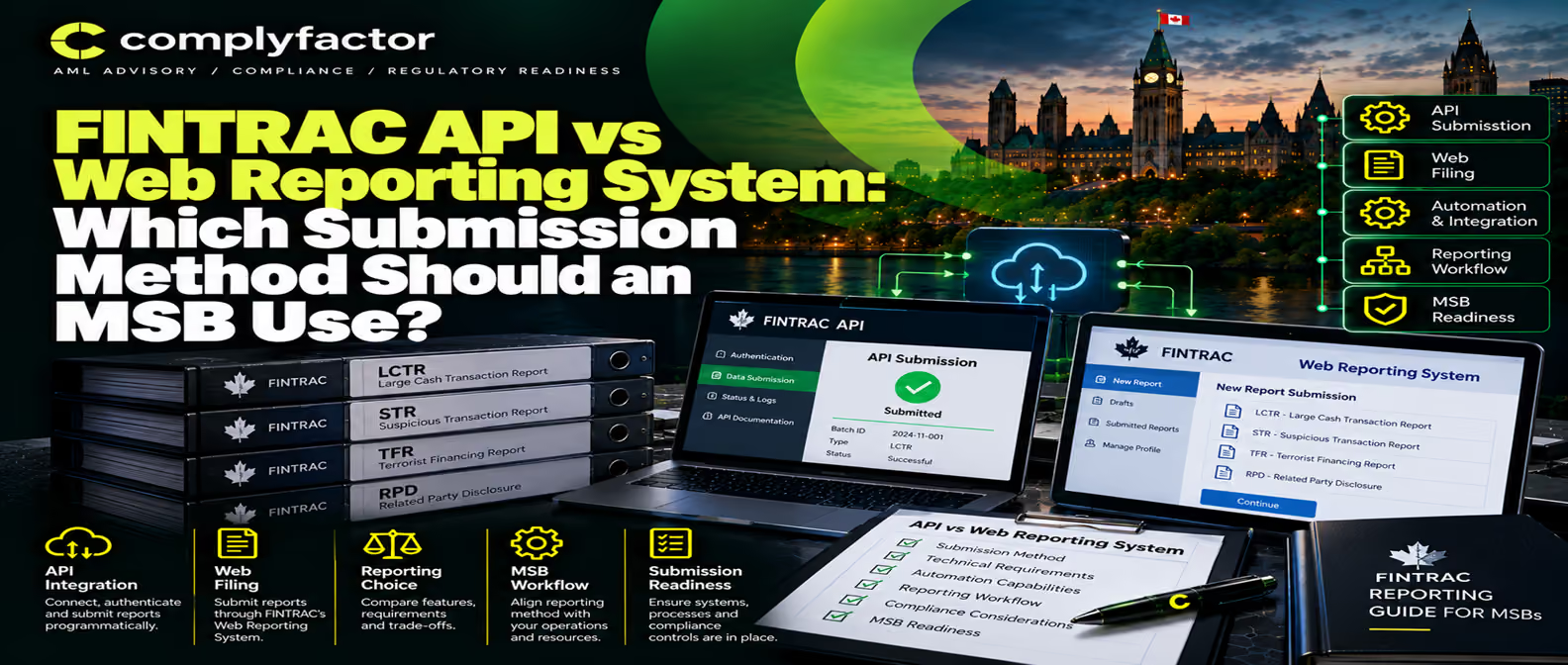
FINTRAC API vs Web Reporting System: Which Submission Method Should an MSB Use?
Comparing FINTRAC's API submission and Web Reporting System — setup requirements, validation, reporting volume, automation and suitable MSB use cases.



Key takeaways
- No single "best" method exists — the choice depends on reporting volume, technical resources, and operational capacity.
- The Web Reporting System suits lower-volume MSBs, offering immediate access with no setup cost or maintenance.
- API reporting scales to handle high-volume automated submissions but requires technical development and ongoing maintenance.
- MSBs must implement business-continuity plans regardless of method — reporting obligations do not pause for technical difficulties.
- Whether web or API, compliance responsibility remains entirely with the MSB; submission method does not transfer accountability.
Introduction
For Canadian Money Services Businesses (MSBs), the obligation to report prescribed financial transactions to the Financial Transactions and Reports Analysis Centre of Canada (FINTRAC) is a cornerstone of national anti-money laundering (AML) efforts. However, identifying a suspicious transaction or crossing a reporting threshold is only the beginning of the compliance process. The operational reality of transmitting that data securely, accurately, and within statutory deadlines forces MSBs to make a critical infrastructure decision: choosing between the FINTRAC API and the FINTRAC Web Reporting System.
The submission method an MSB selects fundamentally impacts reporting accuracy, adherence to filing deadlines, and overall staff workload. Data-entry error management, the scalability of compliance operations, and the retention of regulatory evidence are all heavily influenced by whether reports are entered manually or transmitted automatically. As transaction volumes increase, the friction of manual data entry can stifle business growth and expose the organisation to administrative penalties for delayed or incomplete filings.
While automated reporting might seem like the definitive solution for modern compliance, API reporting is not automatically the best option for every MSB. Implementation requires technical infrastructure, ongoing maintenance, and robust data-governance frameworks. For some reporting entities, the traditional web-based portal remains the most appropriate and secure channel. This article examines the mechanics, risks, and strategic advantages of both reporting methods to help MSBs make an informed operational choice.
Quick Answer
The correct submission method depends on a combination of technical capacity and operational demand. There is no universal "best" method; instead, MSBs must evaluate their specific circumstances. The optimal choice depends on:
- Reporting volume: The frequency and absolute number of reports generated monthly.
- Report types: The complexity of the transactions and the specific reports required.
- Existing transaction systems: Whether the business uses proprietary software capable of exporting structured data.
- Technical resources: The availability of internal developers or the budget for third-party software integration.
- Compliance-team capacity: The amount of staff time available for manual review versus strategic analysis.
- Validation controls: The internal mechanisms used to catch missing or conflicting information before submission.
- Expected growth: The projected scale of the business over the next one to three years.
What Is the FINTRAC Web Reporting System?
The FINTRAC Web Reporting System is a secure, web-based portal provided directly by the regulator. It allows authorised users to manually enter, review, and submit regulatory reports one at a time. Designed as an accessible solution for reporting entities of all sizes, it requires no specialised software other than a standard web browser and secure internet connection.
To use the system, an MSB must be registered with FINTRAC and designate specific individuals as authorised users. These users are granted credentials to log into the portal, where they navigate through web forms corresponding to different report types. The system utilises structured drop-down menus, mandatory field indicators, and built-in logic checks to help prevent incomplete submissions.
A significant advantage of the Web Reporting System is the opportunity for deliberate, manual review. Compliance officers can carefully scrutinize every data point, ensuring narratives are coherent and transaction details match underlying records before hitting submit. However, its primary limitation is the inherent inefficiency of manual data entry. Entering dozens of transaction reports requires significant administrative time and introduces the risk of typographical errors. Despite these limitations, smaller MSBs, businesses with low transaction volumes, or those prioritising immediate access without technical overhead often find the Web Reporting System highly practical.
What Is FINTRAC API Report Submission?
FINTRAC API report submission refers to the use of an Application Programming Interface (API) to transmit reporting data directly from an MSB's internal database to FINTRAC's systems. Instead of a human typing information into a web form, the MSB's software automatically compiles the required data into a structured format — typically a JSON payload — and securely transmits it over the internet.
This machine-to-machine connection requires sophisticated data mapping. Every field in the MSB's transaction database must be meticulously aligned with FINTRAC's specific reporting schema. When an API submission is initiated, the regulatory system receives the data, processes it through automated validation rules, and immediately returns a validation response. If the data meets all structural and regulatory requirements, the MSB receives a formal submission acknowledgement. If the payload contains errors, the system rejects the submission and returns specific error handling codes detailing what must be corrected.
Technical onboarding for API reporting is a rigorous process. It requires developers or third-party software providers to build the integration, secure authentication credentials, and successfully pass testing phases in FINTRAC's pre-production environment. Crucially, using an API or integrating with a third-party reporting platform does not transfer the MSB's legal reporting responsibility. The reporting entity remains entirely accountable for the accuracy, completeness, and timeliness of every automated submission.
FINTRAC API vs Web Reporting System: Key Differences
Which FINTRAC Reports Can Be Submitted Through Each Method?
Under current Canadian regulations, both submission methods support the core obligations required of most entities. Currently, both the Web Reporting System and the API channel support the most critical filings, including:
- Suspicious Transaction Reports (STRs)
- Large Cash Transaction Reports (LCTRs)
- Large Virtual Currency Transaction Reports (LVCTRs)
- Electronic Funds Transfer Reports (EFTRs)
- Casino Disbursement Reports (CDRs)
It is vital to recognise that while both systems support these reports, the operational execution differs significantly. The API is designed to ingest standard schemas for these reports rapidly. However, MSBs should not assume every obscure report type or legacy correction protocol is universally supported through automated channels without verifying the current technical specifications. There is no difference in the legal validity of a report whether it is submitted via the web portal or the API.
When the Web Reporting System May Be the Better Choice
The Web Reporting System remains a highly relevant tool and should not be viewed as outdated. It is often the superior choice for specific operational profiles. For MSBs with a low reporting volume — perhaps filing only a handful of reports per month — the time and financial cost of implementing an API connection cannot be justified. Occasional report filing is perfectly managed through manual entry.
Smaller compliance teams or organisations with limited technical resources benefit significantly from the web portal. It requires zero maintenance on the MSB's side; FINTRAC handles all security updates, schema changes, and system hosting. Furthermore, businesses that require detailed manual review for highly complex transactions often prefer the tactile control of web reporting. MSBs not yet ready for system integration often rely on web reporting while they establish their baseline operations. However, using the Web Reporting System does not imply that manual reporting removes the need for documented controls, internal review, or timely filing.
When FINTRAC API Reporting May Be the Better Choice
As an MSB scales, manual reporting quickly becomes unsustainable. API reporting becomes the better choice — and often a logistical necessity — when dealing with high or rapidly increasing report volumes. When an MSB frequently files reports containing repetitive report-data fields, relying on automation drastically reduces the risk of human error. It also allows multiple reporting teams to work efficiently. If an MSB already utilises sophisticated existing transaction-monitoring systems, connecting those systems directly to FINTRAC via API leverages existing data infrastructure.
A primary driver for API adoption is the need to reduce duplicate data entry. API integration offers structured validation at the point of generation and enables scalable reporting workflows. Nevertheless, MSBs must not present API implementation as instant, simple, or risk-free. It requires rigorous initial data mapping, extensive pre-production testing, and ongoing maintenance.
Reporting Volume and Operational Capacity
Evaluating whether to transition from web reporting to API submission requires a candid assessment of operational capacity. MSBs should not search for a fixed reporting-volume threshold at which API reporting becomes mandatory; FINTRAC does not dictate a specific number. MSBs must calculate the number of reports filed and the filing frequency. Consistent daily filings suggest a strong use case for automation. Furthermore, businesses must account for seasonal spikes that could overwhelm staff reliant on manual entry.
Compliance officers should audit the actual staff time spent entering data versus reviewing alerts. The review and approval capacity of the team must also scale. Finally, MSBs must weigh the manual-entry errors, projected business growth, and the availability of technical maintenance resources against the cost of system integration.
Technical Setup, Testing and Validation
Transitioning to API reporting involves a structured technical onboarding process. An MSB or its software vendor must first review the current FINTRAC API specifications to understand the required JSON schemas, endpoints, and authentication protocols. Access and authentication requirements typically involve secure credentials and strict IP whitelisting.
The core of the integration is data mapping. Developers must align the MSB's internal database fields with FINTRAC's mandatory report fields. The API enforces strict validation rules; submissions that violate schema requirements are immediately rejected. FINTRAC mandates specific testing or onboarding requirements. MSBs must successfully transmit test payloads to prove their system handles submission acknowledgements, rejected submissions, and error messages correctly. When a report is rejected, the API returns granular error codes which the MSB must interpret to facilitate report corrections. Changes to FINTRAC technical specifications require immediate updates to the integration, highlighting the importance of vendor and developer responsibilities.
Manual Reporting Risks
While the Web Reporting System is accessible, it carries specific risks inherent to human processing. The most prominent threat is data-entry errors. A transposed digit in a bank account number compromises the intelligence value of the report. Manual reporting frequently leads to missing required fields if users fail to gather comprehensive data before starting the entry process. It also introduces inconsistent information across reports. The sheer time required for data entry heightens the risk of delayed filing. Furthermore, manual workflows often involve duplicate work and generate weak review records, creating a heavy dependence on individual staff members and increasing the likelihood of missed acknowledgements.
API Reporting Risks
Automation introduces distinct, systemic vulnerabilities. The most critical risk is incorrect field mapping. If an internal database field is mapped to the wrong API endpoint, the MSB could unknowingly submit thousands of flawed reports before the error is detected. Incomplete source data will automatically trigger cascading failed validation. Unmonitored submission errors are a severe compliance failure. If the MSB's software lacks robust alerting mechanisms, rejected reports sit in a technical void. Poor change management when API specifications update can break the connection. There is also the psychological danger of excessive reliance on automation. Weak exception handling and vendor dependency mean that if the software provider suffers an integration outage, the MSB's compliance program is paralysed. Automation can improve efficiency, but it cannot replace compliance judgement and human oversight.
Security, Access and Audit-Trail Considerations
Regardless of the submission method, safeguarding sensitive financial intelligence is paramount. Both systems require strict role-based access to ensure only authorised personnel can view, draft, or submit reports. Effective credential management and strictly enforced user permissions are crucial. Managing staff departures is critical; failing to revoke system access constitutes a severe security breach. MSBs must also maintain active backup contacts. A robust compliance program requires documented internal approvals before reports are transmitted. The system must retain comprehensive submission records and validation responses. Evidence retention involves proving exactly when the report was submitted. Clear incident escalation protocols must be established to address any issues immediately.
Business-Continuity and Fallback Planning
Reporting obligations do not pause for technical difficulties. MSBs must prepare for internal system outages, vendor outages, and potential FINTRAC system interruptions. A comprehensive business-continuity plan must outline exact steps to take when automated pipelines fail. If an MSB experiences failed API submissions due to expired credentials or missing acknowledgements, the compliance team must have an alternative method to meet urgent filing deadlines. Staff absences can also disrupt reporting if only one individual understands the exception-handling process. While it might seem logical to revert to manual entry during an API outage, MSBs must not assume that the Web Reporting System can always be used as an automatic fallback unless FINTRAC confirms this for the relevant report and circumstances. A documented fallback plan is a regulatory necessity.
Practical Decision Framework for MSBs
To determine the optimal submission method, MSBs should evaluate their operations against a structured decision checklist covering:
- Current reporting volume
- Expected growth
- Required report types
- Internal technical capacity
- Compliance-team capacity
- Existing reporting systems
- Validation controls
- Exception management
- Maintenance resources
- Business-continuity arrangements
- Management oversight
Consider these three practical examples:
- A small MSB filing reports occasionally: A boutique currency exchange handling local clients may only file a few reports monthly. The Web Reporting System is the perfect fit, offering a free, secure, and immediate solution without overhead.
- A growing remittance or foreign-exchange MSB: As transaction volumes increase, manual entry becomes strained. This MSB might initially use web reporting but should begin scoping API integration to handle the escalating burden.
- A high-volume MSB with integrated transaction systems: A digital payment processor handling thousands of daily transfers generates massive reporting obligations. For this entity, API submission is the only viable method to ensure timely, accurate compliance.
Questions to Ask a FINTRAC Reporting Software Provider
If an MSB chooses to pursue API integration through a third-party vendor, they must thoroughly vet the platform. When evaluating a FINTRAC reporting software solution, ask the following questions:
- Which FINTRAC report types are supported?
- Is the current FINTRAC API specification being used?
- Can compliance staff review reports before submission?
- How are validation errors displayed?
- How are rejected reports managed?
- Are submission acknowledgements retained?
- How are specification changes implemented?
- What user-access controls are available?
- Can records be exported?
- What happens during an outage?
- Who is responsible for filing accuracy and deadlines?
Final Recommendation
Choosing between the FINTRAC API and the Web Reporting System is a strategic operational decision. Lower-volume MSBs may find web reporting practical, offering tight control and zero integration costs. Conversely, growing or high-volume MSBs may benefit significantly from API integration to maintain scalable, accurate compliance workflows. The decision should be based on documented operational needs, taking into account current capacities and future growth. Automation must remain supported by human review, governance, and exception handling. For MSBs looking to structure their compliance architecture effectively or seeking guidance on system implementation, ComplyFactor provides comprehensive advisory solutions to ensure your reporting processes align with FINTRAC expectations.
Related Resources
Official FINTRAC Sources
- FINTRAC Methods of Reporting Overview
- FINTRAC API Report Submission Details
- FINTRAC Web Reporting System (F2R) Access
- Suspicious Transaction Report (STR) Guidance
- Large Cash Transaction Report (LCTR) Guidance
- Electronic Funds Transfer Report (EFTR) Guidance
Frequently asked questions
Is FINTRAC API reporting mandatory for high-volume MSBs?
No, there is no regulatory threshold that legally forces an MSB to use the API. However, as transaction volumes rise, API reporting becomes practically mandatory to avoid administrative penalties caused by the inherent delays and errors of mass manual data entry.
Can a small MSB continue using the Web Reporting System?
Yes. The Web Reporting System is fully supported by FINTRAC and is designed to accommodate reporting entities of all sizes, particularly those that do not generate sufficient volume to justify technical integration.
Does API reporting remove the need for manual compliance review?
Absolutely not. While data transmission is automated, compliance officers must still review alerts, investigate circumstances, and ensure the accuracy of the underlying data, particularly when writing an effective STR narrative.
Can every FINTRAC report be submitted through the API?
The primary high-volume reports (STRs, LCTRs, LVCTRs, EFTRs) are supported. However, MSBs must verify the exact schemas supported by their integration and check with FINTRAC for specific edge cases or complex legacy report corrections.
What happens when an API submission fails validation?
The FINTRAC system rejects the payload and returns specific technical error codes. The MSB must identify the missing or malformed data, correct the internal record, and re-transmit the report within the regulatory timeframe.
Can an MSB use both submission methods?
Generally, an MSB will rely on one primary method to avoid fragmented audit trails. However, depending on FINTRAC's current policies and the specific report type, web reporting might serve as an emergency fallback, provided it is authorised under the entity's continuity plan.
How should an MSB assess a reporting software provider?
Providers should be evaluated on data security, integration stability, exception handling features, and their ability to quickly adapt to regulatory schema changes. Utilising external AML advisory services can help structure this vendor assessment.
Who remains responsible when a third-party platform submits reports?
The MSB retains 100% of the legal liability for compliance, accuracy, and timeliness. A software vendor facilitates the transmission, but the MSB is ultimately accountable for its AML compliance program and any resulting deficiencies. Engaging fractional compliance officer support can ensure proper oversight of these technical deployments.
ComplyFactor specializes in FINTRAC MSB and PSP registration, independent AML effectiveness reviews, and compliance program design for Canadian and foreign money services businesses, payment service providers, fintechs, and virtual asset service providers.
.svg)
.svg)
Related insights
Book a free Canada AML consultation
Tell us about your business and we'll confirm which services you need — free, no obligation, 30 minutes.