FINTRAC Reporting Automation for Canadian MSBs, Payment Businesses and Casinos
Move from transaction data to validated, reviewed and acknowledged FINTRAC reports through one controlled workflow. Apply report-specific aggregation checks, complete required fields, manage approvals and preserve the reporting history from preparation through submission.
FINTRAC reporting becomes difficult before the report is filed
Most reporting effort is spent upstream of submission: combining transaction data from multiple systems, identifying related transactions, applying report-specific aggregation rules, completing missing client and transaction fields, coordinating approval, tracking deadlines, resolving validation warnings, storing submission evidence and correcting previously filed reports.
.svg)
Fragmented transaction data
Potentially reportable transactions may be spread across payment systems, branches, customer records, wallet infrastructure and third-party processors.
.svg)
Manual aggregation
Individually smaller transactions may become reportable when the relevant FINTRAC 24-hour rule is applied — and finding those relationships by hand is slow and error-prone.
.svg)
Incomplete reporting data
A transaction may cross a threshold while required conductor, beneficiary, third-party or account information is still missing from source systems.
.svg)
Weak approval evidence
Email and spreadsheet-based reporting often makes it difficult to show who prepared, reviewed, approved and corrected a report.
What the platform automates — and what your team controls
Automate the reporting workflow. Keep compliance judgement and accountability with your team. The table below shows exactly where the software's work ends and your compliance function's authority begins.
Five steps from transaction data to a tracked report
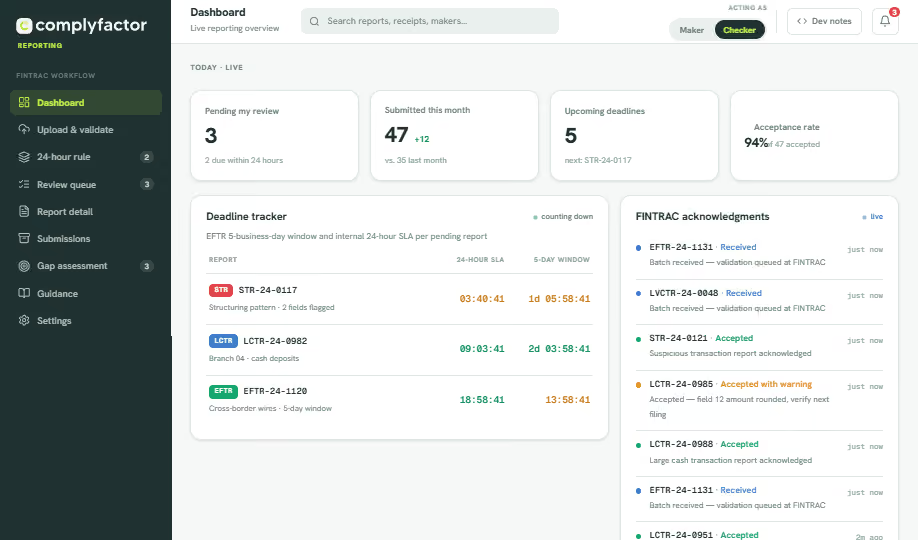
Select a step to see the corresponding screen. Screens shown are illustrative product wireframes.
Upload structured transaction data or connect approved source systems. Reusable mappings align source information with the relevant FINTRAC report fields.
Apply configurable report-type rules, thresholds and aggregation logic to surface transactions that may require review — including report-specific 24-hour aggregation checks.
Check mandatory fields, mandatory-if-applicable information, formatting and conditional data before a report moves toward final approval.
Route reports through configurable maker–checker workflows, with comments, returned-for-correction status and recorded sign-off.
Where FINTRAC API report submission access is in place for your business, submit reports and capture acknowledgements, warnings and rejected-report responses. Where API access is not yet in place, the workflow produces validated, approved report data for submission through your existing FINTRAC channel, with status recorded against the report.
The FINTRAC reports MSBs, payment businesses and casinos file most
Five live report workflows cover the report types that drive most reporting volume for Canadian MSBs and payment businesses with FINTRAC reporting obligations — plus Casino Disbursement Reports for casino reporting entities. Whether a specific report is required in a given situation always depends on your activities and the applicable regulations.
What our fractional compliance officer engagement covers
The scope matrix below maps each core compliance obligation to the engagement type it is included in — so you know exactly what you're getting before signing anything.
Our process — from scoping call to named officer
Every engagement follows a consistent four-step process — scoped before it starts, delivered by a named senior officer, and structured to meet FINTRAC's standards from day one.
Scoping call — free, 30 minutes
We assess your FINTRAC registration status, current setup, and business type. No assumptions, no upselling. The call determines whether you need a standalone program build, ongoing retainer, or interim cover.
Engagement letter — 48 hours
A written engagement letter with fixed scope, named compliance officer, monthly fee, and start date — all confirmed before any work begins. No open-ended retainer.
CO designation & program review
Your named officer is confirmed in FINTRAC's records within the first week. We review your existing program, identify priority gaps, and begin active management immediately.
Active compliance management
Ongoing oversight of reporting obligations, risk assessment, training, and FINTRAC correspondence — managed for the term of the engagement, with a written monthly activity log.
FINTRAC's compliance officer requirements — PCMLTFA s.9.6
Section 9.6 of the PCMLTFA requires every reporting entity to designate a senior compliance officer responsible for implementing the AML program and ensuring the entity meets its obligations under the Act. FINTRAC's examination framework specifically assesses whether the designated officer:
What FINTRAC assesses
Bill C-12 (March 2026) raised maximum AMP penalties to $4,000,000 for serious violations. The compliance officer role is now the highest-risk single point of failure in a Canadian MSB's regulatory structure.

Fractional vs full-time
A senior AML compliance officer in Canada typically earns $110,000–$150,000 annually, plus employer CPP contributions, benefits, and the opportunity cost of a 3–6 month recruitment process. For most Canadian MSBs processing under $100M annually, this structure is disproportionate to the compliance function they actually need.
Why Canadian MSBs & PSPs choose ComplyFactor
Active officers carrying live PCMLTFA responsibility — named in FINTRAC's records, accountable from week one.

A named senior officer — by name
Your engagement is led by a CAMS-certified senior compliance officer with direct FINTRAC examination experience — named in your engagement letter and in FINTRAC's records.
PCMLTFA specialists — not generic compliance
Every officer we assign has direct FINTRAC examination experience with MSBs and PSPs. We do not bring bank or insurance backgrounds into Canadian MSB engagements.
Active officers — not periodic reviewers
Our compliance officers carry live, ongoing responsibility for your program — not a quarterly check-in. Named in FINTRAC records and accountable for active obligations.
Written deliverables on every engagement
Every engagement closes with documented output — policies, risk assessments, training records, monthly logs. Nothing verbal-only.
Fixed-scope pricing — written before work begins
Monthly fee agreed in writing before the engagement starts. No open retainer, no hourly billing surprises.
Frequently asked questions — fractional compliance officer Canada
A fractional compliance officer is a senior AML professional who acts as your designated compliance officer under the PCMLTFA on a part-time or outsourced basis. They carry the same legal responsibilities as a full-time in-house hire — named in FINTRAC's records, accountable for your reporting obligations, and actively managing your compliance program — at a cost appropriate to your business size and transaction volumes. Most Canadian MSBs and PSPs do not need a full-time compliance officer; a fractional arrangement gives them a qualified officer without the salary, recruitment, and overhead cost of a permanent employee.
Yes. The PCMLTFA requires a designated senior officer — it does not specify that the person must be a full-time employee of your business. Outsourced and fractional compliance officers are widely used by Canadian MSBs and PSPs. The key requirement is that the individual is genuinely senior, has real authority within your organisation, and is actively engaged in your compliance program — not simply listed on a form. ComplyFactor's officers meet all three conditions and are updated in FINTRAC's registration records upon engagement.
An AML consultant provides project-based advisory — building a program, conducting a gap analysis, or supporting an examination on a fixed-scope basis. A fractional compliance officer carries ongoing responsibility for your compliance function — named in FINTRAC's records, managing live reporting obligations, and owning your compliance calendar. The two roles are complementary, not interchangeable. ComplyFactor provides both, and our scoping call will confirm which your business needs.
When a ComplyFactor compliance officer is designated, we document your existing program fully — policies, risk assessment, reporting history, and training records. If the engagement ends for any reason, we provide a structured handover package so your next officer, whether internal or external, can take over without a gap in your compliance record. FINTRAC records are updated to reflect the new designation promptly upon a confirmed transition.
ComplyFactor prices all compliance officer engagements on a fixed monthly fee — not hourly billing. The fee is based on your business type, transaction volumes, and the scope of obligations to be managed. A small MSB with straightforward reporting requires less officer time than a multi-product PSP managing complex monitoring. We provide a written fee proposal within 48 hours of a free scoping call. Contact us at +1 807 806 0444 to discuss your situation.
Yes — FINTRAC examination preparation is one of the most common reasons Canadian MSBs engage a fractional compliance officer. If you've received an examination notice, we can begin a rapid gap analysis immediately, update your designation in FINTRAC's records, organise your documentation, and prepare your team for what an examiner will focus on for your specific business type. For businesses that want to prepare proactively, our ongoing retainer engagements include examination readiness as a standard component.
Book a free Canada AML consultation
Tell us about your business and we'll confirm which services you need — free, no obligation, 30 minutes.